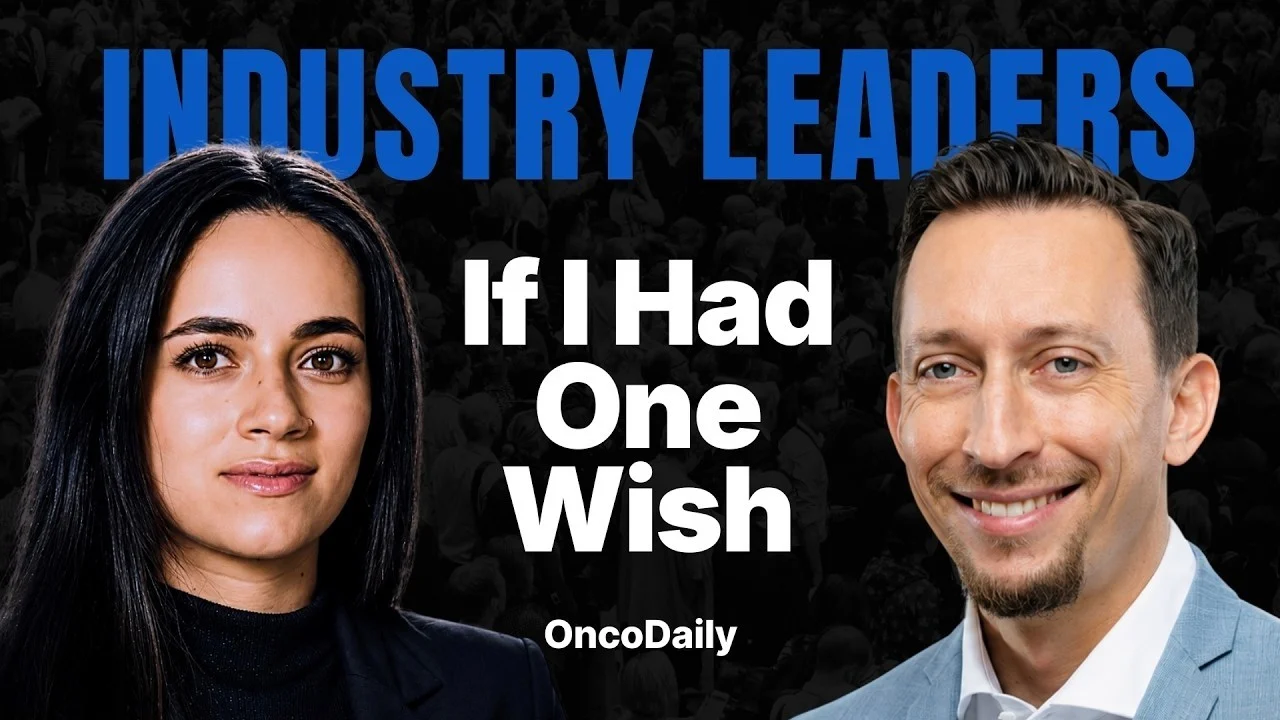
At a major oncology congress, the future can feel remarkably close.
Bispecifics and trispecifics. Molecular glues. Individualized neoantigen therapies. New sequencing technologies. Multimodal diagnostics. Artificial intelligence searching increasingly complex datasets for biomarkers that might once have taken years to find.
For Daniel Malarek, the striking part is how much of that future already exists – and how unevenly it reaches patients. So when asked what he would change in cancer care if he had a magic wand, his answer was immediate.
“I would wish that all the innovations that are present even today could reach every patient.”
The wish is explained through a contrast he has seen repeatedly.
“You go to ASCO, you go to ESMO, you go to these big conferences, you see just the incredible advances that are happening. But then when you go to community oncology, and you realize that 50% of metastatic patients are not even getting a comprehensive genomic profiling test. That’s what hurts me.”
Daniel Malarek has spent his career at the intersection of diagnostics, innovation and cancer care. Trained as a chemist, he moved from academic research into Roche Diagnostics, led Foundation Medicine for nearly three years, and in 2026 became President and CEO of Roche Diagnostics North America.
Seen from the outside, his career path looks like a natural progression. Malarek describes something far less predictable.
Before Oncology: Music, Chemistry and an Unexpected Turn
Long before diagnostics became his professional world, Malarek’s path was moving in a very different direction.
“I dreamed of being an ice hockey player. So no, I did not accomplish my dreams. Physically, I’m much too small to become an ice hockey player. But joking aside, if I look at just the way life has developed and the journey that life has brought, it’s taken many unexpected turns.”
His route into science began with an admission he delivers with self-deprecating humor.
“I started studying music and it took a couple of years at university for me to realize that I’m a poor musician. So it inspired me to switch to chemistry and I ended up studying chemistry then for the next 10 years – my undergrad, my PhD, my postdoc. And then I realized I wasn’t the best chemist either. So then the question is, where do you pivot from there?”
That next pivot came during his postdoctoral work in Basel, where he was introduced to Roche’s Perspectives Management Development Program. The two-year program brought together scientists and business professionals and moved participants through assignments in four countries, giving Malarek his first route into the business side of diagnostics.
The program was his way into Roche, and from there his career gradually moved farther from the laboratory and deeper into diagnostics, taking him through different countries, businesses and leadership roles along the way.
Years later, that path brought him to Foundation Medicine, where the work became closely tied to cancer care and to the growing role of genomic profiling in treatment decisions.
At Foundation Medicine: “Behind Every Sample Is a Patient”
“Foundation Medicine was probably the most exciting role that I’ve done in my career.”
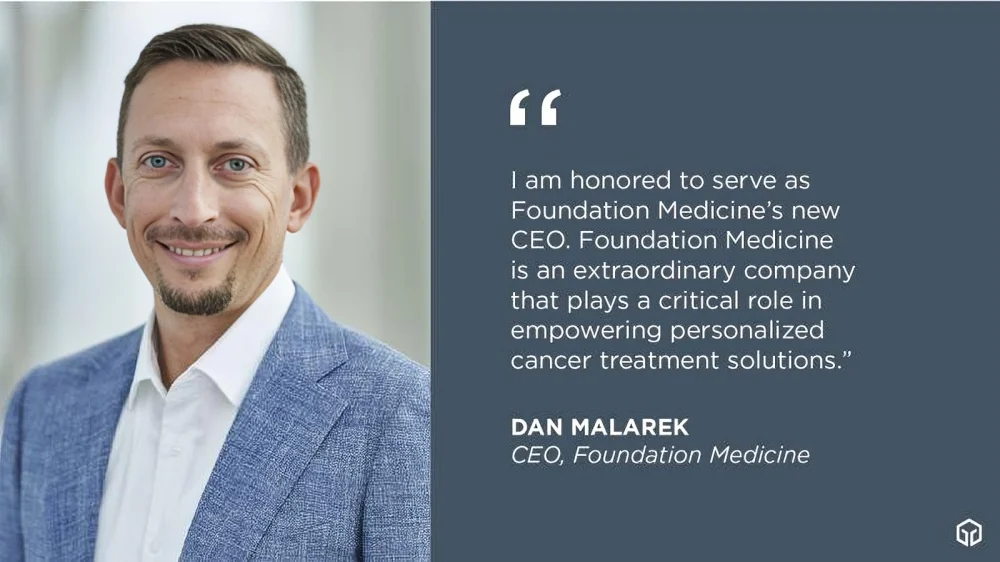
Daniel Malarek during his tenure as CEO of Foundation Medicine. Photo: Foundation Medicine
The company had helped establish comprehensive genomic profiling in oncology, advance regulatory pathways for companion diagnostics and develop reimbursement routes that made molecular testing more widely usable.
At Foundation Medicine, the limits of precision oncology could become very physical. Sometimes, the question was whether there was enough tumor in a sample to get a result at all.
Recovering that result could mean extra hands-on work in the lab, more time, and more cost. For Malarek, that was where the business case and the patient case met most directly.
Producing a result from those samples could require substantial manual work to extract enough DNA. That added cost and complexity, but it could also determine whether a patient received a molecular result at all.
“What we’ve done is actually work through every single sample manually to enhance that sample and be able to get enough DNA to actually get a result. So we’ve dropped our quantity-not-sufficient rates, our QNS rates, down to less than 2%. That comes at a cost, because there’s a lot of manual work that needs to happen.”
The rest of the answer explains why that cost was accepted.
“Behind every sample is a patient. And that could be your family member, that could be your friends. And so we will do whatever it takes to get a result.”
In practice, that commitment eventually reaches the balance sheet.
“When you’re working in an environment where you have this push and pull of like, well, can we afford to do this for all those samples? I think the patient will trump that every time because our business is our patients. And we have to do what’s right for those patients.”
That balance between scientific ambition, business realities and patient impact did not end with Foundation Medicine. In August 2026, Malarek carried it into a much larger organization.
At Roche: A Broader View of Diagnostics
Malarek became President and CEO of Roche Diagnostics North America, taking on a portfolio that extends well beyond comprehensive genomic profiling to sequencing, mass spectrometry, clinical chemistry, immunochemistry and diagnostic platforms used across health systems.
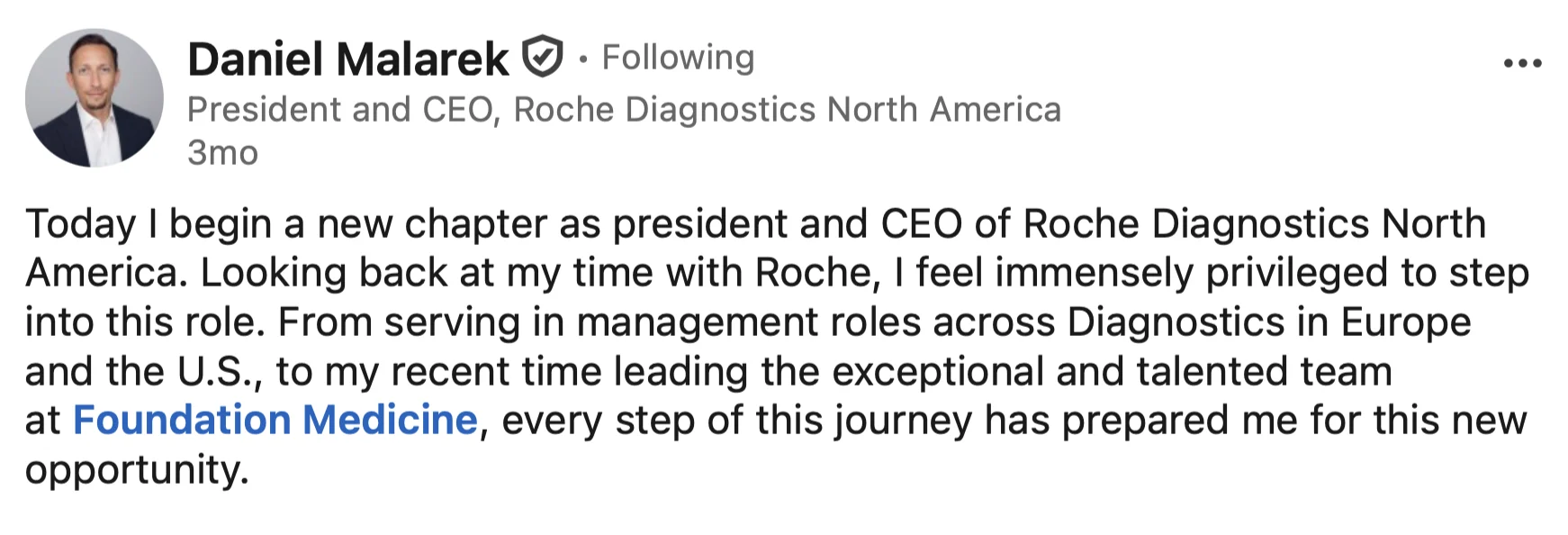
Source: Daniel Malarek/LinkedIn.
For him, that wider portfolio also means more opportunities for diagnostics to influence care – and more responsibility for making sure those technologies do not remain confined to the companies that develop them.
“What drives me personally is making an impact – making an impact on patients, making an impact on society. And I’m extremely excited at the fact that I can, in this new role, make an even bigger impact in both those spheres.”
Running an organization of that size also brings him back to a lesson he learned much earlier in his career: large systems are complicated, and leadership has to make them navigable.
His own experience spans Russia, the United States, India and Norway, environments where communication, hierarchy and decision-making can look very different. That made adaptability less of a management concept and more of a practical requirement.
“Every one of those cultures is very different. They’re very different in the way they interact with each other, in the way they communicate with each other, in the way decisions are made. So you have to adapt.”
At the executive level, he describes leadership as setting a clear direction, explaining why it matters and building the organization around it.
“For me, leadership, especially at an executive high level, is really around setting a vision for your organization and then getting people behind that vision. So really explaining: this is where we’re going and this is why we’re going in that direction.”
For Roche Diagnostics North America, that direction is ultimately measured in what reaches clinical care. The portfolio is broader than the one Malarek worked with at Foundation Medicine, but the test remains the same: whether innovation changes something for the patient.
Asked what he would change in cancer care, he went straight to that point.
“It’s great that all these innovations are happening, and I think it’s incredible. But I don’t think right now our issue in oncology is the innovation. I think it’s how we are bringing that innovation to every patient.”
And much of that is decided long before a result appears on a report. Testing has to be ordered. Usable tissue has to be obtained. Reimbursement has to be secured. The result has to reach the treating team and actually shape a treatment decision.
That is why community oncology matters so much in his view. It is one of the places where the distance between what oncology can offer and what patients actually receive becomes most visible.
The Future Malarek Sees: Smarter Data, Faster Discovery
If access is one half of Malarek’s view of oncology, acceleration is the other.
The therapeutic landscape is expanding rapidly, from bispecifics and trispecifics to molecular glues, cyclic peptides and individualized neoantigen therapies. Diagnostics are evolving alongside it. Multimodal approaches can bring different forms of biological data together, while AI makes it possible to search those datasets at a scale and speed that would previously have been difficult to achieve.
For Malarek, that combination could accelerate everything from biomarker discovery to the development of more precisely targeted therapies.
His view of the next decade is ambitious: some cancers that are life-threatening today could increasingly be managed as chronic diseases.
“We will have such a deep understanding of disease, and so many therapeutics available to very specifically target it, that people will be living normal lives with diseases that today or yesterday would have been a death sentence.”
Reaching that point will depend on more than having better therapies available. Patients first have to be identified as candidates for them. That means getting the right test ordered, having enough tissue to work with, producing a usable result and making sure that result reaches the treatment decision.
And as therapies become more specific, those earlier steps become even more important.
The Part of the Story That Isn’t About Work
The conversation eventually moves away from laboratories, health systems and executive responsibility, and toward the choices Malarek makes outside them.
Physical fitness is one of the few things he treats as non-negotiable. He starts his mornings with high-intensity exercise and has learned that even a few days without it affect both his mood and how clearly he thinks.
The second boundary is more absolute.
“I always take one day, 24 hours off. So from Friday sunset until Saturday sunset, that’s my Sabbath. And I do not work on that day. I won’t answer emails. I won’t answer calls. It’s really the time for me, my family, my friends, to be present.”
That same focus on how he works, and what he chooses to prioritize outside work, carries into the books he cites as influential. Viktor Frankl’s Man’s Search for Meaning is one of them.
“I firmly believe in purpose. And I believe that all of us are united in the desire to want to make an impact with everything that we do. That’s what unites us all.”
Erich Fromm’s To Have or to Be? prompted a different kind of reflection: the distinction between defining life through what one accumulates and through who one becomes. Malarek particularly remembers Fromm’s treatment of knowledge – the difference between learning enough to possess information and learning deeply enough to be changed by it.
“It’s a very difficult read when you start reflecting on the way you live your own life. And that book really, really affected me as well.”
The same questions surface when Malarek looks back on his own career. One of his early mentors at Roche, a former CFO of Roche Diagnostics, showed him how to navigate the complexity of a large organization without allowing that complexity to suppress creativity. Years later, the lesson he passes on to younger professionals is even simpler.
“Always do what you’re extremely excited about. Always do what you’re passionate about. If you do that, you will do a fantastic job. And if you do a fantastic job and deliver value, then people are going to notice.”
So when younger professionals tell him they are considering a job they are not really excited about because it might lead somewhere better, his response is immediate.
“Don’t do it. Life is too short to spend two, three years of your life doing something you’re not super excited about.”
Written by Eliz Baloyan, MD, Features Writer and Editor at OncoDaily and CancerWorld
Interview by Shushan Hovsepyan, MD, Co-chair of SIOP GHN Research and Innovation Working group, SVP of OncoDaily