
Key takeaways
- Recurrence after adjuvant pembrolizumab presents a growing clinical challenge, as most frontline metastatic RCC trials primarily enrolled checkpoint inhibitor-naive patients.
- Timing of recurrence is an important consideration, with early relapse raising concerns about resistance to PD-1 inhibition.
- CONTACT-03 and TiNivo-2 found no benefit from routine immunotherapy rechallenge after prior checkpoint inhibitor treatment in metastatic RCC.
- Metastasis-directed therapy may delay systemic treatment in selected patients with oligometastatic recurrence.
- LITESPARK-011 demonstrated improved progression-free survival with belzutifan plus lenvatinib compared with cabozantinib after prior immunotherapy.
- LITESPARK-022 introduces new sequencing questions as patients may increasingly experience recurrence after exposure to both PD-1 and HIF-2α inhibition.
Ahmed M. Elalfy, Clinical Fellow in Genitourinary Medical Oncology at the Arthur J.E. Child Comprehensive Cancer Centre, University of Calgary, addressed one of the increasingly important challenges in renal cell carcinoma (RCC): selecting treatment for patients whose disease recurs after adjuvant pembrolizumab.
During his presentation at VIRO 2026 – Global Voices in Renal Oncology by OncoDaily, Elalfy examined the growing evidence for managing metastatic RCC after prior immune checkpoint inhibitor exposure, including recurrence patterns, treatment sequencing, metastasis-directed therapy, and emerging HIF-2α-targeted approaches.
Adjuvant pembrolizumab has improved outcomes for patients with high-risk clear cell RCC, but its introduction has also created a distinct clinical population: patients presenting with metastatic disease after already receiving PD-1 inhibition.
Their management is complicated by the fact that the pivotal first-line metastatic RCC trials, including CheckMate 214, KEYNOTE-426, CheckMate 9ER, and CLEAR, primarily enrolled patients without previous checkpoint inhibitor exposure.
As Elalfy explained, the challenge is no longer a complete absence of data. Rather, it is determining how closely the available evidence reflects the patient being treated.
A Patient With Recurrent RCC After Adjuvant Pembrolizumab
Elalfy began with a clinical scenario involving a 58-year-old man who underwent radical nephrectomy for pT3, grade 3 clear cell RCC.
The patient completed 17 cycles of adjuvant pembrolizumab. Fourteen months later, surveillance CT identified three new pulmonary nodules.
He remained asymptomatic, had an ECOG performance status of 0, and had no residual immune-related toxicity.
The immediate question was whether to initiate systemic therapy, consider local treatment, or introduce another immunotherapy-containing regimen.
Before selecting treatment, Elalfy proposed evaluating three factors:
- Timing of recurrence: Did the disease return during pembrolizumab, shortly after discontinuation, or following a longer treatment-free interval?
- Metastatic burden: Is the disease oligometastatic and potentially amenable to surgery or ablation, or is systemic treatment necessary?
- Tumor biology: What is the histological subtype, are sarcomatoid features present, and what is the patient’s IMDC risk classification at recurrence?
These considerations provide a practical framework for evaluating recurrence after adjuvant immunotherapy, although none can independently determine the optimal systemic regimen.
What Real-World Evidence Tells Us About Treatment After Recurrence
One of the most relevant datasets discussed by Elalfy was an international retrospective study published in European Urology in 2024, evaluating first-line treatment following recurrence after adjuvant immune checkpoint inhibition.
The analysis included 94 patients across 29 international institutions who experienced recurrent RCC after receiving adjuvant immunotherapy, including pembrolizumab, atezolizumab, and nivolumab plus ipilimumab.
Of these patients, 76 received subsequent systemic therapy, while the remainder underwent local treatment.
Among patients receiving systemic therapy, commonly used approaches included VEGF-targeted therapy alone, immunotherapy combined with VEGF-targeted treatment, and dual checkpoint inhibition.
The published analysis reported an 18-month progression-free survival rate of 45% and an 18-month overall survival rate of 85% among systemically treated patients.
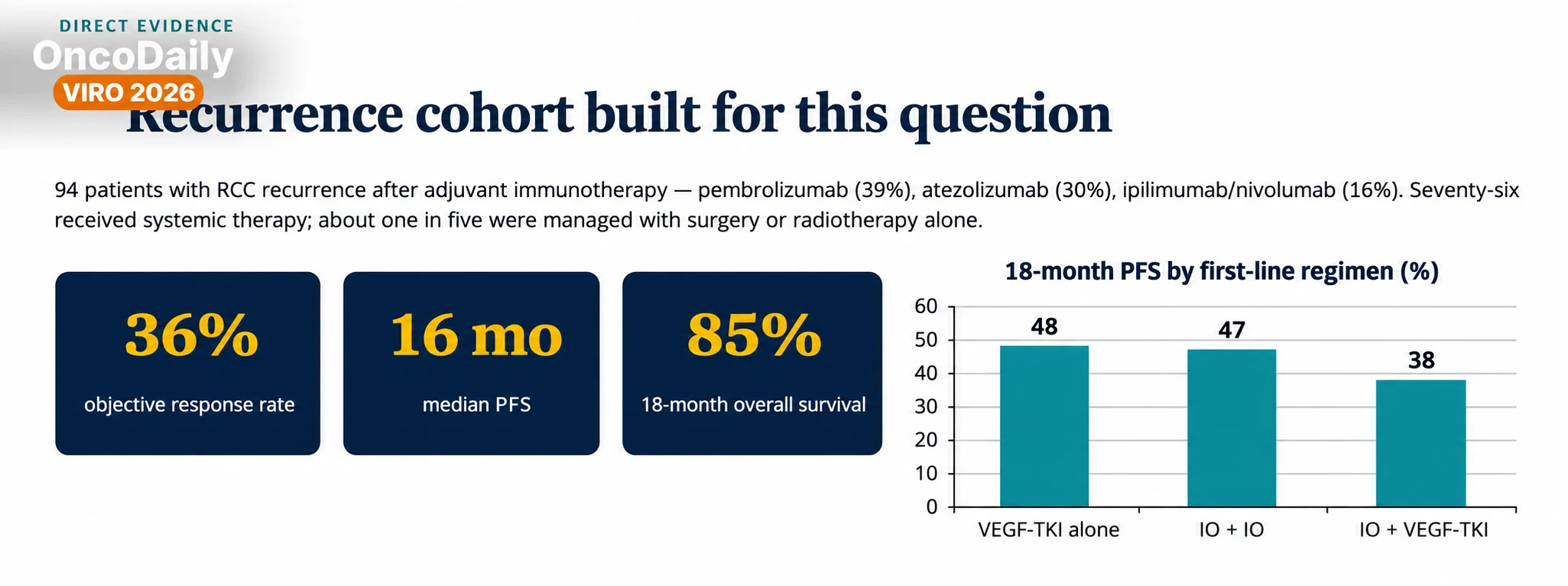
Although outcomes appeared broadly comparable across treatment categories, the retrospective design limits interpretation.
Treatment selection was influenced by individual clinical characteristics, and patients were not randomly assigned to different regimens. Consequently, the findings cannot establish whether one approach is superior.
The study also identified differences according to the timing of recurrence.
In an earlier analysis of patients who had received adjuvant pembrolizumab, the objective response rate to subsequent systemic therapy was:
- 29% (4 of 14 patients) among those whose disease recurred during pembrolizumab.
- 44% (4 of 9 patients) among those whose disease recurred after discontinuation.
- Elalfy emphasized the importance of interpreting these percentages alongside their small denominators.
“These data are useful signals, they are not treatment rules.”
Recurrence during active PD-1 blockade may indicate resistance to checkpoint inhibition, while recurrence after a treatment-free interval could reflect different underlying biology.
However, these observations remain hypothesis-generating and cannot establish whether late recurrence predicts renewed sensitivity to immunotherapy.
Why Routine Immunotherapy Rechallenge Is Questionable
The treatment of metastatic RCC following checkpoint inhibitor exposure has been investigated in several randomized clinical trials.
Two phase III studies, CONTACT-03 and TiNivo-2, have provided important evidence regarding the limitations of immune checkpoint inhibitor rechallenge.
CONTACT-03 compared atezolizumab plus cabozantinib with cabozantinib alone in patients whose advanced RCC had progressed after previous immune checkpoint inhibitor therapy.
Adding atezolizumab did not improve progression-free or overall survival and was associated with additional toxicity.
Similarly, TiNivo-2 evaluated nivolumab plus tivozanib against tivozanib monotherapy in previously treated metastatic RCC.
Median progression-free survival was 5.7 months with the combination and 7.4 months with tivozanib alone, with no statistically significant benefit from adding nivolumab.
Together, these trials challenge the practice of routinely introducing another checkpoint inhibitor after progression on immunotherapy.
However, Elalfy emphasized an important limitation: both trials predominantly studied patients progressing after immunotherapy in the metastatic setting.
Their findings cannot automatically be applied to patients whose cancer returns more than a year after completing adjuvant pembrolizumab.
A patient progressing during active checkpoint blockade may have a different pattern of treatment resistance from one who develops metastatic disease following a prolonged treatment-free interval.
This distinction is particularly relevant when considering whether another IO-based combination might remain appropriate.
Timing of Recurrence as a Clinical Decision-Making Tool
Elalfy proposed a practical framework for interpreting the interval between pembrolizumab exposure and disease recurrence.
Recurrence During Treatment or Within Six Months
Disease progression during adjuvant pembrolizumab or within approximately six months of its discontinuation is generally treated as an early, potentially checkpoint-refractory recurrence.
For patients requiring systemic treatment, VEGF receptor tyrosine kinase inhibitor (VEGFR-TKI) therapy represents an important option.
This approach is consistent with European Association of Urology guidance, which advises against immune checkpoint inhibitor monotherapy or combinations in patients recurring during or within six months after adjuvant pembrolizumab.
Recurrence Between Six and Twelve Months
Patients relapsing during this interval represent an area of greater uncertainty.
There is no validated treatment sequence, and decisions depend on disease kinetics, IMDC risk, treatment tolerance, patient preferences, and clinical trial availability.
The potential benefit of renewed immune checkpoint inhibition cannot be reliably established from existing evidence.
Recurrence After More Than Twelve Months
With a longer treatment-free interval, the disease may behave more similarly to newly diagnosed metastatic RCC without recent checkpoint exposure.
An immunotherapy-containing combination may therefore be considered in selected patients, particularly if they previously tolerated pembrolizumab and have no contraindications.
However, this remains an individualized decision rather than a prospectively validated treatment standard.
Importantly, the six- and twelve-month intervals are pragmatic clinical thresholds, not established predictive biomarkers.
Could Metastasis-Directed Therapy Delay Systemic Treatment?
Another important finding from the international retrospective cohort was that approximately one in five patients with recurrent RCC after adjuvant immunotherapy received local treatment rather than immediate systemic therapy.
These approaches included surgery and radiotherapy.
For patients with limited metastatic disease, metastasectomy or stereotactic ablative radiotherapy may offer meaningful disease control and potentially delay systemic treatment.
This possibility is particularly relevant for patients with a small number of lesions, favorable performance status, and a longer interval between treatment completion and recurrence.
“Sometimes, the first question is, does this patient need a drug yet?”
Elalfy advocated multidisciplinary assessment before initiating systemic treatment in appropriately selected patients.
For the 58-year-old patient presented at the beginning of the session, the presence of three pulmonary nodules and a 14-month treatment-free interval makes the feasibility of local therapy an important consideration.
Further assessment would be required to confirm the nature and extent of the lesions and determine whether complete local treatment is achievable.
The objective is not necessarily to avoid systemic therapy indefinitely, but to identify patients who may benefit from an initial local approach while preserving systemic options for subsequent progression.
LITESPARK-011: Evidence for a Different Therapeutic Mechanism
As the limitations of checkpoint inhibitor rechallenge become clearer, alternative treatment mechanisms are attracting increasing attention.
Elalfy discussed findings from the randomized phase III LITESPARK-011 trial, which evaluated belzutifan plus lenvatinib against cabozantinib in patients with advanced clear cell RCC following prior anti-PD-1 or anti-PD-L1 therapy.
Belzutifan inhibits hypoxia-inducible factor 2 alpha (HIF-2α), a central regulator of clear cell RCC biology, while lenvatinib targets multiple receptor tyrosine kinases involved in angiogenesis and tumor growth.
The combination demonstrated superior progression-free survival compared with cabozantinib.
At the second interim analysis:
- Median progression-free survival: 14.8 months with belzutifan plus lenvatinib versus 10.7 months with cabozantinib.
- Hazard ratio for progression or death: 0.70.
- Objective response rate: 52.6% versus 40.2%.
These findings subsequently supported the FDA approval of belzutifan plus lenvatinib on September 24, 2026, for adults with advanced
RCC containing a clear cell component after prior PD-1 or PD-L1 inhibitor treatment.
The final prespecified analysis continued to demonstrate a progression-free survival benefit, although the overall survival difference did not meet the prespecified threshold for statistical significance.
Treatment safety also requires consideration, particularly belzutifan-associated anemia and hypoxia.
How Relevant Are These Results to Recurrence After Adjuvant Pembrolizumab?
Although LITESPARK-011 included patients who experienced progression during or shortly after adjuvant immunotherapy, most participants had previously received checkpoint inhibitors for advanced disease.
The adjuvant-only subgroup was relatively small, and eligibility for recurrence after adjuvant treatment was restricted to progression during treatment or within six months of the last dose.
This creates an important limitation when considering patients who experience delayed recurrence.
The results strengthen the evidence for treatment strategies using different therapeutic mechanisms following PD-1 exposure, but they do not establish the optimal approach for every post-adjuvant recurrence scenario.
For Elalfy’s patient, whose disease returned 14 months after completing pembrolizumab, the trial population does not directly match his clinical circumstances.
LITESPARK-022 and the Challenge of Earlier HIF-2α Exposure
The treatment landscape is becoming more complex as additional agents move into earlier stages of kidney cancer care.
The phase III LITESPARK-022 trial demonstrated improved disease-free survival with adjuvant pembrolizumab plus belzutifan compared with pembrolizumab alone in patients with resected clear cell RCC at increased risk of recurrence.
The combination received FDA approval in June 2026.
While this represents another opportunity to reduce disease recurrence, it also introduces a new question for metastatic treatment sequencing.
Future patients may present with recurrent RCC after exposure to both PD-1 inhibition and HIF-2α inhibition.
For these patients, strategies involving belzutifan may no longer represent exposure to an entirely new therapeutic mechanism.
Elalfy described this emerging challenge as “sequencing debt.”
“Every mechanism moved earlier changes what remains credible later.”
This concept has important implications for future trial design and treatment planning.
Adjuvant intensification may improve outcomes in the postoperative setting, but it also changes the therapeutic history of patients who subsequently develop metastatic disease.
Understanding whether resistance to one agent affects the activity of later combinations, and which mechanisms remain effective after prior exposure, will become increasingly important.
Treatment Sequencing Also Depends on Global Access
The clinical discussion surrounding post-adjuvant recurrence frequently assumes that patients will have access to several successive lines of treatment.
In practice, this is not always possible.
Healthcare systems differ considerably in their availability of checkpoint inhibitors, VEGFR-TKIs, HIF-2α inhibitors, clinical trials, and specialized local treatments.
Some patients may receive adjuvant pembrolizumab but have limited access to effective systemic therapies when disease recurs.
This creates a challenge for treatment sequencing: the selection of an adjuvant regimen must also consider what options may realistically remain available later.
“Sequencing assumes access to a sequence.”
Elalfy argued that decisions surrounding adjuvant therapy and subsequent metastatic treatment should be viewed as part of a continuous care strategy rather than separate clinical episodes.
This is particularly important in settings where access to second-line or third-line treatment cannot be guaranteed.
A Practical Approach to Recurrence After Adjuvant Pembrolizumab
Elalfy concluded by outlining how these considerations could be incorporated into everyday clinical practice.
The first step is to confirm and stage recurrent disease, using appropriate cross-sectional imaging and additional investigations when clinically indicated. Rebiopsy may be valuable when disease behavior or histology is unexpected.
The next step is to document the precise interval from the last pembrolizumab dose to recurrence and reassess the patient’s IMDC risk.
Before selecting systemic therapy, clinicians should consider whether the disease is amenable to complete local treatment, with input from surgery and radiation oncology where appropriate.
When systemic treatment is necessary, the choice should reflect the timing of relapse and the available evidence:
Early recurrence: Favor VEGFR-TKI-based treatment and avoid routine checkpoint inhibitor rechallenge.
Intermediate recurrence: Individualize treatment according to disease characteristics, previous toxicity, and patient preferences.
Late recurrence: Consider the potential role of IO-based combinations in selected patients, recognizing the absence of definitive prospective comparative evidence.
Eligible patients: Prioritize clinical trial enrollment, particularly when evaluating newer therapeutic mechanisms or uncertain treatment sequences.
Elalfy also emphasized the need for future studies to distinguish patients according to their previous adjuvant treatment exposure and timing of recurrence.
As combined adjuvant strategies become more common, prior PD-1 and HIF-2α inhibitor exposure should be incorporated into clinical trial stratification rather than treated as an incidental characteristic.
Equally important is the development of recurrence registries across different regions and healthcare systems, allowing researchers to capture outcomes beyond major academic centers.
The Next Questions in Post-Adjuvant RCC Care
Recurrence after adjuvant pembrolizumab is becoming an increasingly important part of metastatic RCC practice.
The existing evidence supports several principles: early relapse should raise concern for checkpoint resistance, limited metastatic disease warrants consideration of local treatment, and subsequent systemic therapy should account for prior drug exposure rather than automatically follow checkpoint-naive treatment algorithms.
At the same time, important uncertainties remain regarding delayed recurrence, immunotherapy rechallenge, and the optimal sequencing of VEGFR-TKI and HIF-2α-directed strategies.
The introduction of new adjuvant combinations will make these decisions more complex, as patients increasingly arrive in the metastatic setting with exposure to multiple therapeutic mechanisms.
Future research must therefore address treatment not only according to disease stage, but also according to what the patient has previously received, when recurrence occurred, and which therapeutic options remain available.
Written by Eliz Baloyan, MD, Features Writer and Editor at OncoDaily and CancerWorld
Watch the full video on YouTube.