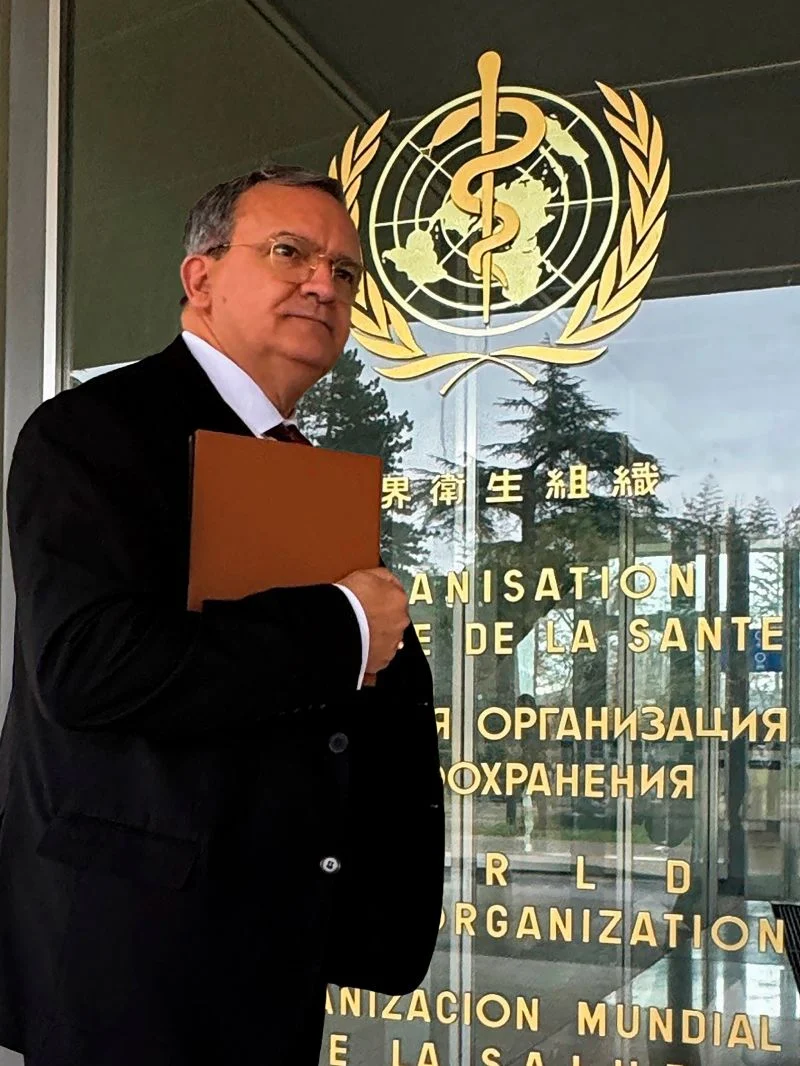
Rogério Gaspar, Director of the Department of Regulation and Prequalification at World Health Organization, Genève, shared on LinkedIn:
“Dear all,
Next August 31st I will be formally separated from WHO as my mandatory retirement moment arrives.
Meanwhile I will start my annual leave with 5 days in July and the entire month of August.
Hence a last opportunity to review with you the joint walk done and the future ahead.
The last 5 years and 8 months have been an impactful experience for me, both personally and professionally. I saw what the world can do better, united under the fire of a paralyzing COVID-19 pandemic, but also the worst with major inequities in access to essential public health goods.
The best, looking daily into the faces of committed staff, experts and partners; the worst, when yet we cannot provide better working conditions, for those that give everything from themselves every day, without asking for public recognition.
The greater good, when innovation is moved through barriers, trying to achieve universal health coverage for all and everywhere, the worst when we saw children dying poisoned by falsified medicines, result of lack of appropriate regulatory oversight.
In these challenging and sometimes dramatic years, we saw how international communities can mobilize to face four PHEIC (COVID-19, twice on MPOX, Ebola), but at the same time the implementation of the pandemic agreement is still essential for the future response.
We saw major improvements in modernizing the tools for our work in prequalification, major advances in workflows in prequalification of medicines, diagnostics, immunization devices and vector control products, but also how much is still needed in the updating of prequalification of vaccines, and to build a stronger system around risk-based assessment of snake anti-venoms (and hopefully enlarged medical devices framework).
All essential to guarantee equitable, timely and affordable access to medical and health products and technologies, quality-assured, safe and effective, as per WHO Constitutional mandate (1948) and World Health Assembly resolutions WHA60.20 (2007), WHA61.21 (2008), WHA62.16 (2009), WHA63.12 (2010), WHA65.17 (2012), WHA65.19 (2012), WHA66.22 (2013), WHA67.20 (2014), WHA67.21 (2014), WHA67.22 (2014), WHA68.7 (2015), WHA71.8 (2018) and WHA72.8 (2019) among others.
The enormous contribution of the prequalification programme needs to be deepened and improved, enlarging the scope with major contributions to access to innovation, and continuously updating methods of work and procedures, not being afraid of change, to always deliver a more efficient and impactful contribution to public health.
Under the impulse of WHA resolution on ‘Regulatory system strengthening for medical products’ (WHA67.20, from 2014), the introduction of a ‘game-changer‘ since 2016, accelerated since 2022, has been the capacity-building programme for regulatory systems, using the global benchmarking tool (GBT) and starting from 2022 the establishment of a WHO Listed Authorities (WLA) framework, based on establishing standards for high performance of regulatory systems, able to allow better reliance mechanisms.
Now both extended from medicines and vaccines to include also medical devices. A long walk still in front of us, when close to 70% of Member States are still lacking adequate regulatory capacity, but a lot closer to major achievements, with now more than 40 WLAs, and the build-up by Member States of a stronger regional system in Africa (both through NRAs and AMA).
Distributed manufacturing capacity was shown as essential during COVID-19. The Member States responded in a positive manner through a dedicated WHA resolution (WHA 74.1 from 2021), pushing for strengthening of local and regional manufacturing. Without solid access policies, sustainable business models, and strong regulatory oversight, that will not be possible to fully implement, and the future will only see the repetition of the errors of the past.
Many achievements were attained in these years, thanks to a dedicated team, at WHO three levels, and your dedicated commitment as trusted colleagues and partners.
‘Working together‘ has been always our motto.
Every single day we work to translate it into actionable items and impactful delivery. Those achievements are well documented in the ‘external impact assessment’ of 2018-2022 performed by McKinsey to the Gates Foundation, as well as in the RPQ annual reports of 2022, 2023, 2024 and 2025.
The ‘RPQ Strategic Action Plan (2025-2028)’ is still our guidance document, even though the restructuring of 2025 meant that almost all procedures had to be better designed. To do better with less!
We concluded 2025 with less 60 positions and having to separate 36 colleagues. Their contributions will be always recognised. We are now contributing to create additional 18 FTEs in the six regional offices (supporting Collaborative Registration Procedure, Pharmacovigilance and Market Surveillance and Control activities), also supporting country offices and other departments at HQ (including norms and standards at HPS) with essential funding mechanisms, thanks to better planning and continued support from our dedicated partners, using PQ fees and VC (and with no funding from AC).
From July 1st we started a ‘country capacity-building‘ programme, through rotational fellowships that existed also in the past. In the last 20 years they were 78; in the next 18 months they will be 30, mostly to support regulatory capacity in LMICs through hands-on at RPQ for periods of six months.
Additionally, we are expanding the network of WHO-Collaborative Centres both in Pharmacovigilance (under the impulse of the 2025 ‘Smart Pharmacovigilance Strategy’, and the WHA 79.11 resolution, approved in May 2026 unanimously by Member States), as well as creating new WHO-CC in Regulatory Science (three under different stages of planning as we speak, one of them just approved by DG).
The support to AMA, the integration of AI tools in regulatory procedures and creating conditions for absorbing innovation (with a positive impact of climate sustainability) are three of the many axes that are currently being pursued in an accelerated mode. The support for the continuation of these areas is essential.
The journey ahead is challenging and needs more than ever collective support to multilateral cooperation within UN system (with WHO and others) and through stronger regional integration, expanding in a more accelerated mode the achievements attained. The base principles of Good Regulatory Practices and Good Reliance Practices that embodied GBT and WLA are beacons in our daily work.
Because we all know that when regulatory systems fail, people die. Mostly innocent, helpless people, that can only trust in sound regulatory oversight, to avoid the drama of the recent past.
A final word thanking you all for your permanent support, in the good days, but much more appreciated also in the bad days.
We need to recognise the uniqueness of a regulatory community that having regulatory authorities at its centre, also benefits enormously from a large community of colleagues, partners, and stakeholders in which all of you are included, participating daily as essential contributors to those global public health objectives.
When I came to WHO I was lucky to have a great mentor. Dr Mariângela Simão, then our ADG at MHP division, told me one day that we need to be impartial in everything except in one topic: public health. This was particularly true when with the support of our DG we had to face difficult moments in 2021.
I have always remembered those words and the need, above all, to keep our work focused on the constitutional and updated mandates of WHO, established by the Member States.
From September, I will be working in the same area, but now with a specific Member State, supporting the development of their regulatory strategy. I bring those words, that focus and the memory of all the work we have done together, to my next professional responsibilities.
I strongly believe that WHO is irreplaceable and should contribute, through leaner procedures, updated technology tools, and a determined vision into the future, for a better world, ensuring Universal Health Coverage to All and Everywhere.
At the same time, it provides the backbone for a robust, resilient, and reliable, preparedness and response, to outbreaks, epidemic events, or public health events of international concern, including new pandemic events if needed.
Its staff has been always present when needed to extend engagement, even with personal sacrifice. The World should support WHO ensuring it keeps fighting in the frontline of collective response, supporting Member States, through international established multilateral mechanisms.
I will always keep truthful to that vision and through it always facing challenges with solutions.
Proud To Be WHO.
Yours,
Rogério Gaspar․”
Other articles about WHO and Rogério Gaspar on OncoDaily.