





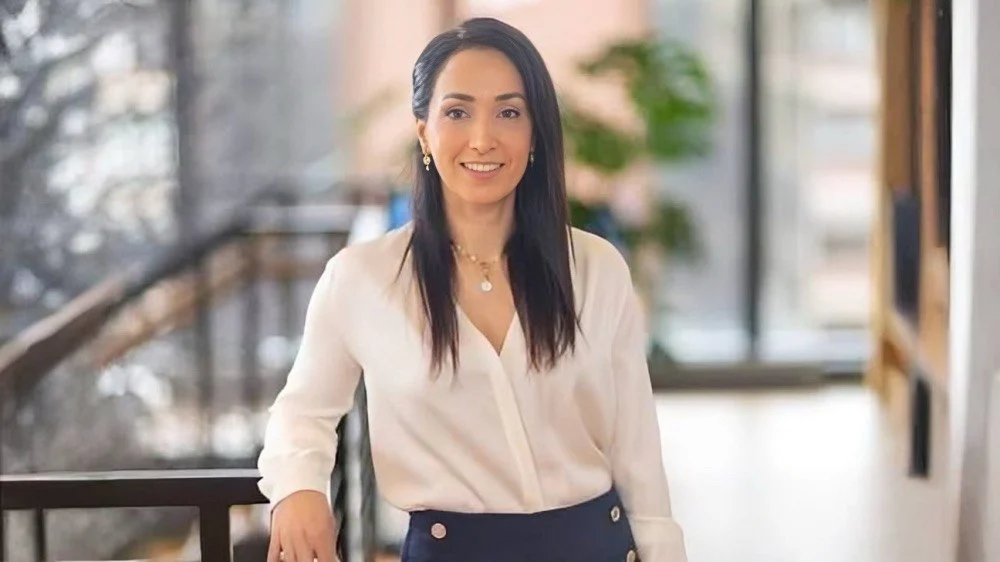
Natalie Artzi, Associate Institute Director at Wyss Institute at Harvard University, shared on LinkedIn:
“I’m thrilled to share that I have been promoted to Professor of Medicine at Harvard Medical School.
While I’m excited to begin this next chapter, I wanted to take a moment to reflect on how I got here and who supported me along the way.
In this article, I share my journey from moving to the United States to begin my postdoctoral fellowship at the Massachusetts Institute of Technology with two babies in tow to building a scientific career while raising three children, from training in plastic materials to transitioning to biomaterials and then more interdisciplinary science, and from being a trainee to becoming a mentor myself and taking on leadership roles, such as becoming the Associate Institute Director at the Wyss Institute at Harvard University.
I hope my story inspires other women scientists to know that you do not have to choose between having a family and building an ambitious scientific career. You can change direction, take risks, pursue unconventional ideas, and build a path that is truly your own.”
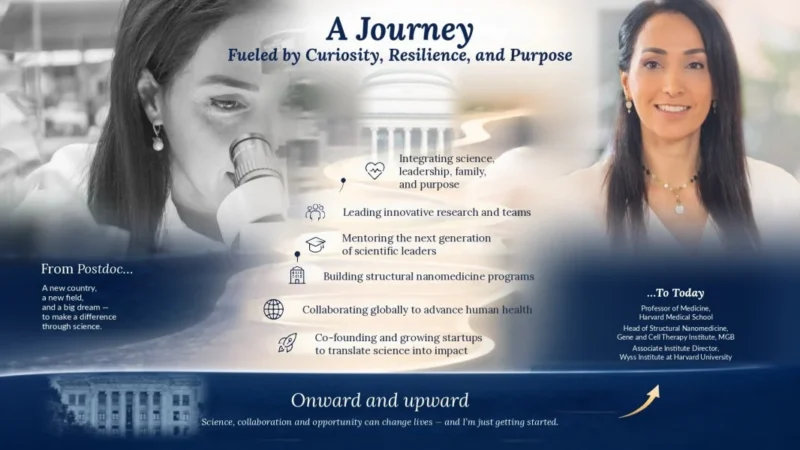
Promotion to Professor of Medicine at Harvard Medical School
I am thrilled to share that I have been promoted to Professor of Medicine at Harvard Medical School.
This milestone has made me pause and reflect on the journey that brought me here. I came to MIT as a postdoc with Elazer Edelman, with two babies in tow. I was starting over in a new academic environment and, in many ways, a new scientific field. I had trained in plastic materials and began moving into biomaterials with a simple but deeply motivating goal: to use science and engineering to make a difference in people’s lives.
And then, during my postdoctoral years at MIT, my third child was born.
Building a scientific career while raising three children, changing fields, starting over, and pursuing ambitious ideas was not always easy. I was incredibly fortunate to have my husband, Shay, beside me-my partner, my sounding board, and one of my greatest sources of support and belief. I could not have built this life and career without him.
I hope this part of my journey can serve as a reminder to other women scientists, especially young women and mothers, that you do not always have to choose.
You can have a family and build an ambitious scientific career. You can change fields. You can take risks. You can start over. You can pursue ideas that seem unconventional. And your path does not have to look like anyone else’s.
My own path has evolved in ways I could never have predicted. Over the past several years, my work at Brigham and Women’s Hospital has grown from materials and biomaterials into a broader scientific and
technological program at the intersection of materials science, nanomedicine, biology, and medicine. My lab have developed technologies designed to interact with cells and tissues in fundamentally new ways.
And increasingly, our mission has expanded from discovery to translation.
My lab has built technologies with the potential to address important problems across cancer, autoimmune diseases, tissue engineering and infectious diseases, and we have begun translating those discoveries beyond the lab through the creation of multiple companies.
Seeing an idea move from a scientific question, to a discovery, to a technology, and ultimately toward something that could reach patients has been one of the most rewarding parts of this journey. I have also been extraordinarily fortunate to have mentors and close collaborators who believed in me and, importantly, believed in my ideas before it was clear where they would lead.
I am deeply grateful to the many people who have shaped my thinking and trajectory over the years, including Elazer Edelman, Chad Mirkin, Nicholas Peppas, Robert Langer, Milan Mrksich, Jeff Karp, Sangeeta Bhatia, Paula Hammond Cunningham, Kathryn Rexrode, and so many others. Their mentorship, friendship, scientific generosity, and willingness to believe in me have meant more than I can fully express.
But none of this happens because of one person. The heart of every laboratory is its people. I am profoundly grateful to the extraordinary trainees and scientists who have chosen to spend a part of their lives in my lab-to those who are here today and to the many who came before them.
They are the ones who turn ideas into experiments, experiments into discoveries, and discoveries into the science that ultimately makes translation possible. They challenge me, teach me, surprise me, and continually push the boundaries of what I believe we can accomplish.
This promotion is as much a reflection of their creativity, persistence, courage, and hard work as it is of my own journey. I hope every trainee who has been part of this lab sees a little piece of themselves in this milestone.
One particularly meaningful chapter in this journey has been my time at the Wyss Institute at Harvard University. What makes Wyss so special to me is its philosophy of transforming bold ideas into real-world impact-bringing together biology, engineering, medicine, and entrepreneurship, and creating a path from high-risk ideas to technologies that can ultimately reach patients.
This approach has deeply shaped the way I think about science and translation, and has accelerated my own trajectory in ways I could not have imagined. I am deeply grateful to Donald Ingber, David Walt, Angelika Fretzen, Matt Makarewicz, Kenneth Carlson, Rushdy Ahmad, Philip Zakas and John H.
Shaw for their belief, partnership, mentorship, and friendship. Their support, and the incredible Wyss community, have been an extraordinary part of my journey, and I am excited about what we can accomplish together in the years ahead.
And I am grateful to the many colleagues and collaborators who have taken risks with us, opened doors, challenged our thinking, and helped transform ambitious ideas into reality.
This promotion is therefore not just a personal milestone. It feels like a milestone for a community of people who have built something together. And perhaps what makes me most excited is that I don’t see it as the culmination of the journey.
I see it as the beginning of an even bigger chapter.
We now have a strong scientific foundation, powerful technologies, an extraordinary team, and an ecosystem that allows us to take ideas from the lab and work toward bringing them to patients.
There is so much more to build.
More ideas to pursue. More technologies to create. More diseases to tackle. More patients to reach.
And if my journey can give one young woman, or one young mother, the confidence to believe that she does not have to choose between the family she wants and the career she dreams of, then that would be one of the most meaningful things I could accomplish.
I am incredibly proud of how far we have come.
But I am even more excited about where we are going.
And yes, I realize this is a very long Linkedin post.
But it does attempt to summarize a couple of decades-and there was a lot to be grateful for along the way.
Onward and upward.
Ron DePinho, Professor of Department of Cancer Biology, Division of Discovery Science at MD Anderson Cancer Center, shared Natalie Artzi‘s post, adding:
”Congratulations Natalie. You are a rock star.”
Other articles about Harvard Medical School on OncoDaily.