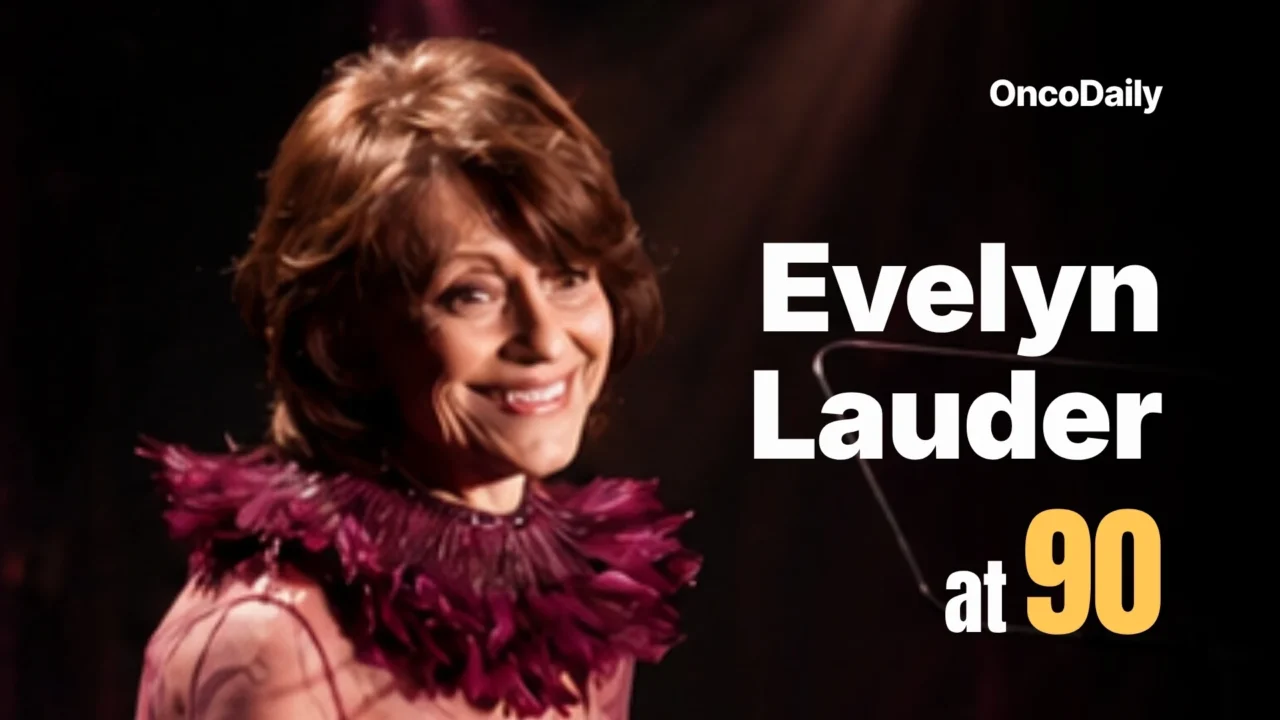
The Breast Cancer Research Foundation (BCRF) has marked what would have been the 90th birthday of its late founder, Evelyn H. Lauder, honoring a life that helped reshape breast cancer awareness, research, philanthropy, and care around the world.
Born Evelyn Hausner on August 12, 1936, in Vienna, Austria, Lauder came to New York with her family in 1940 after fleeing Nazi-occupied Europe. Her life would eventually become closely intertwined with one of the most recognizable public health movements of the modern era and with an enduring commitment to advancing breast cancer research.
“Mrs. Lauder was a visionary who recognized that research is the only way to eradicate breast cancer,” BCRF wrote in its tribute marking her 90th birthday. “BCRF is deeply honored to advance her legacy every day.”
From a Pink Ribbon to a Global Movement
One of Evelyn H. Lauder’s most enduring contributions came in 1992, when she and Alexandra Penney, then editor of SELF magazine, created the pink ribbon, which would become an internationally recognized symbol of breast cancer awareness.
That same year, Lauder launched The Estée Lauder Companies’ Breast Cancer Awareness Campaign. The initiative grew far beyond its original form, bringing breast cancer awareness into public spaces around the world.
Lauder and the campaign later achieved a Guinness World Record by illuminating 38 historic and iconic landmarks within 24 hours in recognition of breast cancer awareness and research. The broader Global Landmarks Illumination Initiative would eventually bring pink lighting to landmarks internationally each October.
The pink ribbon became one of the most visible symbols associated with breast cancer, but Lauder’s work extended far beyond awareness. At the center of her efforts was a conviction that meaningful progress would depend on sustained investment in research.
Building a Foundation Around Research
In 1993, Lauder founded the Breast Cancer Research Foundation, serving as its chairman and committing the organization to funding clinical and translational breast cancer research.
BCRF was established with a central principle: that research was fundamental to preventing breast cancer, improving treatment, and ultimately finding a cure.
The foundation has continued that mission after Lauder’s death in 2011, supporting investigators and collaborative research initiatives focused on understanding the biology of breast cancer and improving outcomes for patients.
Her commitment to research also received recognition from the scientific and medical community. In 2007, she received the American Society of Clinical Oncology Partners in Progress Award, and in 2011, Lauder and her family received the Carnegie Medal of Philanthropy.

A Breast Center Designed Around the Patient
Lauder’s impact can also be seen directly in the delivery of breast cancer care.
In 1989, she initiated a fundraising effort that helped establish a breast and diagnostic center at Memorial Sloan Kettering Cancer Center (MSK) in New York.
Today, the Evelyn H. Lauder Breast Center at MSK provides prevention, diagnosis, treatment, and supportive services within a single facility.
Its services include medical oncology, surgical consultations, chemotherapy, pathology, diagnostic imaging, screening programs, supportive medicine, rehabilitation, survivorship care, nutrition, social work, psychiatry, integrative medicine, and sexual health services.
The center also promotes advances in diagnostic technologies, targeted treatments, less-invasive surgery, molecular pathology, chemotherapy, vaccine development, and prevention.
For Lauder, the concept went beyond constructing a medical facility. It reflected an approach in which patients could receive coordinated breast cancer care in one place, supported by multidisciplinary teams that include medical, surgical, and radiation oncologists.
A Legacy Extending Into Metastatic Breast Cancer Research
Lauder’s name also remains connected to major efforts to understand one of the most difficult challenges in breast cancer: metastasis.
Following her death, BCRF established a dedicated metastatic breast cancer research initiative in 2013, now known as the Evelyn H. Lauder Founder’s Fund for Metastatic Breast Cancer Research.
The international, multi-year collaboration focuses on understanding how breast cancer evolves from localized disease into metastatic disease, identifying the molecular changes associated with progression, and investigating mechanisms of treatment resistance.
BCRF has dedicated $41.5 million to the initiative, according to the foundation.
Among its flagship programs are AURORA EU and AURORA US, which examine primary breast tumors and metastatic lesions using molecular analyses to better understand the evolution of metastatic disease.
AURORA EU, conducted through the Breast International Group, has recruited more than 1,100 women and men with metastatic breast cancer from 60 hospitals across 11 European countries. Researchers are analyzing tumor tissue, blood, serum, and plasma to investigate genes involved in metastasis and identify blood-based biomarkers that could help assess disease progression and treatment response.
Early analyses reported several important observations, including molecular differences between primary and metastatic tumors, changes in tumor subtype during progression, alterations associated with DNA repair, and differences in immune-related characteristics.
AURORA US has similarly investigated the molecular differences between primary tumors and distant metastases, including changes involving the tumor microenvironment, immune regulation, and breast cancer subtype.
These projects continue the research-centered philosophy that defined Lauder’s work.
More Than an Advocate
Although breast cancer advocacy became one of the defining parts of her public life, Evelyn H. Lauder’s career and interests extended considerably further.
Before joining the Lauder family business, she attended New York City public schools and worked as a public school teacher in Harlem. She later held several positions at The Estée Lauder Companies, ultimately serving as Senior Corporate Vice President and Head of Fragrance Development Worldwide.
She was also an accomplished photographer whose work was exhibited at institutions and galleries including the Whitney Museum of American Art in New York, Gagosian Gallery in Los Angeles, and Galeries Lafayette in Paris.
She published two photography books, The Seasons Observed and An Eye for Beauty, as well as the cookbook In Great Taste: Fresh, Simple Recipes for Eating and Living Well. Royalties from her books and exhibitions were donated to BCRF.
Her contributions to philanthropy, business, culture, and breast cancer advocacy earned international recognition, including France’s Chevalier de la Légion d’Honneur.
A Vision That Continues Beyond a Lifetime
Evelyn H. Lauder died in 2011 at the age of 75 following ovarian cancer.
Her influence, however, remains visible across breast cancer research and care: in the pink ribbon recognized around the world, in the foundation she created, in the research collaborations carrying her name, and in the breast center that continues to provide multidisciplinary care to patients in New York.
On what would have been her 90th birthday, BCRF’s tribute reflects the central idea that guided much of Lauder’s work: awareness could bring breast cancer into public view, but research would be necessary to change its future.
More than three decades after the creation of BCRF, that mission continues.
More articles like this are available on OncoDaily