





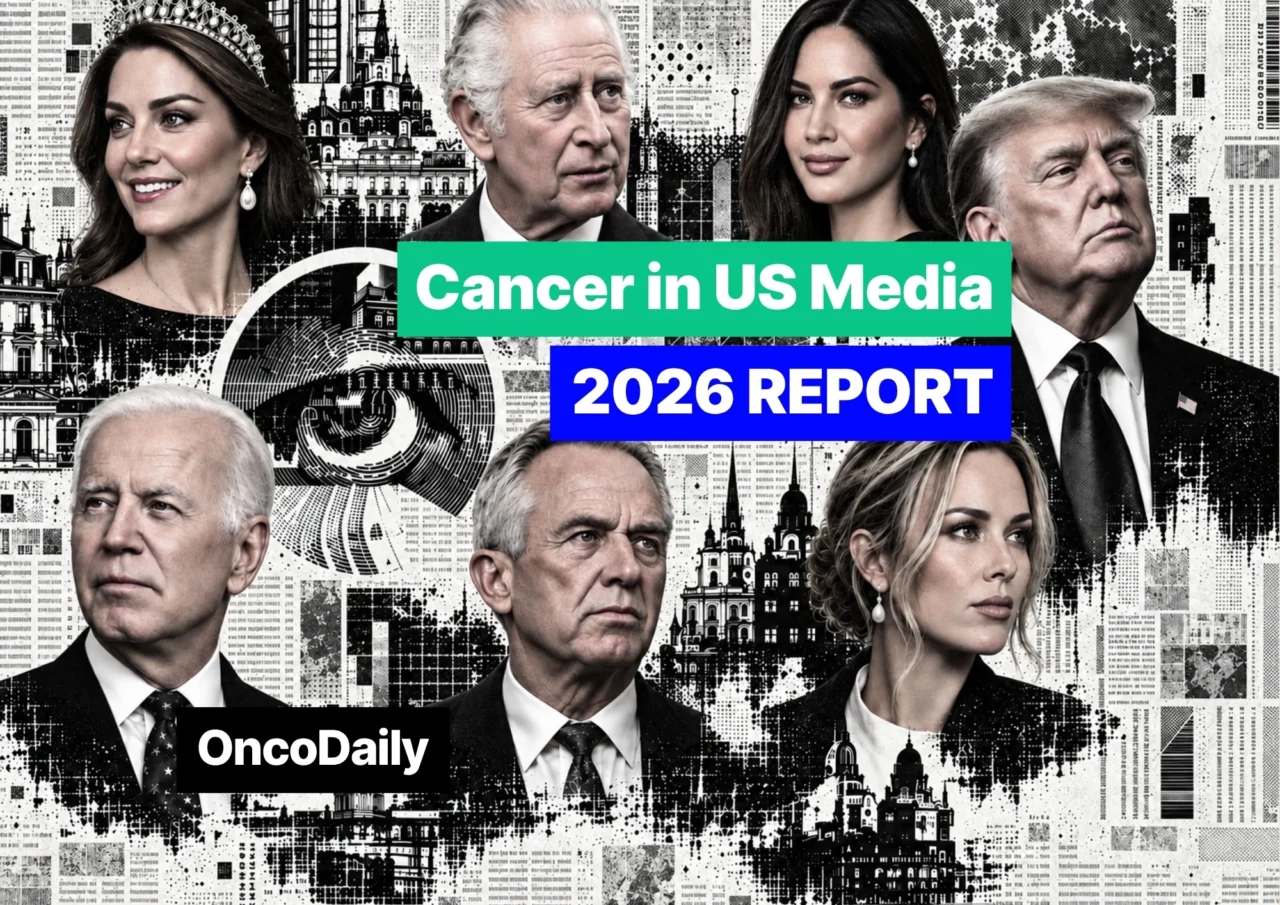
Cancer In US Media: 2026
Overview
Key takeaways
- Broad, sustained attention - cancer is one of the most consistently covered health topics in US media, showing up as a near-daily presence rather than an occasional story.
- Human-centered storytelling - the dominant approach is telling individual patient stories, which makes cancer relatable and has real public-health value (driving screenings, awareness, donations).
- Coverage follows headlines, not health data - which cancers and topics get covered tracks celebrity diagnoses and political news cycles far more than actual incidence or mortality rates.
- Thin scientific and systemic depth - clinical trials and policy get meaningful but secondary coverage, while structural issues like access and health disparities are barely covered at all, leaving a gap between what readers see and the fuller picture of the disease.
- News events set the agenda, not awareness months, and AI is marginal. AI/ML is only 221 articles (about 1.8%), and four outlets have none.
Cancer is one of the defining health stories of our era. More than 20 million new cases are diagnosed worldwide each year, a number which is projected to rise to 35 million by 2050, according to the World Health Organization, driven by aging populations, environmental exposures and other persistent risk factors we have known about for decades. In some countries, it has replaced other leading causes of mortality such as cardiovascular disease as a primary risk factor for premature death. The pervasiveness of cancer makes it a mainstay in news media coverage, be it through stories about new drugs and research, celebrity diagnoses, or stories about patients.
For many people, the news media is how they first encounter cancer, often through a headline about a celebrity, or an article that lists warning signs or details a new treatment. This makes news content an important way through which the public forms its beliefs about what cancer is and which ones are worth being afraid of.
But for all the coverage that cancer generates, there is not much known about how that coverage takes shape. For example, which cancers occupy the most headlines, which voices are featured most in the reporting, whether the story is told through the lens of science or humans, or a policy failure or business deal. OncoDaily, a leading oncology media platform run by oncologists, and one of the most prolific sources of cancer news globally, set out to answer those questions systematically.
We applied an analytical framework to thousands of articles to make an aggregate view of cancer coverage visible for the first time. Asking specific and narrow questions, such as what gets covered, who is quoted, which cancers appear and which do not, how the story is told. Working across thirty major American news outlets over a twelvemonth period, and drawing on an AI-assisted analysis, this report maps how mainstream media tells the cancer story.
OncoDaily built a corpus drawn from thirty major U.S. news outlets including general news organizations, business publications, broadcast media, lifestyle magazines, and longform and investigative outlets covering the 12-month period ending on April 30, 2026.
The picture that has emerged is not necessarily consistent across the board. American cancer coverage is driven by breaking news, and often patient or celebrity focused. Discussions on disease burden and innovative cancer treatments are often secondary to celebrity diagnoses, patient narratives, and a focus on the better-known treatments of surgery and chemotherapy. Despite lung cancer being the country’s deadliest cancer, it received only a fraction of the attention given to other cancers related to celebrity diagnosis or hype.
Oncology Relevance
How central is cancer to the coverage?
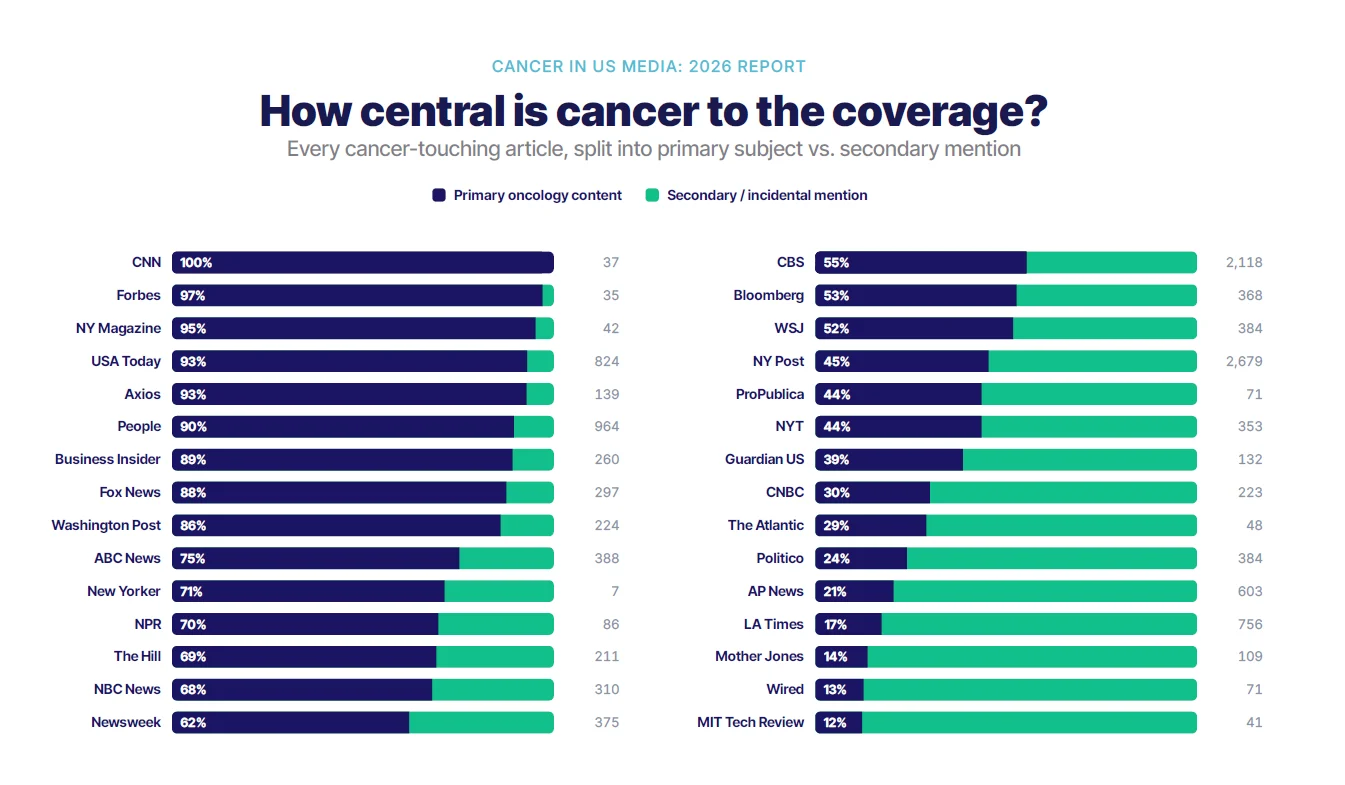
Every article about cancer was classified into two tiers by how central cancer was as a focus. An article counts as primary when cancer is the spine of the piece – the diagnosis, treatment, trial, policy, or patient at the heart of the story – and secondary when cancer appears only in passing, surfacing inside a story really about funding cuts, AI, the environment, or an obituary.
Across 30 outlets over twelve months (Apr 2025–Apr 2026), the corpus holds 12,539 articles about cancer: 6,974 primary (55.6%) and 5,565 secondary (44.4%).
Business and specialist desks tended to treat cancer as the main subject: CNN (100% primary), Forbes (97%), NY Magazine (95%), USA Today (93%), Axios (93%).
Investigative, tech, and policy outlets mostly mentioned cancer in passing – MIT Tech Review (12% primary), Wired, Mother Jones, LA Times, AP – where cancer rides inside broader narratives. Volume and centrality don’t necessarily correlate. NY Post leads in terms of raw output (2,679 articles) yet only 45% primary, while outlets that published fewer articles about cancer like CNN and Forbes kept it the focus of the story.
Editorial Categories
Which editorial frames dominate?
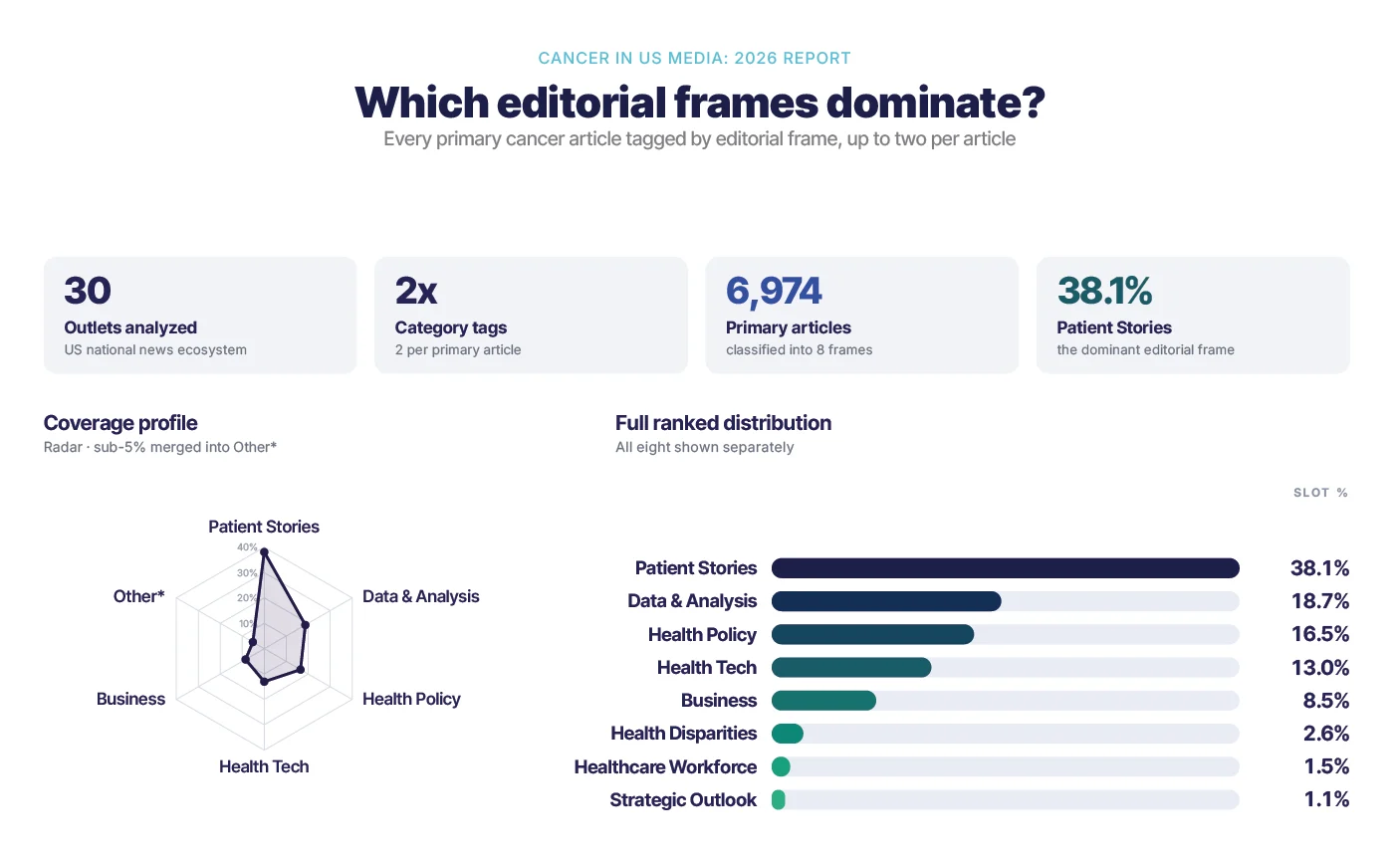
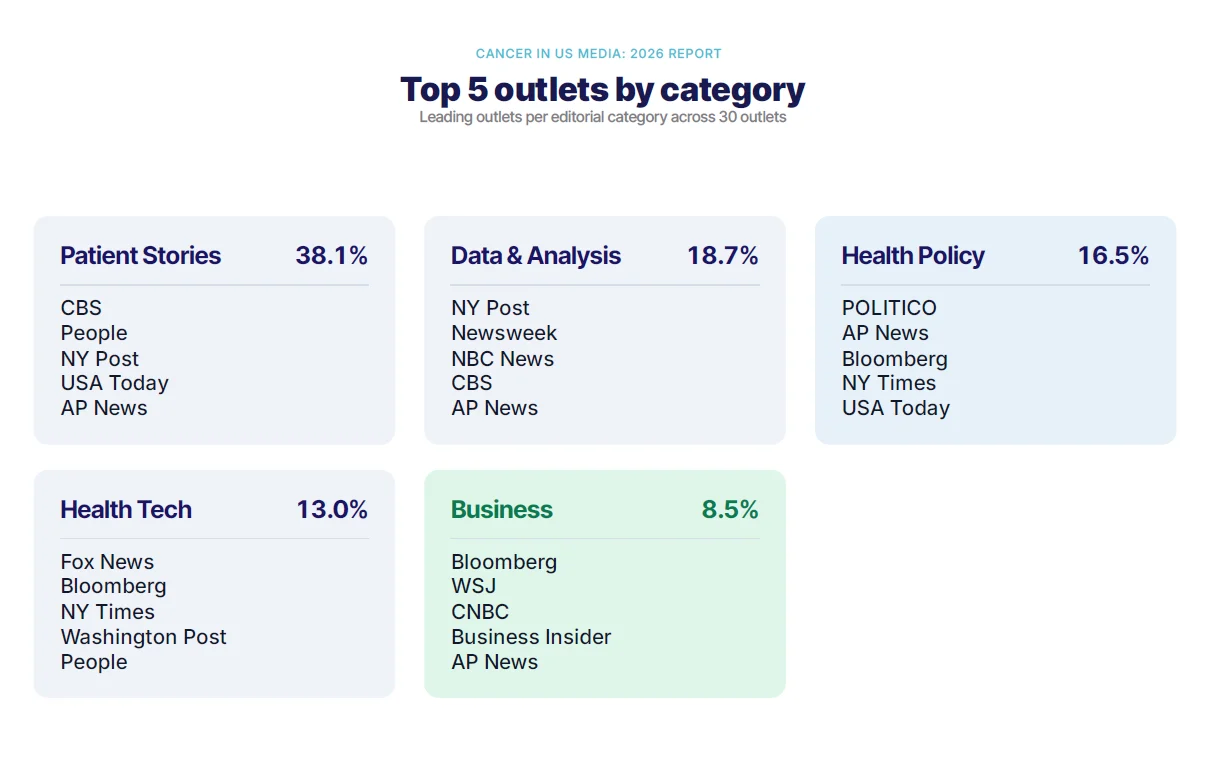
Coverage is overwhelmingly human-interest: Patient Stories alone takes 38.1% of all tags – more than the next two categories combined – driven by celebrity-diagnosis cycles and highvolume
outlets (People, CBS, USA Today, NY Post). Data & Analysis (18.7%) and Health Policy (16.5%) form a strong second tier, the latter inflated by Politico, Bloomberg, and the federal-funding story. Health Tech (13.0%) and Business (8.5%) trail. Health Disparities, Healthcare Workforce, and Strategic Outlook together barely account for 5%.
Cancer Types
Which cancers get named
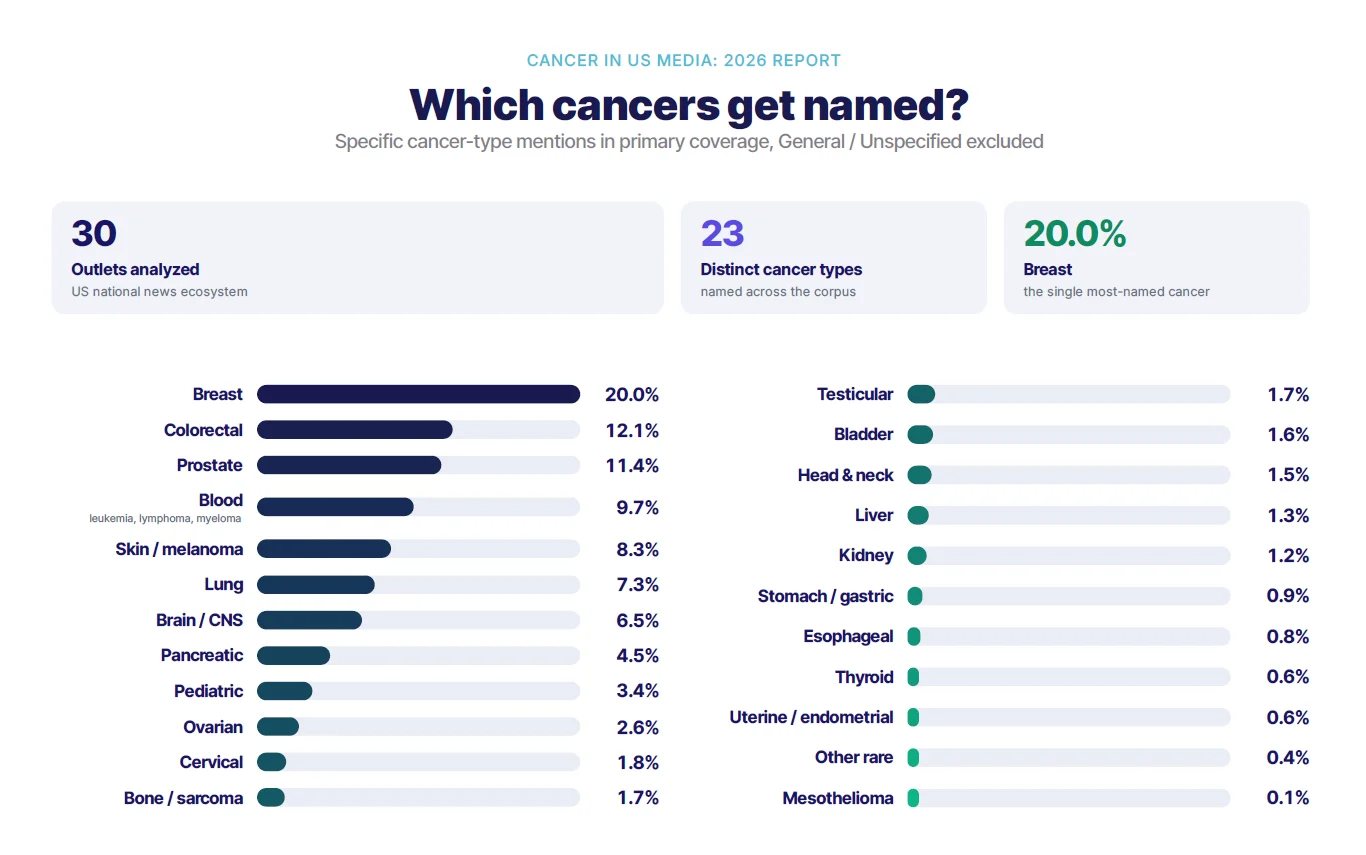
Coverage tracks celebrity diagnosis and screening news hooks rather than disease burden. Breast leads everywhere at 20.0% – the single most-named cancer. Colorectal (12.1%) and Prostate (11.4%) are also prominent, with colorectal mostly tied to the early-onset-under-50 coverage, and prostate the Biden diagnosis coverage. Blood cancers (9.7%) and Skin/melanoma (8.3%) follow, the latter inflated by tabloid sun-risk service journalism. Interestingly, Lung takes just 7.3% of the coverage, despite being the deadliest US cancer – outlets cover it through never-smoker and vaping angles, rather than population mortality. The long tail (testicular, bladder, head & neck, liver, kidney, and rarer types) each sit below 2%, reflecting celebrity-driven attention rather than systematic coverage.
Therapies
Which treatments get mentioned?
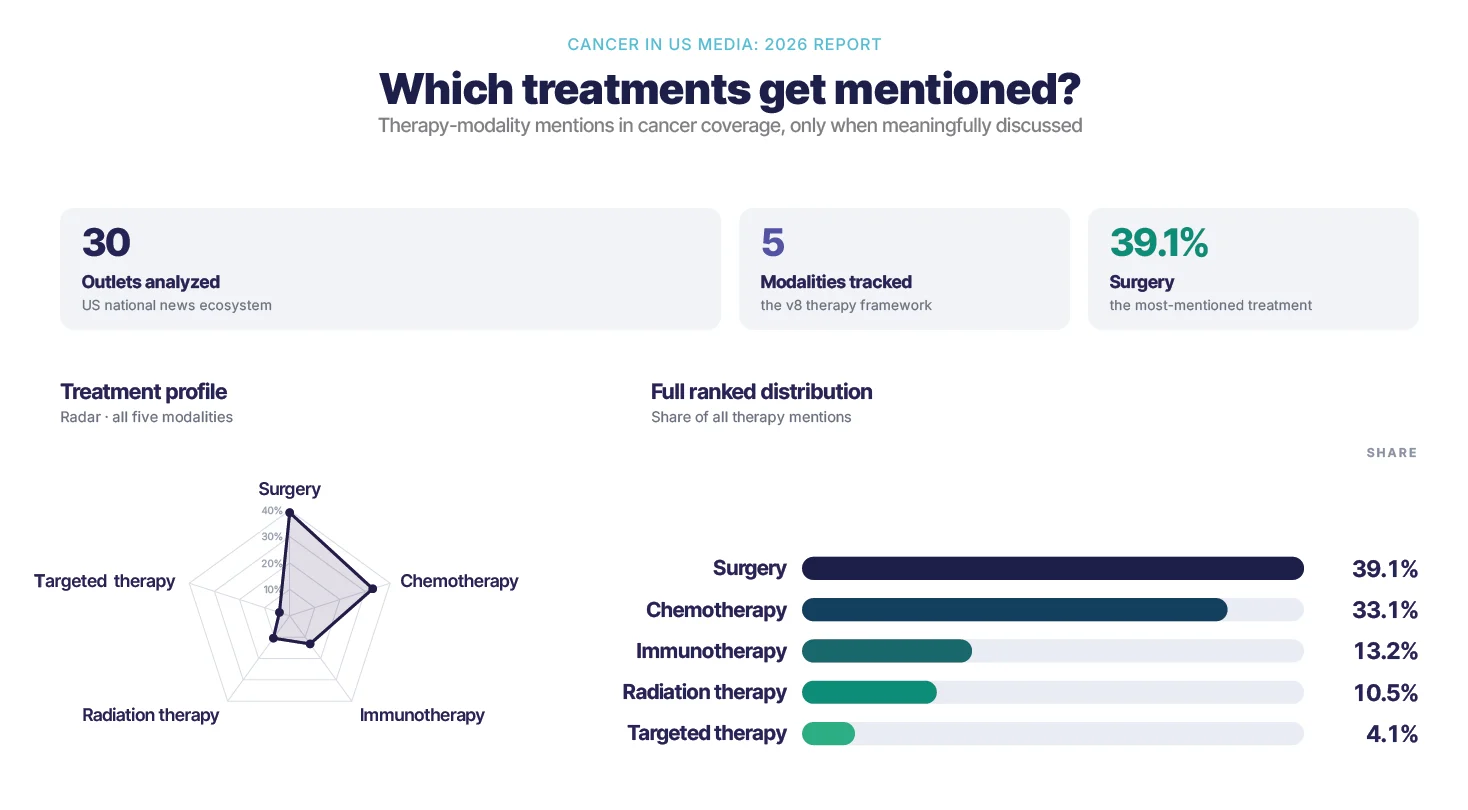
Coverage leans on the two oldest, most recognizable treatments. Surgery (39.1%) and Chemotherapy (33.1%) together account for nearly three-quarters of all therapy mentions.The precision-medicine era is comparatively thin: Immunotherapy 13.2%, Radiation 10.5%, and Targeted therapy just 4.1%. Interestingly, the targeted and immune agents are where almost all current oncology innovation, FDA activity, and pharma deals actually sit, yet they’re the least-named in coverage.
The split also varies sharply by outlet type: business/science desks (CNBC, WSJ, Business Insider, Bloomberg) over-represent immunotherapy and targeted therapy, while consumer outlets (People, NY Post, USA Today) drive the surgery/chemo dominance.
Pharma / Biotech
Which drugmakers own the coverage?
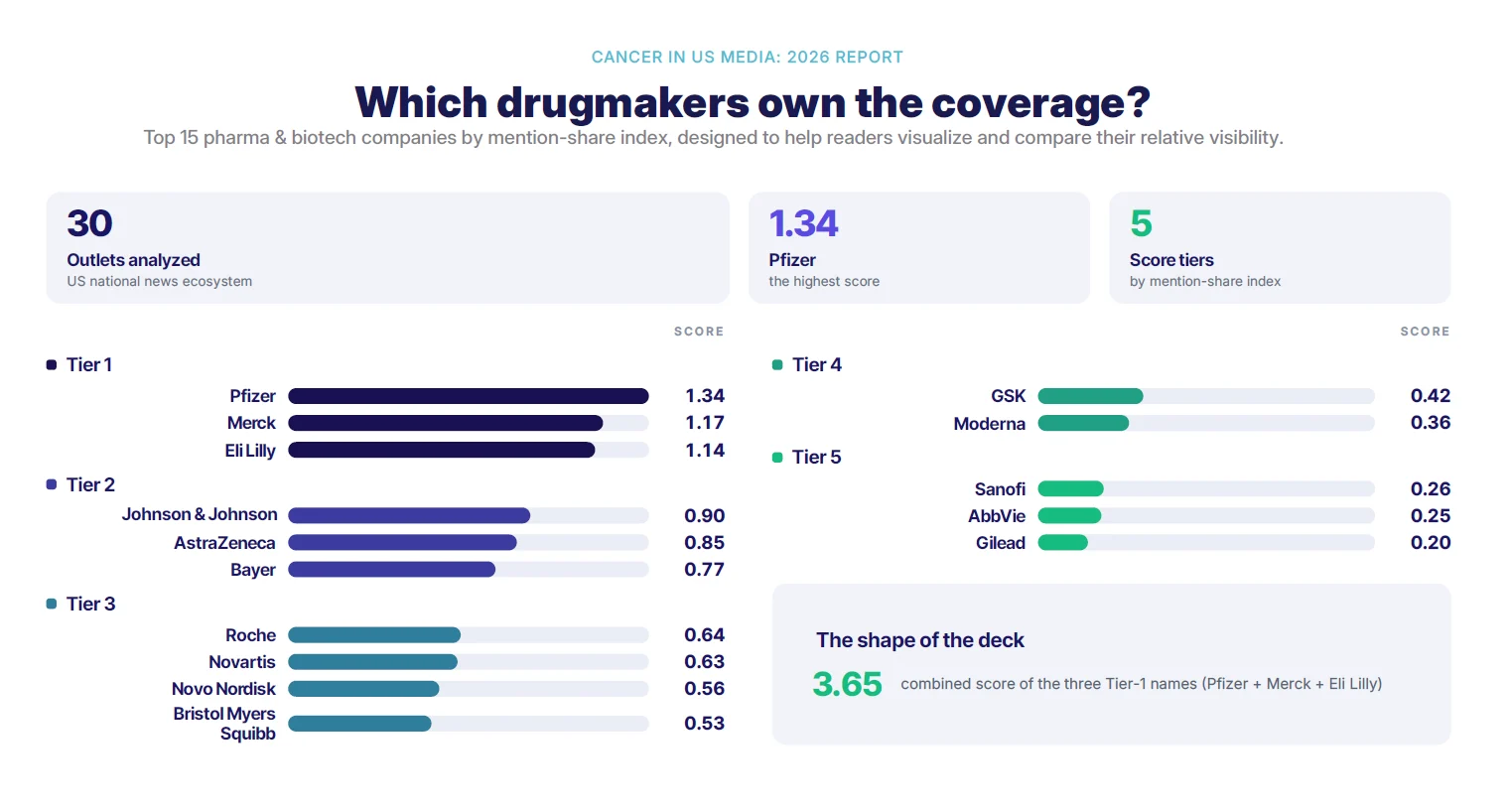
The coverage is owned by a small global drug deck. Tier 1 (score ≥ 1.0) is Pfizer (1.34), Merck (1.17), Eli Lilly (1.14) – three companies taking ~36% of all top-15 mentions. Tier 2 (0.70–0.99) is J&J, AstraZeneca, and Bayer; Tier 3 (0.50–0.69) is Roche, Novartis, Novo Nordisk, BMS; Tier 4 GSK and Moderna; Tier 5 Sanofi, AbbVie, Gilead. Bayer ranks high almost entirely on Roundup/glyphosate litigation (non-Hodgkin lymphoma lawsuits), and Novo Nordisk on GLP-1 (Wegovy/Ozempic) crossover into cancer-prevention stories – not cancer drugs. The list also tracks where the mentions originate: Bloomberg, CNBC, WSJ, and Politico generate the overwhelming majority.
Cancer Centers
Which cancer centers get cited?
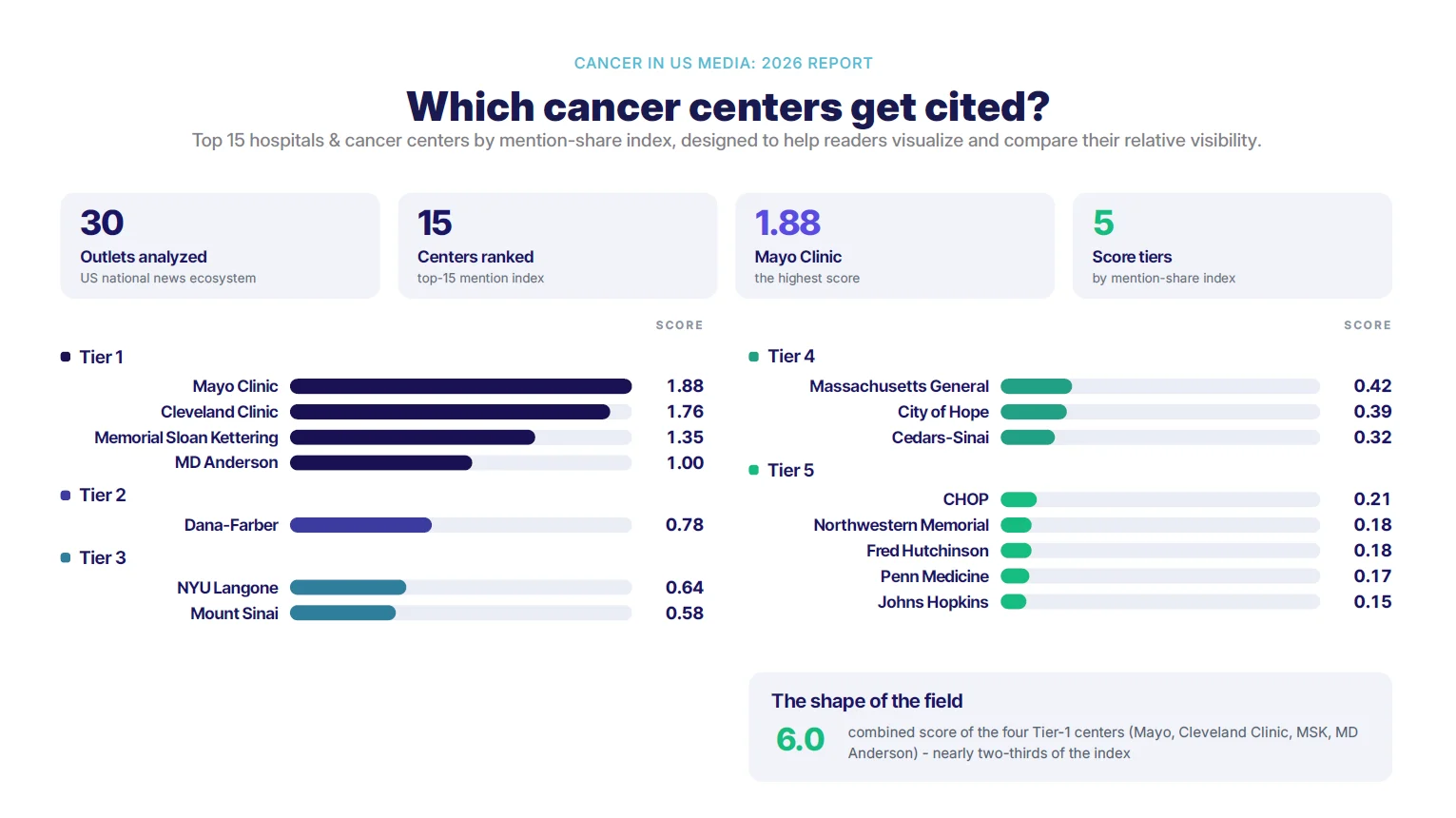
The field is extraordinarily top-heavy. Mayo Clinic (1.88) and Cleveland Clinic (1.76) run away with the coverage – together more than a third of the index – they both appear to run enormous comms efforts that service articles quote constantly (People alone cites Mayo 78× and Cleveland 68×). They anchor a four-center elite tier (≥1.0) with Memorial Sloan Kettering (1.35) and MD Anderson (1.00) that holds 6.0 of the 10.0 index. Below sits Dana-Farber alone in Tier 2, then the NYC academic centers NYU Langone and Mount Sinai (lifted heavily by NY Post), and a long tail of children’s and academic hospitals – CHOP, Northwestern, Fred Hutchinson, Penn, Johns Hopkins.
Universities
Which universities get cited?
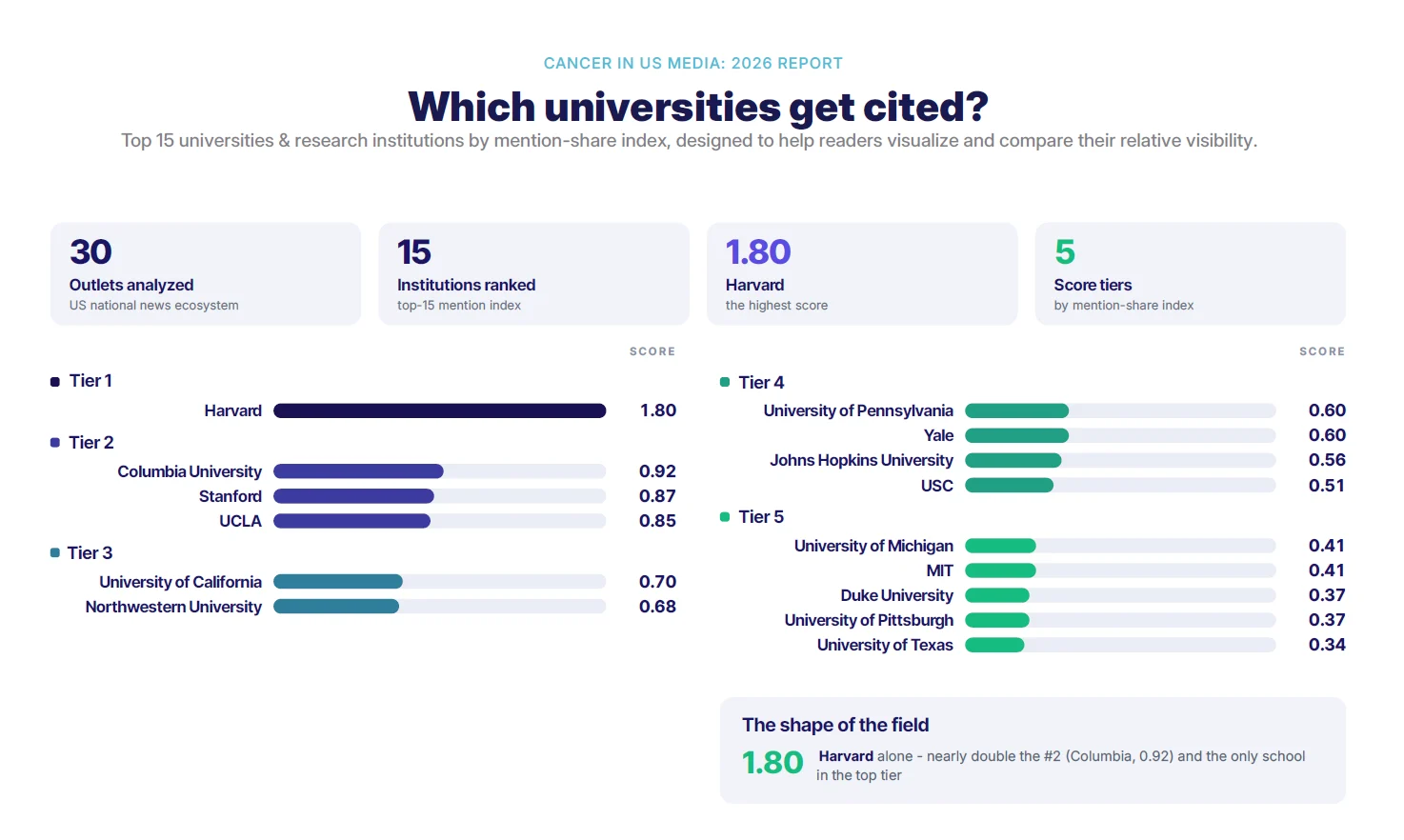
There’s one runaway leader – Harvard (1.80), nearly double the #2. Below it sits a tight elite cluster (Columbia 0.92, Stanford 0.87, UCLA 0.85), then a broad, even spread: the UC system and Northwestern in Tier 3; the mix of Penn, Yale, Johns Hopkins, USC in Tier 4; and then Michigan, MIT, Duke, Pittsburgh, and Texas.
The top five hold more than half the index. The ranking maps where journalists source cancer science – name-brand institutions whose faculty and press offices dominate research coverage – with the California presence notably split across multiple campuses.
Journals
Which journals get cited?
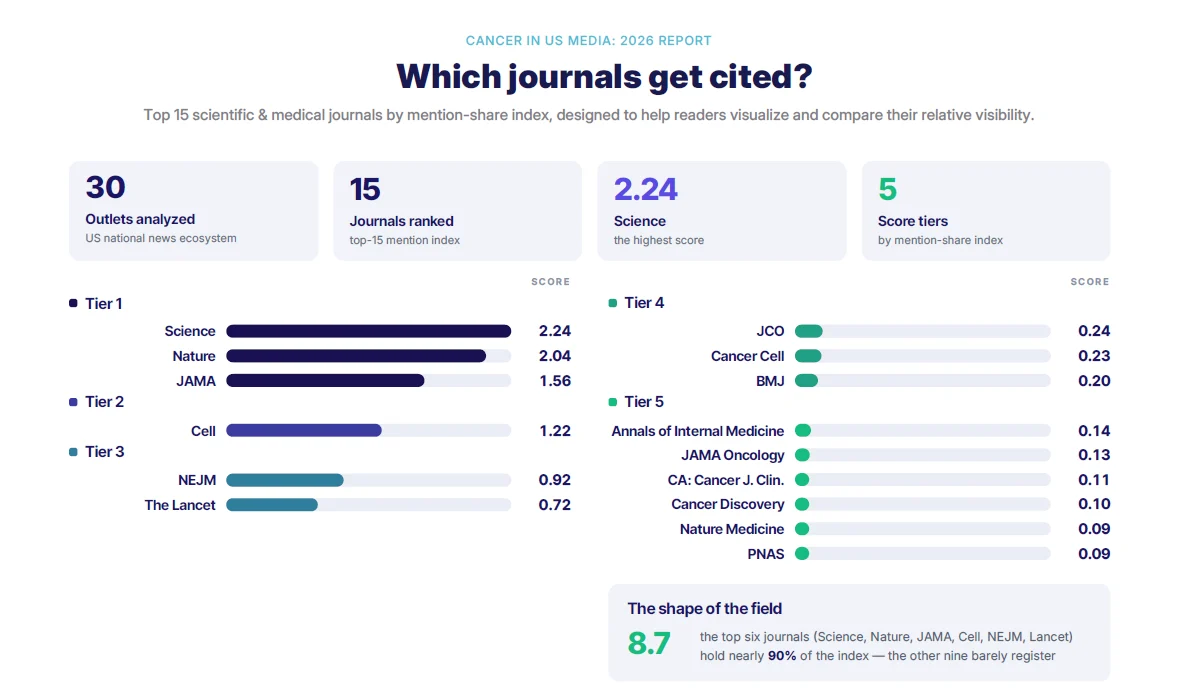
Coverage leans on a tiny set of marquee titles. Science (2.24) and Nature (2.04) lead, with JAMA (1.56) the top clinical name and Cell (1.22) close behind; together with NEJM (0.92) and The Lancet (0.72), six journals hold nearly 90% of the index. General-science (Science, Nature, Cell = 5.5) outweighs the clinical-focus journals (JAMA + NEJM + Lancet = 3.2). Everything specialist – JCO, Cancer Cell, JAMA Oncology, Cancer Discovery, CA – sits in a long tail. Journalists reach for the highest-prestige, highest-impact names rather than the specialist oncology literature.
Celebrities
Who are the faces of cancer coverage?
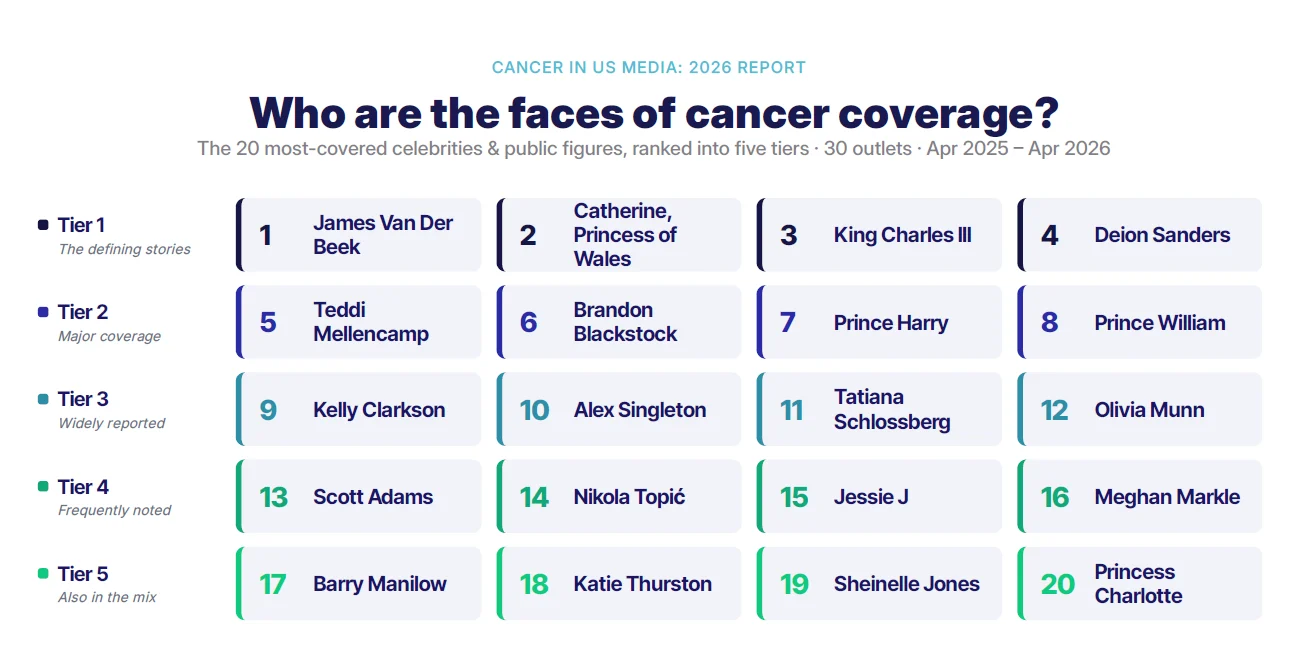
Tier 1 – the defining stories. James Van Der Beek – the Dawson’s Creek actor’s Stage III colorectal-cancer disclosure and treatment updates made him the single most-covered figure. Catherine, Princess of Wales – her 2024 cancer announcement, chemotherapy, and 2025 remission update drove sustained royal coverage. King Charles III – diagnosed in early 2024, with ongoing treatment news through the window. Deion Sanders – the Colorado football coach revealed a bladder-cancer diagnosis and neobladder surgery while vowing to keep coaching.
Tier 2 – major coverage. Teddi Mellencamp – the reality-TV star’s Stage IV melanoma (spread to brain and lungs) generated continuous updates. Brandon Blackstock – talent manager and Kelly Clarkson’s ex-husband, who died of melanoma at 48. Prince Harry and Prince William – covered as the central figures of the royal family during Catherine’s and Charles’s illnesses (reconciliation angles, public duties).
Tier 3 – widely reported. Kelly Clarkson – tied to Blackstock’s death (and her father’s earlier cancer death). Alex Singleton – the Broncos linebacker diagnosed with testicular cancer via a random drug test, back on the field within weeks. Tatiana Schlossberg – JFK’s granddaughter, who wrote a widely-shared New Yorker essay about her terminal leukemia and died at 35. Olivia Munn – breast-cancer diagnosis, double mastectomy, and vocal advocacy for risk-assessment screening.
Tier 4 – frequently noted. Scott Adams – the Dilbert creator announced metastatic, terminal prostate cancer. Nikola Topić – the Thunder rookie diagnosed with testicular cancer. Jessie J – the British singer disclosed a breast-cancer diagnosis and surgery. Meghan Markle – covered adjacent to the royal-family cancer narrative.
Tier 5 – Barry Manilow – revealed an early-caught cancer found “by pure luck” on an MRI. Katie Thurston – the Bachelorette star documenting Stage 4 breast cancer. Sheinelle Jones – the Today host whose husband, Uche Ojeh, died of brain cancer (glioblastoma). Princess Charlotte – the young Wales daughter, present in royal-family coverage during her mother’s illness. Coverage is driven by two engines – personal-disclosure stories (a famous name revealing or living with a diagnosis) and the British royal family, whose 2024–26 cancer news pulled the whole Windsor circle into the corpus.
Politicians & Leaders
Which politicians & leaders shape the story?
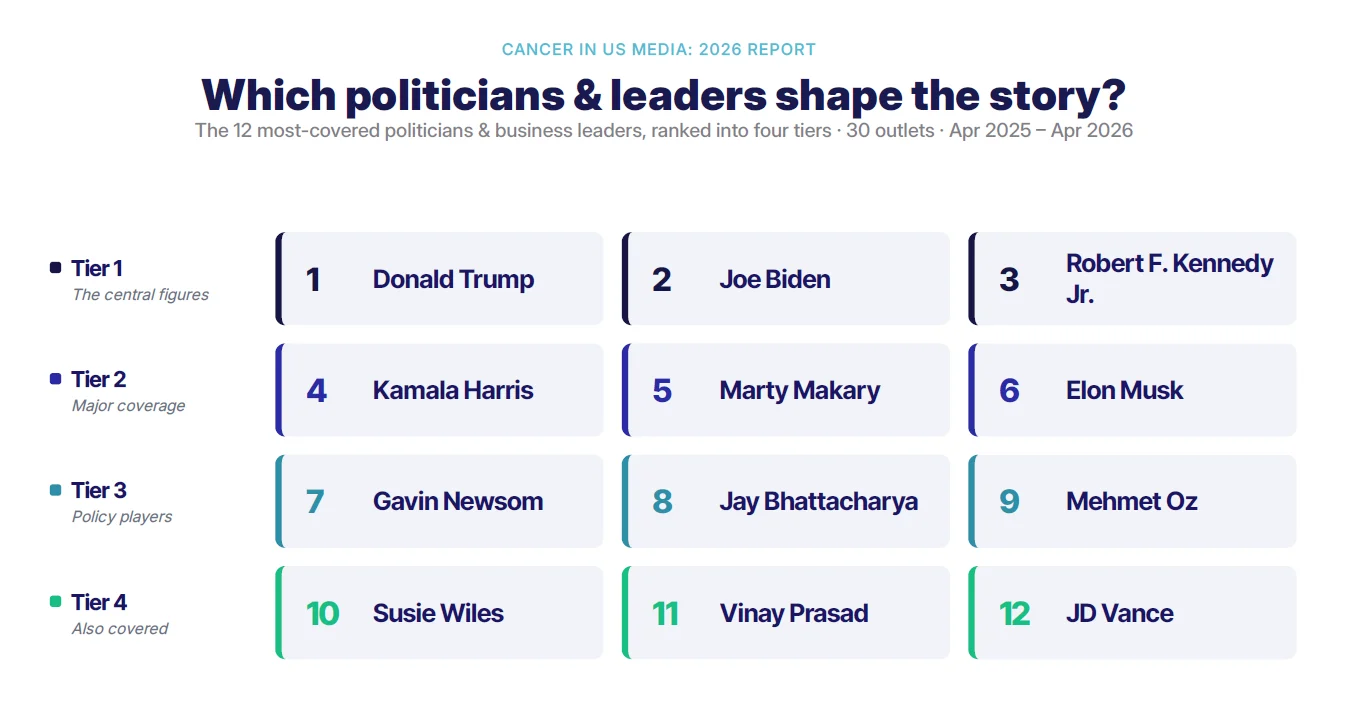
Tier 1 – the central figures. Donald Trump – the single most-cited name in the whole set; cancer enters through his administration’s health agenda (RFK Jr.’s appointment, NIH/NCI funding cuts, FDA leadership) and his commentary on Biden’s diagnosis. Joe Biden – former president, whose May 2025 Stage IV prostate-cancer diagnosis was a defining story, layered on his Cancer Moonshot legacy. Robert F. Kennedy Jr. – HHS Secretary and the policy engine of the period: CDC/NIH restructuring, USPSTF and screeningguideline fights.
Tier 2 – major coverage. Kamala Harris – recurring background figure in health-policy stories. Marty Makary – FDA Commissioner, named on approvals and screening guidance. Elon Musk – the only business leader near the top, appearing chiefly through DOGE’s federal-science cuts hitting NIH and NCI.
Tier 3 – policy players. Gavin Newsom – California governor, prominent in state-level health coverage (and heavy LA Times citing). Jay Bhattacharya – NIH Director, tied to researchfunding decisions. Mehmet Oz – CMS Administrator, covered on Medicare/Medicaid coverage policy (plus his physiciancelebrity profile).
Tier 4 – also covered. Susie Wiles – White House Chief of Staff, surfacing in administration healthpolicy stories. Vinay Prasad – the FDA’s oncology/ biologics director, related to accelerated-approval and drug-evidence debates. JD Vance – Vice President, background political context.
Ten of twelve are government figures, and the administration’s health apparatus – Trump, RFK Jr., Makary, Bhattacharya, Oz, Prasad is making up most of the list.. Biden bridges both worlds as ex-president and patient. Actual business leaders don’t appear much.
AI In Oncology
What the Coverage Actually Shows
Over the past year, artificial intelligence has become increasingly part of cancer coverage in the news media. The coverage has ranged from cautious reports to hype, describing a technology that is beginning to change parts of oncology, while also making claims that outrun the evidence. Of the more than 12,000 articles we analyzed, only about 223 touched on AI in oncology.
The first thing the coverage reveals is that “AI in cancer” is not one thing. Diagnostic imaging, such as AI reading mammograms, colonoscopy footage, and CT scans are the closest to routine clinical use, and drew the most coverage. Molecular profiling and liquid biopsy, where machine learning parses blood or tissue for tumor signals, sits slightly behind in terms of coverage. Drug discovery, where companies like Isomorphic Labs and Recursion are applying protein-structure modeling to oncology pipelines, is still less covered. And workflow automation, such as AI tools that navigate prior authorizations, summarize charts, match patients to trials, is the newest and least-examined category.
The diagnostic area is where the strongest peer-reviewed evidence is. A randomized controlled trial out of Lund University, involving more than 100,000 women, showed AI-assisted mammography screening cut interval cancers by roughly 12 percent at a fraction of the labor cost. Clairity Breast, a deep-learning model trained on more than 421,000 mammograms, received FDA de novo authorization and began clinical deployment at Beth Israel Deaconess Medical Center in February 2026. SimBioSys’s TumorSight Viz, a 3D surgical planning tool, was used at Mercy Cedar Rapids to plan a lumpectomy.
But a study published in The Lancet Gastroenterology & Hepatology documented ‘deskilling’, where endoscopists who used AI polyp-detection tools for three months saw their unaided adenoma detection rate fall from 28.4 to 22.4 percent. When the AI was removed, they were measurably worse at the thing the AI had been helping them do.
Drug discovery attracted some of the most attention. In April 2026, Isomorphic Labs announced that AI-designed drugs were moving into human clinical trials. The Atlantic had already run a piece in April 2025 compiling what Hassabis, Sam Altman, and Dario Amodei had each said publicly about AI’s timeline for ending cancer. Working oncologists and researchers at Pfizer, Memorial Sloan Kettering, and the University of Chicago described decade-long timelines.
The coverage around generative AI in clinical settings, such as ChatGPT as a patient-facing tool, was also prominent. At least nine articles across Fox News, the New York Post, People, Newsweek, and NPR described a patient with dismissed or missed symptoms who consulted ChatGPT, which surfaced a serious condition. These pieces ran largely without statistical context on chatbot accuracy or false-positive rates. Separate reporting of a study from April 2026 found that AI medical chatbots gave problematic advice roughly half the time. NBC documented chatbots offering patients unsolicited alternatives to chemotherapy. The Wall Street Journal reported that radiology AI produced fabricated information in clinical reports, requiring human review that slowed rather than accelerated the workflow.
Several gaps in the coverage are as notable as what was covered. Tempus AI, Flatiron Health, and Foundation Medicine, which are three of the largest US oncology data and AI companies, were largely absent. Training-data composition, particularly the performance of AI tools on darker skin tones and non-Western patient populations, appeared in almost no coverage.
The coverage suggests AI technology at an interesting point, where some applications have cleared clinical validation and are deploying, and others are years from it, as the claims made about all of them exceed what the evidence supports.
Oncology Relevance
How central is cancer to the coverage?
Every article about cancer was classified into two tiers by how central cancer was as a focus. An article counts as primary when cancer is the spine of the piece – the diagnosis, treatment, trial, policy, or patient at the heart of the story – and secondary when cancer appears only in passing, surfacing inside a story really about funding cuts, AI, the environment, or an obituary.
Across 30 outlets over twelve months (Apr 2025–Apr 2026), the corpus holds 12,539 articles about cancer: 6,974 primary (55.6%) and 5,565 secondary (44.4%).
Business and specialist desks tended to treat cancer as the main subject: CNN (100% primary), Forbes (97%), NY Magazine (95%), USA Today (93%), Axios (93%).
Investigative, tech, and policy outlets mostly mentioned cancer in passing – MIT Tech Review (12% primary), Wired, Mother Jones, LA Times, AP – where cancer rides inside broader narratives. Volume and centrality don’t necessarily correlate. NY Post leads in terms of raw output (2,679 articles) yet only 45% primary, while outlets that published fewer articles about cancer like CNN and Forbes kept it the focus of the story.
Article Types
What forms does the coverage take?
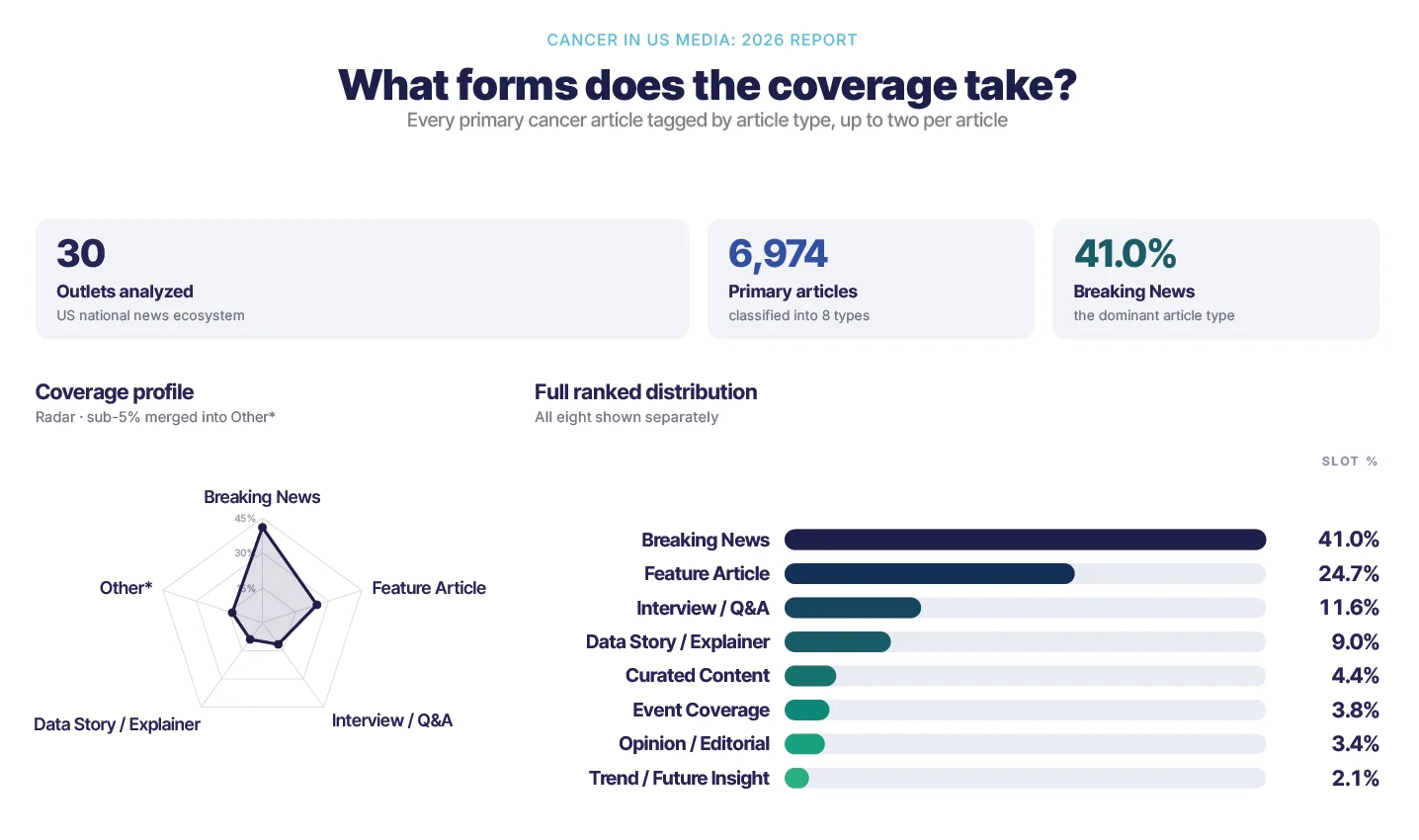
The corpus focuses on speed and narrative: Breaking News (41.0%) and Feature Article (24.7%) together claim nearly two-thirds of all type tags.Interview/Q&A (11.6%) and Data Story/Explainer (9.0%) form the analytical middle. Everything else is peripheral. Curated Content (4.4%, mostly Politico’s newsletter franchises), Event Coverage (3.8%, ASCO/conference reporting concentrated in CBS, Axios, CNBC), Opinion/Editorial (3.4%), and Trend/Future Insight (2.1%).
Editorial Categories
Which editorial frames dominate?
Coverage is overwhelmingly human-interest: Patient Stories alone takes 38.1% of all tags – more than the next two categories combined – driven by celebrity-diagnosis cycles and highvolume
outlets (People, CBS, USA Today, NY Post). Data & Analysis (18.7%) and Health Policy (16.5%) form a strong second tier, the latter inflated by Politico, Bloomberg, and the federal-funding story. Health Tech (13.0%) and Business (8.5%) trail. Health Disparities, Healthcare Workforce, and Strategic Outlook together barely account for 5%.
Cancer Types
Which cancers get named
Coverage tracks celebrity diagnosis and screening news hooks rather than disease burden. Breast leads everywhere at 20.0% – the single most-named cancer. Colorectal (12.1%) and Prostate (11.4%) are also prominent, with colorectal mostly tied to the early-onset-under-50 coverage, and prostate the Biden diagnosis coverage. Blood cancers (9.7%) and Skin/melanoma (8.3%) follow, the latter inflated by tabloid sun-risk service journalism. Interestingly, Lung takes just 7.3% of the coverage, despite being the deadliest US cancer – outlets cover it through never-smoker and vaping angles, rather than population mortality. The long tail (testicular, bladder, head & neck, liver, kidney, and rarer types) each sit below 2%, reflecting celebrity-driven attention rather than systematic coverage.
Therapies
Which treatments get mentioned?
Coverage leans on the two oldest, most recognizable treatments. Surgery (39.1%) and Chemotherapy (33.1%) together account for nearly three-quarters of all therapy mentions.The precision-medicine era is comparatively thin: Immunotherapy 13.2%, Radiation 10.5%, and Targeted therapy just 4.1%. Interestingly, the targeted and immune agents are where almost all current oncology innovation, FDA activity, and pharma deals actually sit, yet they’re the least-named in coverage.
The split also varies sharply by outlet type: business/science desks (CNBC, WSJ, Business Insider, Bloomberg) over-represent immunotherapy and targeted therapy, while consumer outlets (People, NY Post, USA Today) drive the surgery/chemo dominance.
Pharma / Biotech
Which drugmakers own the coverage?
The coverage is owned by a small global drug deck. Tier 1 (score ≥ 1.0) is Pfizer (1.34), Merck (1.17), Eli Lilly (1.14) – three companies taking ~36% of all top-15 mentions. Tier 2 (0.70–0.99) is J&J, AstraZeneca, and Bayer; Tier 3 (0.50–0.69) is Roche, Novartis, Novo Nordisk, BMS; Tier 4 GSK and Moderna; Tier 5 Sanofi, AbbVie, Gilead. Bayer ranks high almost entirely on Roundup/glyphosate litigation (non-Hodgkin lymphoma lawsuits), and Novo Nordisk on GLP-1 (Wegovy/Ozempic) crossover into cancer-prevention stories – not cancer drugs. The list also tracks where the mentions originate: Bloomberg, CNBC, WSJ, and Politico generate the overwhelming majority.
Cancer Centers
Which cancer centers get cited?
The field is extraordinarily top-heavy. Mayo Clinic (1.88) and Cleveland Clinic (1.76) run away with the coverage – together more than a third of the index – they both appear to run enormous comms efforts that service articles quote constantly (People alone cites Mayo 78× and Cleveland 68×). They anchor a four-center elite tier (≥1.0) with Memorial Sloan Kettering (1.35) and MD Anderson (1.00) that holds 6.0 of the 10.0 index. Below sits Dana-Farber alone in Tier 2, then the NYC academic centers NYU Langone and Mount Sinai (lifted heavily by NY Post), and a long tail of children’s and academic hospitals – CHOP, Northwestern, Fred Hutchinson, Penn, Johns Hopkins.
Universities
Which universities get cited?
There’s one runaway leader – Harvard (1.80), nearly double the #2. Below it sits a tight elite cluster (Columbia 0.92, Stanford 0.87, UCLA 0.85), then a broad, even spread: the UC system and Northwestern in Tier 3; the mix of Penn, Yale, Johns Hopkins, USC in Tier 4; and then Michigan, MIT, Duke, Pittsburgh, and Texas.
The top five hold more than half the index. The ranking maps where journalists source cancer science – name-brand institutions whose faculty and press offices dominate research coverage – with the California presence notably split across multiple campuses.
Journals
Which journals get cited?
Coverage leans on a tiny set of marquee titles. Science (2.24) and Nature (2.04) lead, with JAMA (1.56) the top clinical name and Cell (1.22) close behind; together with NEJM (0.92) and The Lancet (0.72), six journals hold nearly 90% of the index. General-science (Science, Nature, Cell = 5.5) outweighs the clinical-focus journals (JAMA + NEJM + Lancet = 3.2). Everything specialist – JCO, Cancer Cell, JAMA Oncology, Cancer Discovery, CA – sits in a long tail. Journalists reach for the highest-prestige, highest-impact names rather than the specialist oncology literature.
Celebrities
Who are the faces of cancer coverage?
Tier 1 – the defining stories. James Van Der Beek – the Dawson’s Creek actor’s Stage III colorectal-cancer disclosure and treatment updates made him the single most-covered figure. Catherine, Princess of Wales – her 2024 cancer announcement, chemotherapy, and 2025 remission update drove sustained royal coverage. King Charles III – diagnosed in early 2024, with ongoing treatment news through the window. Deion Sanders – the Colorado football coach revealed a bladder-cancer diagnosis and neobladder surgery while vowing to keep coaching.
Tier 2 – major coverage. Teddi Mellencamp – the reality-TV star’s Stage IV melanoma (spread to brain and lungs) generated continuous updates. Brandon Blackstock – talent manager and Kelly Clarkson’s ex-husband, who died of melanoma at 48. Prince Harry and Prince William – covered as the central figures of the royal family during Catherine’s and Charles’s illnesses (reconciliation angles, public duties).
Tier 3 – widely reported. Kelly Clarkson – tied to Blackstock’s death (and her father’s earlier cancer death). Alex Singleton – the Broncos linebacker diagnosed with testicular cancer via a random drug test, back on the field within weeks. Tatiana Schlossberg – JFK’s granddaughter, who wrote a widely-shared New Yorker essay about her terminal leukemia and died at 35. Olivia Munn – breast-cancer diagnosis, double mastectomy, and vocal advocacy for risk-assessment screening.
Tier 4 – frequently noted. Scott Adams – the Dilbert creator announced metastatic, terminal prostate cancer. Nikola Topić – the Thunder rookie diagnosed with testicular cancer. Jessie J – the British singer disclosed a breast-cancer diagnosis and surgery. Meghan Markle – covered adjacent to the royal-family cancer narrative.
Tier 5 – Barry Manilow – revealed an early-caught cancer found “by pure luck” on an MRI. Katie Thurston – the Bachelorette star documenting Stage 4 breast cancer. Sheinelle Jones – the Today host whose husband, Uche Ojeh, died of brain cancer (glioblastoma). Princess Charlotte – the young Wales daughter, present in royal-family coverage during her mother’s illness. Coverage is driven by two engines – personal-disclosure stories (a famous name revealing or living with a diagnosis) and the British royal family, whose 2024–26 cancer news pulled the whole Windsor circle into the corpus.
Politicians & Leaders
Which politicians & leaders shape the story?
Tier 1 – the central figures. Donald Trump – the single most-cited name in the whole set; cancer enters through his administration’s health agenda (RFK Jr.’s appointment, NIH/NCI funding cuts, FDA leadership) and his commentary on Biden’s diagnosis. Joe Biden – former president, whose May 2025 Stage IV prostate-cancer diagnosis was a defining story, layered on his Cancer Moonshot legacy. Robert F. Kennedy Jr. – HHS Secretary and the policy engine of the period: CDC/NIH restructuring, USPSTF and screeningguideline fights.
Tier 2 – major coverage. Kamala Harris – recurring background figure in health-policy stories. Marty Makary – FDA Commissioner, named on approvals and screening guidance. Elon Musk – the only business leader near the top, appearing chiefly through DOGE’s federal-science cuts hitting NIH and NCI.
Tier 3 – policy players. Gavin Newsom – California governor, prominent in state-level health coverage (and heavy LA Times citing). Jay Bhattacharya – NIH Director, tied to researchfunding decisions. Mehmet Oz – CMS Administrator, covered on Medicare/Medicaid coverage policy (plus his physiciancelebrity profile).
Tier 4 – also covered. Susie Wiles – White House Chief of Staff, surfacing in administration healthpolicy stories. Vinay Prasad – the FDA’s oncology/ biologics director, related to accelerated-approval and drug-evidence debates. JD Vance – Vice President, background political context.
Ten of twelve are government figures, and the administration’s health apparatus – Trump, RFK Jr., Makary, Bhattacharya, Oz, Prasad is making up most of the list.. Biden bridges both worlds as ex-president and patient. Actual business leaders don’t appear much.
AI In Oncology
What the Coverage Actually Shows
Over the past year, artificial intelligence has become increasingly part of cancer coverage in the news media. The coverage has ranged from cautious reports to hype, describing a technology that is beginning to change parts of oncology, while also making claims that outrun the evidence. Of the more than 12,000 articles we analyzed, only about 223 touched on AI in oncology.
The first thing the coverage reveals is that “AI in cancer” is not one thing. Diagnostic imaging, such as AI reading mammograms, colonoscopy footage, and CT scans are the closest to routine clinical use, and drew the most coverage. Molecular profiling and liquid biopsy, where machine learning parses blood or tissue for tumor signals, sits slightly behind in terms of coverage. Drug discovery, where companies like Isomorphic Labs and Recursion are applying protein-structure modeling to oncology pipelines, is still less covered. And workflow automation, such as AI tools that navigate prior authorizations, summarize charts, match patients to trials, is the newest and least-examined category.
The diagnostic area is where the strongest peer-reviewed evidence is. A randomized controlled trial out of Lund University, involving more than 100,000 women, showed AI-assisted mammography screening cut interval cancers by roughly 12 percent at a fraction of the labor cost. Clairity Breast, a deep-learning model trained on more than 421,000 mammograms, received FDA de novo authorization and began clinical deployment at Beth Israel Deaconess Medical Center in February 2026. SimBioSys’s TumorSight Viz, a 3D surgical planning tool, was used at Mercy Cedar Rapids to plan a lumpectomy.
But a study published in The Lancet Gastroenterology & Hepatology documented ‘deskilling’, where endoscopists who used AI polyp-detection tools for three months saw their unaided adenoma detection rate fall from 28.4 to 22.4 percent. When the AI was removed, they were measurably worse at the thing the AI had been helping them do.
Drug discovery attracted some of the most attention. In April 2026, Isomorphic Labs announced that AI-designed drugs were moving into human clinical trials. The Atlantic had already run a piece in April 2025 compiling what Hassabis, Sam Altman, and Dario Amodei had each said publicly about AI’s timeline for ending cancer. Working oncologists and researchers at Pfizer, Memorial Sloan Kettering, and the University of Chicago described decade-long timelines.
The coverage around generative AI in clinical settings, such as ChatGPT as a patient-facing tool, was also prominent. At least nine articles across Fox News, the New York Post, People, Newsweek, and NPR described a patient with dismissed or missed symptoms who consulted ChatGPT, which surfaced a serious condition. These pieces ran largely without statistical context on chatbot accuracy or false-positive rates. Separate reporting of a study from April 2026 found that AI medical chatbots gave problematic advice roughly half the time. NBC documented chatbots offering patients unsolicited alternatives to chemotherapy. The Wall Street Journal reported that radiology AI produced fabricated information in clinical reports, requiring human review that slowed rather than accelerated the workflow.
Several gaps in the coverage are as notable as what was covered. Tempus AI, Flatiron Health, and Foundation Medicine, which are three of the largest US oncology data and AI companies, were largely absent. Training-data composition, particularly the performance of AI tools on darker skin tones and non-Western patient populations, appeared in almost no coverage.
The coverage suggests AI technology at an interesting point, where some applications have cleared clinical validation and are deploying, and others are years from it, as the claims made about all of them exceed what the evidence supports.
Methodology
OncoDaily built a corpus drawn from thirty major U.S. news outlets, including general news outlets, business titles, broadcast-focused outlets, lifestyle publications, and long-form and investigative outlets, spanning twelve months from April 2025. The study deliberately excludes health-focused and trade publications to focus on how cancer reaches a non-specialist audience. English-language articles were gathered through each publication’s own search infrastructure and supplemented by Google search tools when these were unreliable.
Every article was then run through a single analytical framework, applied across the entire corpus. Each piece was filtered for true relevance to oncology, classified by editorial category, tone, cancer type, therapeutic focus, source, and analyzed for named entities, such as companies, drugs, institutions, trials and clinicians. It accounted for peculiarities in the use of the word “cancer”, including as a zodiac sign, or as a descriptor.
The analysis was conducted using Claude AI, drawing on Opus 4.7 and Opus 4.8 models, which has a capacity to process and classify thousands of articles consistently, making a study of this scale possible. The aggregated result of these analyses is a snapshot of how the news media covers one of the most important health stories of our time.
Oncology Relevance
Every article about cancer was classified into two tiers by how central cancer was as a focus. An article counts as primary when cancer is the spine of the piece – the diagnosis, treatment, trial, policy, or patient at the heart of the story – and secondary when cancer appears only in passing, surfacing inside a story really about funding cuts, AI, the environment, or an obituary.
Categories
Every primary cancer article in the corpus receives up to two ranked editorial-category tags drawn from a fixed eight-category framework.
- Health Policy – Laws, FDA approvals, govern-ment action, legislation
- Business – Pharma/biotech, M&A, deals, mar-kets, drug commercial launches
- Health Tech – Research, AI, innovation, trial science, new treatments
- Patient Stories – Individual narratives, advo-cacy, awareness, survivors
- Data & Analysis – Statistics, reports, rankings, epidemiology
- Health Disparities – Access, racial/socioeco-nomic gaps, system failures
- Healthcare Workforce – Conferences, events, workforce, training, profiles
- Strategic Outlook – Predictions, forecasts, future-of-care thinking
Article Types
Every primary cancer article receives up to two ranked article-type tags from a fixed eight-type framework.
- Breaking News – Time-sensitive hard news
- Interview / Q&A – Original interviews with named sources
- Feature Article – Longform, narrative journalism
- Data Story / Explainer – Data-driven, contextual, how/why
- Opinion / Editorial – Subjective viewpoint, op-ed, columnist
- Curated Content – Lists, rankings, roundups, newsletter roll-ups
- Event Coverage – Conference reporting (ASCO, etc.)
- Trend / Future Insight – “What’s next” pieces
Cancer Types Mentioned
Each article names every specific cancer type it substantively discusses (one article can name sev-eral), and the many outlet-specific sub-labels are normalized into 23 canonical types (e.g., leukemia + lymphoma + myeloma → Blood; melanoma + skin → Skin). Counts are summed across all 30 outlets and each type is shown as its share of the 8,372 specific-type mentions, so the named types sum to 100%.
Therapies Mentioned
The framework tracks five treatment modalities – Sur-gery, Radiation therapy, Chemotherapy, Targeted ther-apy, Immunotherapy – tagged on an article only when the treatment is meaningfully discussed (not a passing mention). Modalities are multi-tag: one article can name several. Counts are summed across all 30 outlets and each modality is shown as its share of the 5,077 total therapy mentions, so the five sum to 100%.
Tone Distribution
Each article is assigned exactly one dominant tone from a four-register framework – Clinical/Neutral (measured, evidence-driven), Human/Emotional Storytelling (nar-rative, character-led), Fear/Risk Framing (warning-driv-en), and Hype/Breakthrough (“miracle,” “game-chang-er”).
Politicians & Business Leaders
As the celebrities board the chart shows most-covered names in four tiers of three.
Geographic Focus
Each article is tagged by its primary geographic frame: US (national), State-specific (a local/state dateline or focus), International (a specific non-US country), or Global (worldwide/cross-border framing). All 30 outlets are shown as a share of the 11,868 geo tags, so the four sum to 100% – bars show percentag-es only.
Pharma / Biotech Companies, Hospitals & Cancer Centers, Universities & Research Institutions, Institutions (Research / Ad-vocacy / Regulatory), Journals
The index is based on the top 15 mentions, banded into 5 score tiers.
Celebrities & Famous Personalities
Mention counts were aggregated across all 30 out-lets only to rank the figures; the chart itself shows just the 20 most-covered names, grouped into five tiers of four. Royal name-variants were merged (Princess Kate / Catherine, Princess of Wales).
Special Topics Overview
Each of the four special-topic tags was counted across all 30 outlets and expressed as a share of the 6,974 primary cancer articles in the corpus. The percentage is the headline metric; the underlying article counts sit beneath each ring.
Disclaimer
This report was produced by OncoDaily using AI-assisted analysis (Claude, Opus 4.7/4.8) to classify and aggregate publicly available news articles from 30 major U.S. media outlets over a 12-month period (April 2025–April 2026). Classifications of editorial category, tone, cancer type, and other tags reflect an automated analytical framework and may not perfectly capture editorial intent or nuance in every article. Figures are based on the specific corpus collected and are not exhaustive of each outlet’s total output. This report is intended for media analysis and informational purposes only and does not constitute medical, legal, or investment advice. Mentions of specific companies, institutions, or individuals reflect their prominence in media coverage during the study period and are not endorsements or criticisms by OncoDaily.