
Gedatolisib continues to show substantial activity in PIK3CA-mutant HR-positive/HER2-negative advanced breast cancer, with updated phase III VIKTORIA-1 data demonstrating clinically meaningful progression-free survival benefits even in patients with visceral and liver metastases.
Presented at ESMO Congress 2026, the updated Study 2 analysis showed that gedatolisib plus palbociclib and fulvestrant maintained a strong advantage over alpelisib plus fulvestrant across clinically important high-risk subgroups.
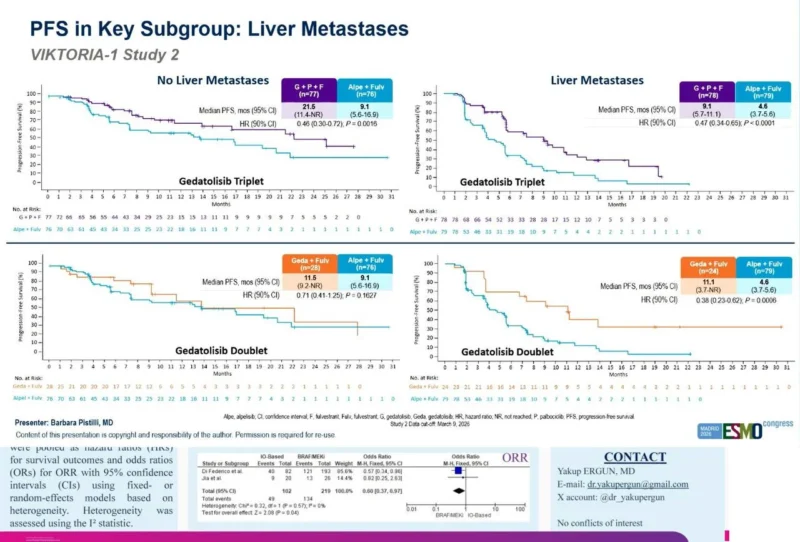
Among patients with liver metastases, median PFS was 9.1 months with the gedatolisib triplet versus 4.6 months with alpelisib plus fulvestrant, corresponding to an HR of 0.47. Among patients without liver metastases, median PFS reached 21.5 versus 9.1 months, with an HR of 0.46.
The gedatolisib doublet also demonstrated activity. In patients with liver metastases, median PFS was 11.1 months with gedatolisib plus fulvestrant versus 4.6 months with alpelisib plus fulvestrant, with an HR of 0.38. These updated subgroup findings strengthen the argument that broader PI3K/mTOR pathway blockade may remain effective even in biologically aggressive, endocrine-resistant disease.
VIKTORIA-1 Is Testing a Different Approach to the PI3K Pathway
PIK3CA mutations are among the most common actionable genomic alterations in HR-positive/HER2-negative breast cancer.
Targeting the PI3K pathway has already become an established strategy after endocrine resistance, but clinical use can be limited by toxicity, particularly hyperglycemia, as well as by incomplete suppression of signaling across the broader PI3K/AKT/mTOR pathway.
Gedatolisib takes a different approach. Rather than selectively inhibiting PI3Kα alone, gedatolisib inhibits all four class I PI3K isoforms—α, β, δ and γ—as well as both mTORC1 and mTORC2.
The strategy is intended to provide broader blockade of the PI3K/AKT/mTOR, or PAM, signaling network and potentially limit compensatory signaling that can emerge when only one component of the pathway is inhibited. VIKTORIA-1 was designed around that concept.
The phase III trial enrolled patients with HR-positive/HER2-negative advanced breast cancer who had progressed during or after previous CDK4/6 inhibitor plus nonsteroidal aromatase inhibitor therapy and separated patients into PIK3CA wild-type and PIK3CA-mutant studies.
The updated ESMO analysis focused on Study 2, the PIK3CA-mutant population.
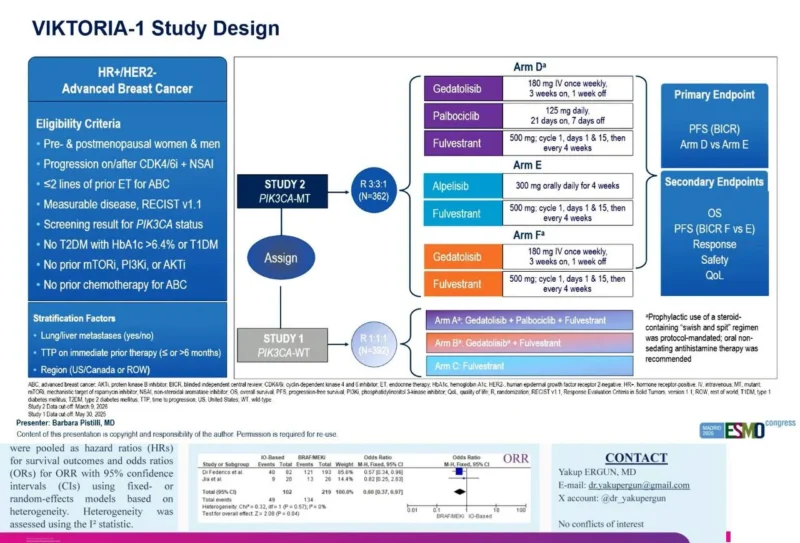
Study 2 Compared Gedatolisib Directly With Alpelisib
Patients in Study 2 were randomized 3:3:1 to three treatment strategies. The triplet combined gedatolisib, palbociclib and fulvestrant. The active control was alpelisib plus fulvestrant, while the third arm evaluated gedatolisib plus fulvestrant without continued CDK4/6 inhibition.
The enrolled population had already progressed after CDK4/6 inhibitor-based endocrine treatment and had received no previous chemotherapy for advanced breast cancer.
Patients also had not previously received a PI3K, AKT or mTOR inhibitor. The primary comparison was between the gedatolisib triplet and alpelisib plus fulvestrant.
Study 2 had already met its primary PFS endpoint. The ESMO 2026 presentation now provides greater detail about how the treatment performed in subgroups defined by visceral and liver metastatic involvement.
Liver Metastases Did Not Eliminate the Triplet Benefit
Liver involvement is particularly important in HR-positive metastatic breast cancer because it often reflects more aggressive disease and is associated with poorer outcomes than non-visceral or bone-predominant metastatic patterns.
The updated VIKTORIA-1 results show that the gedatolisib advantage persisted despite this adverse clinical feature.
Among patients with liver metastases, median PFS with the gedatolisib triplet was 9.1 months compared with 4.6 months with alpelisib plus fulvestrant.
The HR of 0.47 corresponds to an approximately 53% reduction in the hazard of progression or death.
The result is clinically meaningful because this is precisely the population in which endocrine-targeted combinations are often challenged by more aggressive disease biology and shorter treatment durability.
PFS Reached 21.5 Months Without Liver Metastases
The benefit was even more striking among patients without liver involvement. Median PFS reached 21.5 months with gedatolisib plus palbociclib and fulvestrant compared with 9.1 months with alpelisib plus fulvestrant.
The HR was 0.46. The more than 12-month difference in median PFS illustrates how strongly underlying disease distribution influences absolute treatment duration even when the relative treatment effect remains similar.
The key point is therefore not that gedatolisib works only in patients without liver metastases. Instead, the relative benefit was preserved in both groups, while patients without hepatic disease had substantially longer absolute disease control.
The Doublet Also Showed Activity in Liver Metastases
One of the more interesting findings from the ESMO update concerns the gedatolisib doublet. Among patients with liver metastases, gedatolisib plus fulvestrant produced median PFS of 11.1 months compared with 4.6 months with alpelisib plus fulvestrant.
The HR was 0.38, representing an approximately 62% reduction in the hazard of progression or death. This result is noteworthy because it suggests that the activity of gedatolisib is not entirely dependent on continuation of CDK4/6 inhibition.
Among patients without liver metastases, median PFS with the doublet was 11.5 months versus 9.1 months with alpelisib plus fulvestrant, with an HR of 0.71. That latter comparison was less definitive, while the liver-metastatic subgroup showed a much stronger numerical signal.
Because the doublet arm was smaller, subgroup estimates should be interpreted with more caution than the primary triplet comparison.
Visceral Disease Showed the Same Pattern
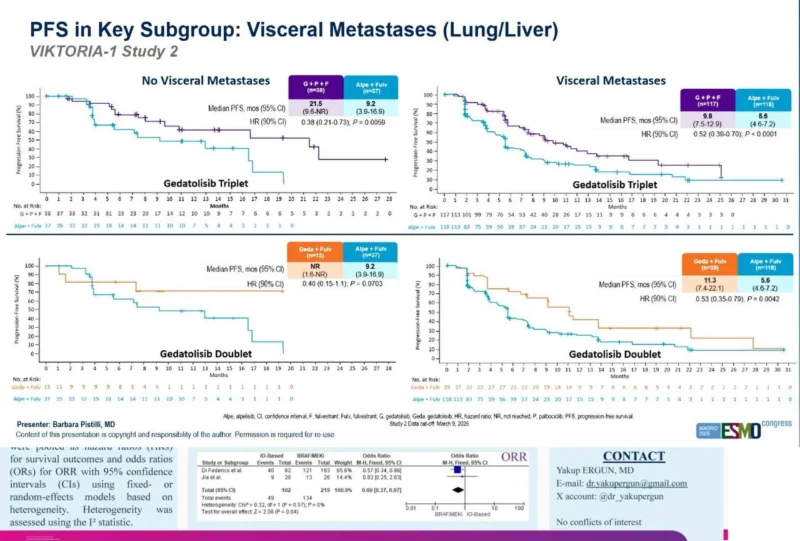
The analysis of visceral metastases produced broadly consistent findings. Among patients with lung and/or liver metastases, median PFS was 9.8 months with the gedatolisib triplet versus 5.6 months with alpelisib plus fulvestrant, corresponding to an HR of 0.52.
For the gedatolisib doublet, median PFS was 11.3 months versus 5.6 months, with an HR of 0.53. Among patients without visceral metastases, the triplet produced median PFS of 21.5 months compared with 9.2 months with alpelisib plus fulvestrant.
The consistency of the treatment effect across visceral and non-visceral disease strengthens the overall phase III result.
Responses Were Also More Durable With Gedatolisib
The updated ESMO presentation also provided response durability data.
Objective response rate was 59% with the gedatolisib triplet, 43% with the gedatolisib doublet and 33% with alpelisib plus fulvestrant. Median duration of response was particularly notable.
Responses lasted a median of 19.4 months with the triplet and 27.8 months with the doublet, compared with only 7.5 months with alpelisib plus fulvestrant.
The doublet duration-of-response estimate is based on fewer patients and has a wide confidence interval, so it should not be interpreted as evidence that the doublet is more effective than the triplet.
However, the overall pattern reinforces that gedatolisib-containing regimens can generate durable disease control.
Safety May Be an Important Differentiating Feature
Safety is central to the interpretation of any PI3K-pathway therapy. One of the most clinically relevant findings from VIKTORIA-1 is that gedatolisib did not appear to produce the same degree of metabolic toxicity that has complicated use of some PI3K-directed strategies.
The updated ESMO analysis reported no clinically meaningful impact on fasting or non-fasting glucose levels with gedatolisib-containing regimens. Stomatitis remained an important toxicity, particularly early in therapy.
Most events occurred during the first one to two weeks, but grade 3 stomatitis became uncommon after cycle 2, affecting fewer than 3% of patients beyond that point. Treatment withdrawal specifically because of gedatolisib occurred in approximately 5% with the triplet and 4% with the doublet.
By comparison, the company reported a 19% treatment discontinuation rate because of treatment-emergent adverse events with alpelisib in Study 2.
These differences may become clinically important if the PIK3CA-mutant indication enters routine practice.
Gedatolisib Is Already Approved, but Not Yet for PIK3CA-Mutant Disease
The regulatory context requires an important distinction. On July 14, 2026, the FDA approved gedatolisib, marketed as Revtorpyk, with fulvestrant with or without palbociclib for HR-positive/HER2-negative locally advanced or metastatic breast cancer without a detected PIK3CA mutation after progression on endocrine therapy.
That approval was based on Study 1 of VIKTORIA-1, the PIK3CA wild-type population. The updated ESMO data come from Study 2 and therefore address a different population.
Celcuity submitted a supplemental New Drug Application to the FDA on August 26, 2026 seeking to expand the indication to patients with PIK3CA-mutant disease. As of October 24, 2026, that indication remains under regulatory review rather than approved.
This distinction should remain explicit in publication.
Why the Alpelisib Comparison Matters
VIKTORIA-1 is particularly relevant because the comparator in the PIK3CA-mutant study is not placebo or endocrine monotherapy. It is an established PI3K-directed strategy: alpelisib plus fulvestrant.
The phase III result therefore asks whether broader PI3K/mTOR pathway inhibition can improve on a treatment already designed specifically for PIK3CA-mutant disease.
The answer from VIKTORIA-1 is increasingly favorable. The triplet reduced progression risk across the overall Study 2 population and maintained that benefit in patients with liver and other visceral metastases.
The doublet also demonstrated clinically meaningful activity, creating the possibility that gedatolisib could eventually provide both a CDK4/6-containing and CDK4/6-free strategy.
The Remaining Question Is How to Sequence It
The post-CDK4/6 treatment landscape is becoming crowded. PIK3CA-mutant disease may now be approached with PI3K- or AKT-directed therapy, next-generation endocrine agents, antibody-drug conjugates, and other biomarker-selected treatments depending on previous therapy and disease characteristics.
VIKTORIA-1 establishes strong comparative activity against alpelisib, but it does not answer how gedatolisib should be sequenced relative to every modern alternative.
The particularly durable responses and activity in liver metastases make the regimen compelling, but mature overall survival, longer safety follow-up and real-world tolerability will remain important.
OncoDaily Takeaway
The ESMO 2026 VIKTORIA-1 update strengthens the case for gedatolisib in PIK3CA-mutant HR+/HER2− advanced breast cancer.
The gedatolisib triplet maintained a substantial PFS advantage over alpelisib plus fulvestrant regardless of metastatic distribution. In patients with liver metastases, median PFS was 9.1 versus 4.6 months, with an HR of 0.47.
Without liver metastases, median PFS reached 21.5 versus 9.1 months, with an HR of 0.46. The gedatolisib doublet also showed notable activity, including median PFS of 11.1 versus 4.6 months in patients with liver metastases.
Response durability further favored gedatolisib-containing therapy, while metabolic toxicity appeared limited and treatment discontinuation remained relatively uncommon.
These findings are particularly relevant because gedatolisib is already FDA-approved for PIK3CA wild-type disease, and an application to expand that approval to PIK3CA-mutant disease is now under FDA review.
The emerging VIKTORIA-1 message is therefore broader than another positive subgroup analysis.
Gedatolisib may offer a way to achieve more comprehensive PI3K/mTOR pathway suppression while preserving activity even in clinically aggressive visceral disease, and potentially with a different tolerability profile from established PI3Kα-selective therapy.
Source
- Pistilli B, et al. VIKTORIA-1: Updated results of a randomized, open-label, phase III study of gedatolisib plus fulvestrant with or without palbociclib versus standard of care in patients with HR-positive/HER2-negative advanced breast cancer, Study 2. Presented at ESMO Congress 2026, October 24, 2026. Clinical trial identifier NCT05501886.