
The approval of vepdegestrant (ARV-471; Veppanu) marks more than the arrival of another endocrine therapy for ER-positive breast cancer. It represents the first successful regulatory translation of an entirely different drug-development concept: proteolysis-targeting chimeras, or PROTACs, designed not simply to inhibit a cancer-driving protein but to remove it from the cell.
A new commentary in Medicinal Chemistry Research examines how vepdegestrant became the first FDA-approved heterobifunctional oral PROTAC, highlighting both its clinical relevance in ESR1-mutated breast cancer and the medicinal chemistry lessons behind turning a large, structurally complex degrader into an orally administered drug (Yang & Hu, 2026).
For breast oncology, the immediate significance is clear. Vepdegestrant offers a new ER-directed strategy for patients with ER-positive/HER2-negative, ESR1-mutated advanced or metastatic breast cancer after progression on prior endocrine therapy. But the larger implication may be even more important: the approval provides clinical validation that targeted protein degradation can move from a compelling laboratory concept into routine oncology drug development.
From Blocking the Estrogen Receptor to Destroying It
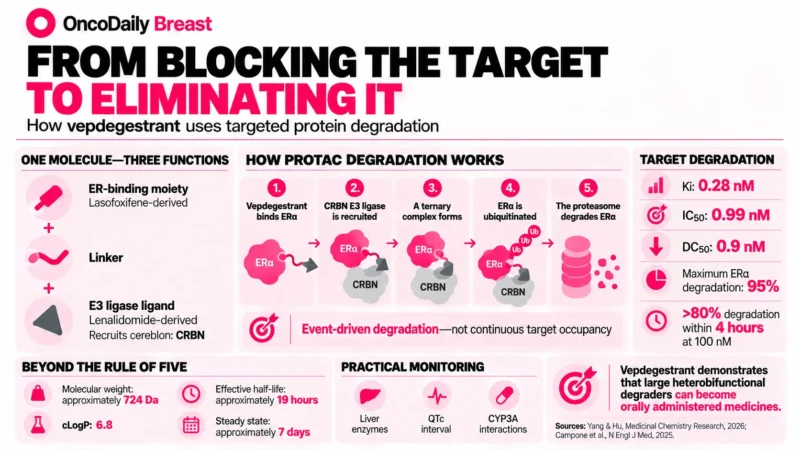
Most conventional targeted therapies depend on sustained binding to their target. PROTACs operate differently. Rather than occupying a protein continuously, a PROTAC brings the target protein into proximity with an E3 ubiquitin ligase. This promotes ubiquitination of the target, after which the cell’s proteasome recognizes and degrades it.
In principle, the degrader can then participate in another cycle. This makes PROTAC pharmacology event-driven rather than occupancy-driven. A productive interaction does not merely switch the target off temporarily; it can lead to physical removal of the protein from the cell (Yang & Hu, 2026). Vepdegestrant applies this concept to estrogen receptor alpha, ERα, one of the most established therapeutic targets in breast cancer.
Its molecular architecture combines three functional components: a lasofoxifene-derived ER-binding moiety, a linker, and a lenalidomide-derived ligand that recruits the cereblon E3 ubiquitin ligase, or CRBN. Formation of the ERα–vepdegestrant–CRBN complex enables ubiquitination and subsequent proteasomal degradation of ERα (Yang & Hu, 2026).
This distinction is central to understanding why vepdegestrant is not simply another oral endocrine agent. It is designed to make the estrogen receptor disappear.
Why ESR1-Mutated Disease Is the Critical Clinical Setting
Endocrine resistance remains one of the defining challenges of ER-positive/HER2-negative advanced breast cancer. Among the most clinically important mechanisms are acquired ESR1 mutations, particularly alterations such as Y537S and D538G in the estrogen receptor ligand-binding domain. These mutations can permit constitutive ER signaling and reduce sensitivity to conventional endocrine therapy.
That provides a strong biological rationale for ER degradation. Instead of trying only to prevent an altered receptor from signaling, a degrader can potentially eliminate the mutant receptor itself. Preclinical data summarized in the commentary support this concept. Vepdegestrant retained activity against clinically relevant Y537S- and D538G-mutant ERα models and achieved substantial receptor degradation together with antiproliferative activity.
The ability to maintain activity against ESR1-mutant forms ultimately became central to the clinical development strategy.
VERITAC-2 Provided the Clinical Validation
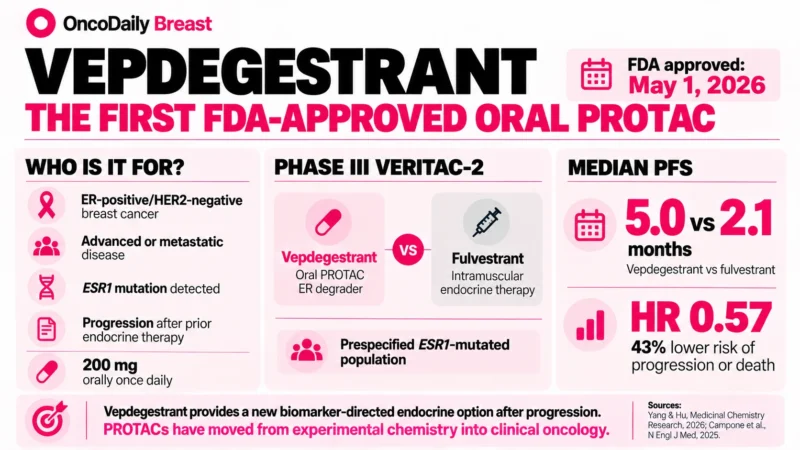
The pivotal phase III VERITAC-2 trial compared oral vepdegestrant with intramuscular fulvestrant in patients with ER-positive/HER2-negative advanced or metastatic breast cancer. In the prespecified ESR1-mutated population, median progression-free survival was:
- 5.0 months with vepdegestrant
versus
- 2.1 months with fulvestrant
with:
- HR 0.57
corresponding to a 43% reduction in the risk of disease progression or death (Campone et al., 2025). These results provided the clinical evidence supporting the therapeutic potential of PROTAC-mediated ER degradation.
Importantly, the effect was most compelling in the biomarker-defined ESR1-mutated population. The commentary notes that both vepdegestrant and the oral SERD elacestrant have demonstrated more limited activity in patients without detectable ESR1 mutations, emphasizing how difficult endocrine resistance remains outside this molecularly defined subgroup (Yang & Hu, 2026). s00044-026-03622-6
That observation matters clinically. The vepdegestrant story is therefore not simply about developing a more potent endocrine therapy. It is also another example of biomarker-defined endocrine treatment, in which ESR1 testing increasingly informs therapeutic selection after progression.
FDA Approval Established a New Drug Modality in Oncology
On May 1, 2026, the FDA approved vepdegestrant for adults with ER-positive/HER2-negative, ESR1-mutated advanced or metastatic breast cancer after disease progression on at least one prior line of endocrine therapy. The approved dose described in the commentary is 200 mg orally once daily. From the breast cancer perspective, this expands the endocrine treatment landscape.
From the drug-development perspective, however, the significance is broader: vepdegestrant became the first FDA-approved heterobifunctional PROTAC, providing regulatory validation for a modality that has been pursued for more than two decades.
The original PROTAC concept dates back to work published in 2001. Since then, a major challenge has been converting large bifunctional molecules into compounds with the pharmacokinetic properties required for oral human therapy. Vepdegestrant demonstrates that this barrier can be overcome.
A Large Molecule That Should Not Have Been an Easy Oral Drug
PROTACs often sit well outside the conventional physicochemical territory associated with orally available small molecules. Vepdegestrant has a molecular weight of approximately 724 Da and a calculated lipophilicity, cLogP, of 6.8, values that substantially exceed traditional Rule-of-Five expectations. Yet the compound achieves clinically useful oral exposure (Yang & Hu, 2026). This is one of the most interesting medicinal chemistry lessons from its development.
The commentary argues that conventional drug-likeness rules should not be treated as absolute exclusion criteria for PROTACs. Molecular conformation, linker rigidity, exposed versus internally engaged polarity, permeability, metabolic stability, and three-dimensional architecture may be more informative than simply applying traditional cutoffs.
In other words, successful oral degraders may require a different medicinal chemistry framework. The rigid nitrogen-containing heterocyclic linker in vepdegestrant appears to contribute to conformational organization and may help balance the molecular properties necessary for both productive degradation and oral exposure.
Target Binding Alone Is Not Enough
Vepdegestrant also illustrates why PROTAC development requires different optimization priorities from conventional inhibitors. The molecule binds ERα with subnanomolar affinity:
- Ki: 0.28 nM
- IC50: 0.99 nM
But binding potency alone does not determine degrader efficacy. In MCF7 cells, vepdegestrant produced:
- DC50: 0.9 nM
- Maximum ERα degradation: 95%
and more than 80% receptor degradation within 4 hours at 100 nM (Yang & Hu, 2026). For PROTACs, medicinal chemistry must therefore optimize not only target affinity but also ternary-complex formation, ubiquitination efficiency, degree of target degradation, cellular activity, and pharmacokinetic exposure.
This is why the vepdegestrant story is relevant well beyond breast oncology. It provides one of the first real-world templates for designing clinically successful targeted degraders.
Oral Exposure Translated Into Tumor ER Degradation
The preclinical pharmacodynamic data also demonstrated that oral administration could achieve substantial ER degradation inside tumors. In MCF7 tumor-bearing mice, oral vepdegestrant reduced tumor ER levels by at least 90%. Across orthotopic xenograft models, tumor growth inhibition ranged from 87% to 123%, compared with 31% to 80% with fulvestrant. Activity was also observed in ESR1 Y537S-mutant and palbociclib-resistant models.
The compound also showed enhanced activity in combination with CDK4/6, PI3K, and mTOR pathway inhibitors in preclinical models. These findings create a strong biological rationale for continuing to explore PROTAC-based ER degradation as part of combination strategies rather than viewing vepdegestrant solely as endocrine monotherapy.
The Safety Profile Is Manageable, but Not Without Distinct Considerations
In VERITAC-2, grade 3 or higher adverse events occurred in:
- 23.4% with vepdegestrant
versus
- 17.6% with fulvestrant.
Treatment discontinuation because of adverse events remained uncommon:
- 2.9% versus 0.7%, respectively (Campone et al., 2025).
Reported toxicities included fatigue, liver enzyme elevations, nausea, and musculoskeletal pain. One safety signal deserving attention is QTc prolongation. Any-grade QTc prolongation occurred in 9.9% of patients receiving vepdegestrant compared with 1.3% receiving fulvestrant, while grade 3 events occurred in 1.6% versus 0.7% (Campone et al., 2025).
The commentary also contrasts the tolerability profile with elacestrant, noting lower reported gastrointestinal toxicity with vepdegestrant across their respective trials. However, such comparisons should be interpreted cautiously because the agents were evaluated in separate studies rather than in a direct randomized comparison.
The clinically relevant message is therefore not that one oral ER-directed agent is inherently better tolerated, but that their toxicity profiles differ, which may ultimately influence treatment selection alongside efficacy, patient comorbidities, prior therapy, and biomarker status.
Drug-Drug Interactions Will Matter in Routine Practice
Because vepdegestrant is intended for chronic oral treatment, its metabolic profile is also clinically relevant. At 200 mg once daily, steady-state exposure was achieved after approximately seven days, with an effective elimination half-life of approximately 19 hours.
Strong CYP3A inhibition with itraconazole increased vepdegestrant exposure, while the strong CYP3A inducer carbamazepine reduced exposure. Vepdegestrant itself also produced weak inhibition of CYP3A-mediated metabolism. These pharmacokinetic considerations will become increasingly important as degraders are combined with targeted therapies and other oral agents.
Vepdegestrant Versus the Oral SERD Era
The arrival of vepdegestrant comes during a broader transformation in ER-directed treatment. Elacestrant previously established that an oral endocrine therapy could improve outcomes in ESR1-mutated ER-positive/HER2-negative metastatic breast cancer. Vepdegestrant now validates a different approach.
Both strategies seek to suppress ER signaling, but their mechanisms are not identical. An oral SERD works through receptor antagonism and degradation within the pharmacology of a conventional endocrine agent. A PROTAC instead recruits the cell’s ubiquitin-proteasome machinery and uses an external degradation mechanism to eliminate the target protein.
The distinction may become increasingly important as the field develops more potent degraders, different E3 ligase recruiters, combination regimens, and strategies aimed at overcoming specific resistance mechanisms.
Why This Approval Matters Beyond Breast Cancer
The most important long-term consequence of vepdegestrant may extend well beyond estrogen receptor biology. Targeted protein degradation potentially creates therapeutic opportunities for proteins that have historically been difficult to inhibit using conventional small molecules.
The vepdegestrant experience demonstrates that a heterobifunctional degrader can achieve:
- oral exposure
- clinically relevant pharmacokinetics
- efficient target degradation
- antitumor activity
- randomized phase III efficacy
- ultimately regulatory approval
The next generation of degraders will still face substantial challenges, including resistance, tumor selectivity, tissue distribution, identification of additional E3 ligases, and better prediction of pharmacokinetic–pharmacodynamic relationships (Yang & Hu, 2026). But one major uncertainty has now been resolved. PROTACs can become medicines.
The Bottom Line
Vepdegestrant represents two developments simultaneously. For patients with ER-positive/HER2-negative, ESR1-mutated advanced or metastatic breast cancer, it provides a new oral ER-directed treatment after endocrine progression. For drug development, it represents the first FDA-approved heterobifunctional PROTAC and the first major regulatory proof that targeted protein degradation can move from experimental chemistry into clinical oncology.
In VERITAC-2:
- Median PFS: 5.0 vs 2.1 months
- HR 0.57
43% reduction in progression or death in the ESR1-mutated population (Campone et al., 2025). But perhaps the most important part of the story is mechanistic. For decades, targeted therapy has largely been built around the idea of blocking cancer-driving proteins. Vepdegestrant demonstrates that the next era may increasingly involve something different: not just inhibiting the target, but eliminating it.
References
- Yang, J., & Hu, L. (2026). Vepdegestrant: The first FDA-approved oral PROTAC and a milestone in targeted protein degradation. Medicinal Chemistry Research. https://doi.org/10.1007/s00044-026-03622-6. s00044-026-03622-6
- Campone, M., De Laurentiis, M., Jhaveri, K., Hu, X., Ladoire, S., Patsouris, A., Zamagni, C., Cui, J., Cazzaniga, M., Cil, T., Jerzak, K. J., Fuentes, C., Yoshinami, T., Rodriguez-Lescure, A., Sezer, A., Fontana, A., Guarneri, V., Molckovsky, A., Mouret-Reynier, M.-A., Demirci, U., et al. (2025). Vepdegestrant, a PROTAC estrogen receptor degrader, in advanced breast cancer. The New England Journal of Medicine, 393(6), 556–568. https://doi.org/10.1056/NEJMoa2505725