
As trastuzumab deruxtecan moves earlier in the treatment of HER2-positive metastatic breast cancer, one of the most practical questions is becoming increasingly difficult: what should come next after progression on T-DXd?
A French multicenter retrospective study provides clinically relevant evidence for one of the most established post-T-DXd options: tucatinib, trastuzumab, and capecitabine (TTC). The study evaluated 105 patients with HER2-positive metastatic breast cancer who received TTC immediately after T-DXd as second- or third-line therapy across 17 centers in France (Frenel et al., 2026).
The results do not reproduce the efficacy historically observed with TTC in T-DXd-naïve populations, but they demonstrate that the regimen retains clinically meaningful activity after prior exposure to a highly active HER2-directed ADC. This was particularly notable in patients with brain metastases and in those who had experienced prolonged disease control with T-DXd.
The Sequencing Problem Is Becoming More Important
T-DXd has fundamentally changed the treatment landscape in HER2-positive metastatic breast cancer. Its movement into earlier treatment lines means that an increasing proportion of patients will eventually need an effective post-T-DXd strategy. The original evidence supporting tucatinib, trastuzumab, and capecitabine came from patients who had not previously received T-DXd. Consequently, the efficacy of TTC after T-DXd could not simply be assumed from earlier trials.
Frenel et al. specifically addressed this evidence gap by examining patients treated in contemporary routine practice after prior T-DXd exposure (Frenel et al., 2026).
That distinction is important. Treatment sequencing studies increasingly need to evaluate drugs not only according to whether they work in isolation, but whether they retain meaningful activity after exposure to therapies with overlapping HER2-directed mechanisms.
A Contemporary Post-T-DXd Population
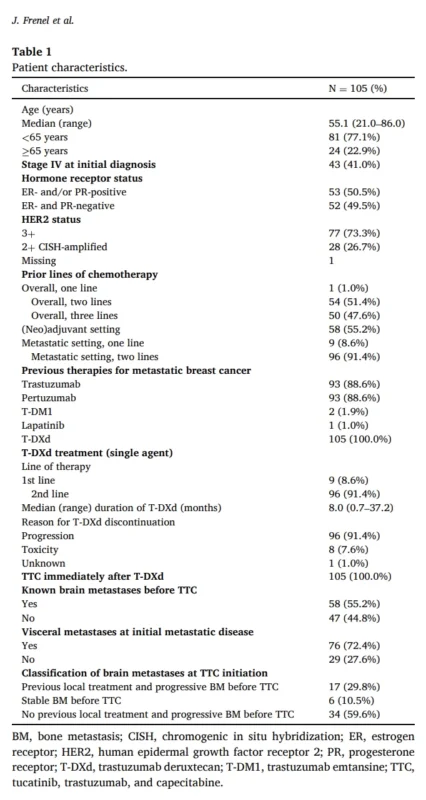
Between July 2021 and June 2025, 105 patients with HER2-positive metastatic breast cancer received TTC immediately after T-DXd. The median age was 55.1 years, and 41.0% had de novo metastatic disease. Approximately half of the tumors were hormone receptor-positive, while 73.3% were HER2 IHC 3+ and 26.7% were HER2 IHC 2+ with amplification (Frenel et al., 2026).
Importantly, 55.2% of patients had brain metastases before TTC, making the cohort particularly relevant to routine HER2-positive metastatic breast cancer practice.
Most patients had already received pertuzumab, and all had previously received T-DXd. In 91.4%, T-DXd had been given as second-line therapy and TTC consequently became third-line treatment. T-DXd had been discontinued because of disease progression in 91.4% of patients, with a median prior T-DXd duration of eight months.
This makes the study particularly relevant to the emerging sequence of:
- first-line HER2-directed therapy → T-DXd → tucatinib-based therapy.
TTC Retained Activity After T-DXd
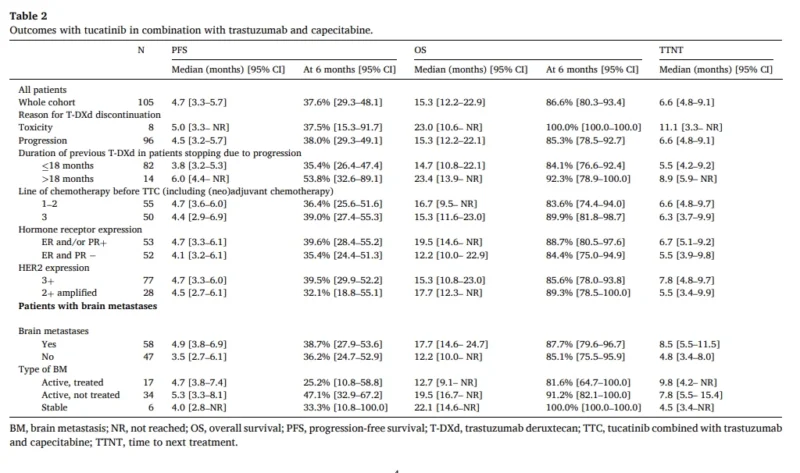
After a median follow-up of 19.5 months, median progression-free survival with TTC was:
- 4.7 months
Median time to next treatment was:
- 6.6 months
and median overall survival was:
- 15.3 months
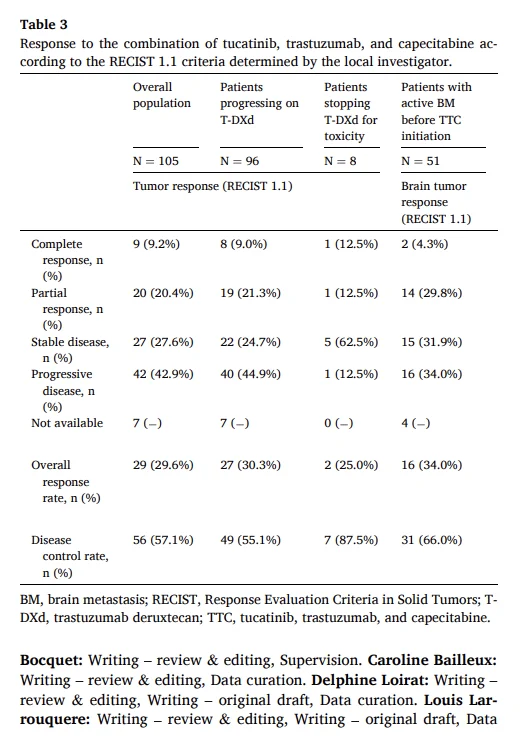
Among 98 patients evaluable by RECIST, the objective response rate was 29.6%.
This included:
- 9.2% complete responses
and
- 20.4% partial responses
An additional 27.6% achieved stable disease, producing a disease control rate of 57.1%. These results demonstrate that HER2-directed treatment with tucatinib remains active even immediately after disease progression on T-DXd. The magnitude of benefit is clearly lower than that historically observed with TTC before widespread use of T-DXd, but that comparison must be interpreted carefully because the current population had already progressed through a highly active HER2-targeted ADC.
Duration of Prior T-DXd Benefit May Matter
One of the most interesting findings was the relationship between prior T-DXd treatment duration and subsequent TTC outcomes.
Among patients who stopped T-DXd because of progression, those who had remained on T-DXd for more than 18 months had a median PFS of:
- 6.0 months
compared with:
- 3.8 months among patients whose prior T-DXd duration was 18 months or less.
Median time to next treatment was similarly longer:
- 8.9 months versus 5.5 months
The same subgroup had a median overall survival of 23.4 months, compared with 14.7 months among those with shorter prior T-DXd exposure. This finding is exploratory and should not be interpreted as a validated predictive biomarker. However, it raises a biologically interesting possibility: patients whose tumors remain sensitive to HER2-directed treatment for a prolonged period may retain greater dependence on HER2 signaling and therefore remain more responsive to another HER2-directed strategy after T-DXd.
In contrast, rapid progression on T-DXd may identify tumors with more aggressive biology or resistance mechanisms that also limit subsequent HER2-directed therapy.
Brain Metastases Did Not Eliminate Benefit
The CNS findings may be among the most clinically relevant aspects of the study. More than half of the cohort had brain metastases before starting TTC, yet median PFS among these patients was:
- 4.9 months
- compared with 3.5 months among patients without brain metastases.
Median time to next treatment was:
- 8.5 months versus 4.8 months, respectively
Median OS among patients with brain metastases was 17.7 months, compared with 12.2 months among those without brain metastases. These numbers should not be interpreted as evidence that brain metastases confer better prognosis; the groups were not randomized and likely differed in multiple clinical characteristics. The clinically important point is that the presence of CNS disease did not abolish the activity of TTC.
Among patients with active brain metastases evaluable for intracranial response, brain response rate was 34.0%, with a disease control rate of 66.0%. This finding is consistent with the established CNS penetration and intracranial activity of tucatinib-based therapy and supports its continued relevance in patients whose disease involves the brain.
Activity Was Seen Even in Untreated Active Brain Metastases
The study provides additional detail according to the status of CNS disease. Among patients with active, untreated brain metastases, median PFS was 5.3 months, median OS was 19.5 months, and median time to next treatment was 7.8 months. Among those with previously treated but progressing brain metastases, median PFS was 4.7 months and median time to next treatment was 9.8 months. These subgroup numbers are relatively small and must be interpreted cautiously.
Nevertheless, they provide useful real-world evidence in a population that remains one of the most clinically challenging in HER2-positive metastatic breast cancer.
The Results Are Less Impressive Than Historical HER2CLIMB Outcomes
Frenel and colleagues explicitly acknowledge that the outcomes observed after T-DXd were inferior to those reported historically in HER2CLIMB. That difference is unsurprising. Patients in HER2CLIMB had not previously received T-DXd, whereas the current cohort had already progressed through one of the most effective HER2-directed therapies available.
This highlights a fundamental problem in modern oncology: the efficacy of a treatment depends increasingly on what came before it. A drug may remain biologically active yet produce shorter disease control when used after another potent therapy because the surviving tumor population has already undergone treatment-driven selection. Cross-trial comparisons between pre-T-DXd and post-T-DXd populations should therefore be avoided.
Real-World Data From Other Cohorts Point in the Same Direction
The French results are broadly consistent with other retrospective experiences. The authors cite a US real-world cohort in which TTC immediately after T-DXd produced a median time to next treatment of 8.8 months and median OS of 17.3 months.
They also discuss a Flatiron database analysis in which 419 patients with HER2-positive metastatic breast cancer received subsequent therapy after T-DXd. Among patients receiving TTC, real-world PFS was approximately 4.7 months, closely matching the present French study.
The consistency across datasets is notable, even though retrospective studies cannot establish the optimal sequence. T-DM1 also demonstrated similar real-world PFS in the Flatiron analysis, leaving an important unresolved question about how clinicians should choose among available post-T-DXd HER2-directed options.
What Happens After Both T-DXd and TTC Remains a Major Problem
The study also provides a sobering view of the next treatment line. After progression on TTC, 78 patients received additional systemic therapy. Median PFS with subsequent treatment was only:
- 2.7 months
This reinforces the rapidly increasing unmet need for effective therapies after exposure to both T-DXd and tucatinib. The authors also highlight the phase II SATEEN trial, in which sacituzumab govitecan plus trastuzumab showed limited activity after prior T-DXd in heavily pretreated HER2-positive disease, with an ORR of 3.7%, median PFS of 2.3 months, and median OS of 9.2 months.
Although that study was small and involved a much more heavily pretreated population, it raises an important concern regarding sequential ADC therapy with related topoisomerase I payload biology.
Post-ADC Sequencing Is Becoming a New Therapeutic Discipline
The broader significance of this study extends beyond tucatinib. As T-DXd moves earlier, metastatic HER2-positive breast cancer is entering an era in which most patients will eventually be post-ADC.
Resistance may involve multiple mechanisms: reduced HER2 expression, altered internalization, changes in lysosomal trafficking, payload resistance, drug efflux, clonal evolution, or alternative signaling pathways. A small-molecule HER2 TKI such as tucatinib may retain activity partly because its mechanism differs substantially from that of an ADC.
The study therefore supports an increasingly important sequencing principle: changing therapeutic modality after ADC progression may be more meaningful than simply changing one ADC for another with a similar payload mechanism. That hypothesis still requires prospective validation.
Important Limitations
The authors appropriately emphasize several limitations. This was a retrospective study, without randomization or a contemporary comparator arm. HER2 status was assessed locally and was not systematically reassessed immediately before TTC, despite the possibility that HER2 expression or amplification may evolve during treatment.
The investigators also did not collect data from patients who received alternative therapies after T-DXd, creating the possibility of treatment-selection bias. Patients receiving TTC may have been selected according to physician preference, CNS involvement, performance status, previous toxicity, or perceived HER2 dependence.
Furthermore, the relatively short prior T-DXd exposure in some patients may reflect aggressive tumor biology and could partly explain the shorter outcomes compared with historical TTC trials. These limitations mean the study cannot establish TTC as superior to other post-T-DXd options. What it does establish is that TTC remains clinically active in this setting.
The Bottom Line
The French multicenter study by Frenel et al. provides important real-world evidence for a treatment sequence that is becoming increasingly common: T-DXd followed by tucatinib, trastuzumab, and capecitabine. Among 105 patients with HER2-positive metastatic breast cancer treated with TTC immediately after T-DXd:
- Median PFS: 4.7 months
- Median TTNT: 6.6 months
- Median OS: 15.3 months
- ORR: 29.6%
- Complete response: 9.2%
Patients with prolonged prior T-DXd benefit appeared to experience better outcomes with TTC, while patients with brain metastases, including active CNS disease, continued to derive clinically meaningful benefit. The results should not be interpreted as defining the optimal post-T-DXd sequence. The retrospective design and absence of a comparator prevent that conclusion.
But they do provide an important practical message: progression on T-DXd does not eliminate the value of continued HER2 targeting, and tucatinib-based therapy remains a relevant post-ADC option, particularly when CNS disease is part of the clinical picture.
As T-DXd moves earlier in HER2-positive metastatic breast cancer, prospective sequencing studies will be increasingly necessary to determine not simply which treatments are active, but which mechanism should follow which, and in which patient.
Reference
- Frenel, J.-S., de Nonneville, A., Guerin-Charbonnel, C., Zeghondy, J., Mathiot, L., Mailliez, A., Poumeaud, F., Isambert, N., Arnedos, M., Le Du, F., Galland, L., Kabirian, R., Guiu, S., Poestch, L., Deluche, E., Cherifi, F., Dalenc, F., Volant, E., Pistilli, B., San, T., et al. (2026). Tucatinib, trastuzumab, and capecitabine as second- or third-line therapy after trastuzumab deruxtecan in HER2-positive metastatic breast cancer: A multicenter retrospective study in France. The Breast, 90, 104939. https://doi.org/10.1016/j.breast.2026.104939.