
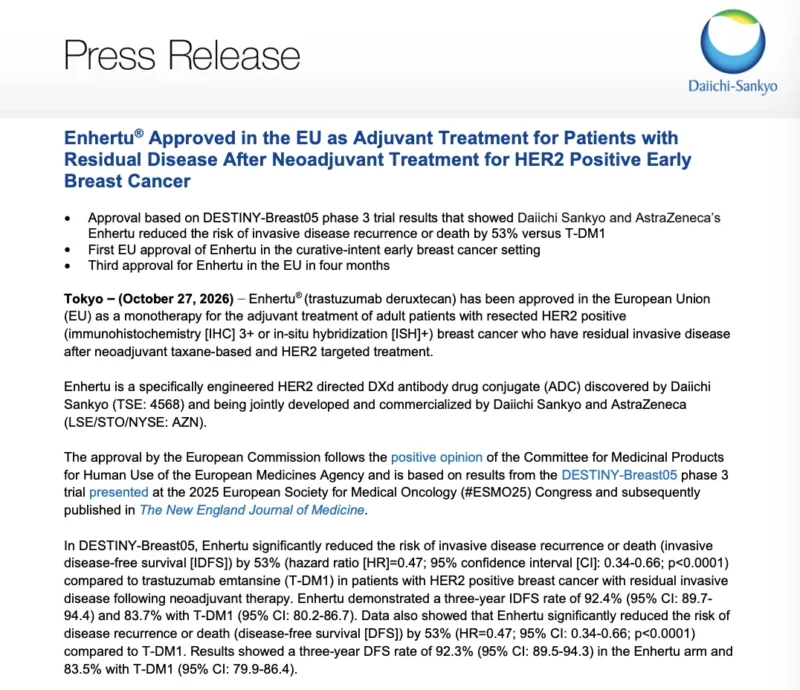
The European Commission has approved trastuzumab deruxtecan (Enhertu; T-DXd) as adjuvant monotherapy for adults with HER2-positive early breast cancer who have residual invasive disease following neoadjuvant taxane-based chemotherapy and HER2-targeted treatment. Announced on October 27, 2026, the decision represents the first European Union approval of Enhertu in the curative-intent early breast cancer setting and introduces a new post-neoadjuvant treatment option supported by the phase III DESTINY-Breast05 trial.
The approval follows a positive opinion from the European Medicines Agency’s Committee for Medicinal Products for Human Use (CHMP) on September 17, 2026, and is based on randomized evidence demonstrating that T-DXd substantially improves invasive disease-free survival compared with trastuzumab emtansine (T-DM1).
In DESTINY-Breast05, three-year invasive disease-free survival (IDFS) reached 92.4% with Trastuzumab Deruxtecan compared with 83.7% with T-DM1, corresponding to a hazard ratio (HR) of 0.47 (95% CI 0.34–0.66; p<0.0001).
These results translate into a 53% relative reduction in the hazard of invasive disease recurrence or death, with an absolute improvement of 8.7 percentage points in estimated three-year IDFS.
The findings represent a significant advance in post-neoadjuvant treatment, particularly for patients whose residual disease indicates an elevated risk of recurrence despite contemporary HER2-targeted therapy.
However, the benefit must be considered alongside the known toxicity profile of T-DXd, particularly interstitial lung disease (ILD) and pneumonitis, which occurred more frequently than with T-DM1.
The Clinical Significance of the European Approval
HER2-positive breast cancer accounts for approximately one-fifth of breast cancer diagnoses and is characterized by increased HER2 signaling, which historically has been associated with aggressive clinical behavior.
Over the past two decades, HER2-directed therapy has transformed outcomes through the introduction of trastuzumab, pertuzumab, T-DM1, and newer antibody-drug conjugates. In early-stage disease, neoadjuvant chemotherapy combined with HER2-targeted therapy is commonly used to reduce tumor burden and provide an assessment of treatment sensitivity before surgery.
Achieving a pathological complete response (pCR), defined by the absence of residual invasive carcinoma in the breast and sampled regional lymph nodes, is associated with more favorable long-term outcomes.
However, a substantial proportion of patients do not achieve pCR and remain at increased risk of recurrence. The identification of residual invasive disease creates an opportunity to individualize postoperative treatment according to the biological response observed during neoadjuvant therapy.
Historically, T-DM1 became the established post-neoadjuvant treatment option following the KATHERINE trial, which demonstrated that switching from trastuzumab-based treatment to T-DM1 substantially reduced recurrence risk.
Nevertheless, some patients continued to experience distant or locoregional recurrence despite receiving T-DM1. DESTINY-Breast05 was designed to address this remaining clinical need by evaluating whether the more potent HER2-directed ADC Trastuzumab Deruxtecan could further improve outcomes.
The new EU authorization allows eligible patients to receive T-DXd after surgery when residual invasive disease persists following neoadjuvant taxane-based and HER2-targeted treatment.
Eligibility requires HER2-positive disease, defined as immunohistochemistry (IHC) 3+ or positive in situ hybridization (ISH). The indication does not apply to HER2-low disease solely on the basis of low-level protein expression.
DESTINY-Breast05: Study Design and Patient Population
DESTINY-Breast05 (NCT04622319) was a global, multicenter, randomized, open-label phase III study comparing adjuvant Trastuzumab Deruxtecan with T-DM1 in patients with HER2-positive early breast cancer at high risk of recurrence.
A total of 1,635 patients were randomly assigned in a 1:1 ratio to receive T-DXd (n=818) or T-DM1 (n=817). All participants had residual invasive disease in the breast and/or axillary lymph nodes following neoadjuvant treatment.
Importantly, the trial focused on a particularly high-risk population. Eligibility required either disease considered inoperable at initial presentation or pathologically positive axillary lymph nodes following neoadjuvant treatment.
This distinction is clinically relevant because the European authorization encompasses patients meeting the approved residual-disease criteria, while the pivotal randomized trial specifically investigated patients with additional high-risk characteristics.
T-DXd was administered at 5.4 mg/kg intravenously every three weeks, while T-DM1 was administered at 3.6 mg/kg every three weeks. Treatment was planned for a maximum of 14 cycles unless recurrence or unacceptable toxicity occurred.
The primary endpoint was investigator-assessed IDFS, capturing invasive breast cancer recurrence or death. The key secondary endpoint was disease-free survival (DFS), with additional outcomes including overall survival (OS), distant recurrence-free interval, brain metastasis-free interval, and safety.
At the prespecified interim analysis, median follow-up was approximately 30 months in each treatment group.
Primary Efficacy: A 53% Reduction in the Hazard of Invasive Recurrence or Death
The primary analysis demonstrated a statistically significant improvement in IDFS with T-DXd compared with T-DM1. Invasive disease events or deaths occurred in 51 patients (6.2%) receiving T-DXd versus 102 patients (12.5%) receiving T-DM1.
The corresponding HR was 0.47 (95% CI 0.34–0.66; p<0.0001). At three years, estimated IDFS was 92.4% with T-DXd and 83.7% with T-DM1. The difference represents a substantial improvement against an active standard-of-care comparator, rather than against chemotherapy alone or a less effective historical treatment.
This is important because T-DM1 had already significantly improved outcomes in patients with residual HER2-positive disease following neoadjuvant treatment.
The magnitude of benefit observed in DESTINY-Breast05 therefore suggests that further therapeutic gains are possible through post-neoadjuvant ADC escalation. The findings also reinforce the importance of pathological response assessment after neoadjuvant treatment.
Residual invasive disease is not simply a prognostic indicator. It identifies a population in whom changing systemic therapy can meaningfully improve disease control.
However, the reported HR should be interpreted correctly. A 53% reduction in the hazard of an IDFS event does not mean that mortality was reduced by 53%, and it does not establish a definitive improvement in cure rates.
Disease-Free Survival and Distant Recurrence
The key secondary endpoint of DFS also favored Trastuzumab Deruxtecan. At three years, DFS was 92.3% with T-DXd versus 83.5% with T-DM1, corresponding to an HR of 0.47 (95% CI 0.34–0.66; p<0.0001).
DFS events occurred in 52 patients (6.4%) receiving T-DXd and 103 patients (12.6%) receiving T-DM1. The consistency between IDFS and DFS supports the robustness of the efficacy findings.
Additional analyses reported favorable effects on distant recurrence-free interval and brain metastasis-free interval, suggesting that improved systemic disease control may extend to clinically important recurrence patterns.
These outcomes are particularly relevant in HER2-positive breast cancer, where distant recurrence and CNS metastases remain important concerns. However, secondary endpoint findings should not be interpreted as proof that T-DXd eliminates the risk of distant or brain metastases.
Longer follow-up will be necessary to establish the durability of these benefits and their eventual relationship to overall survival.
Overall Survival Remains Immature
Despite the substantial reduction in recurrence-related events, mature overall survival data were not available at the interim analysis. A total of 47 deaths had occurred across both study groups, representing approximately 2.9% of the randomized population.
The preliminary OS HR favored T-DXd numerically but was not statistically conclusive. Accordingly, the European approval is supported principally by the established improvement in IDFS, with DFS providing additional evidence of clinical benefit.
This distinction is especially important in the curative-intent setting, where patients may live for many years following treatment. Long-term follow-up will be required to determine whether the early reduction in invasive recurrence translates into a meaningful overall survival advantage.
It will also be important to assess the durability of disease control, late toxicity, and the impact of prior adjuvant T-DXd exposure on treatment options for patients who subsequently develop metastatic disease.
Safety: ILD Remains the Most Important Clinical Concern
The safety profile of T-DXd in DESTINY-Breast05 was generally consistent with previous experience, but the transition into earlier-stage disease increases the importance of careful toxicity assessment. Unlike patients with advanced cancer, many individuals receiving adjuvant treatment may already have a favorable long-term prognosis.
Consequently, even relatively uncommon severe toxicities require particular consideration when the therapeutic objective is cure. In the trial, grade 3 or higher treatment-emergent adverse events occurred in approximately 50.6% of patients receiving T-DXd compared with 51.9% receiving T-DM1.
The overall frequency of severe events was therefore similar, although the nature of toxicity differed. T-DXd was associated predominantly with gastrointestinal and hematologic adverse events, including nausea, vomiting, constipation, and neutropenia.
T-DM1 was more commonly associated with thrombocytopenia and elevations in liver enzymes. The principal concern with T-DXd was drug-related ILD or pneumonitis.
Adjudicated drug-related ILD occurred in 9.6% of patients receiving T-DXd compared with 1.6% receiving T-DM1. Most T-DXd-associated events were grade 1 or 2. However, grade 3 ILD occurred in approximately 0.9%, and two fatal ILD events were reported in the T-DXd group.
These findings highlight the importance of baseline pulmonary assessment, patient education, prompt investigation of respiratory symptoms, and adherence to dose-interruption or discontinuation recommendations. Permanent treatment discontinuation due to adverse events was also more frequent with T-DXd, occurring in approximately 18% of patients compared with 12.9% receiving T-DM1.
Nevertheless, more than 70% of patients in both treatment groups completed the planned 14 cycles. The trial therefore demonstrates substantial efficacy while reinforcing that post-neoadjuvant treatment escalation must incorporate careful risk-benefit assessment.
Radiotherapy and Pulmonary Toxicity: An Important Practical Consideration
Adjuvant radiotherapy is an essential component of treatment for many patients with high-risk HER2-positive early breast cancer. The use of Trastuzumab Deruxtecan in this setting raises a clinically relevant question because both thoracic radiation exposure and ADC-associated ILD may contribute to pulmonary toxicity.
An additional DESTINY-Breast05 safety analysis presented at ASCO 2026 evaluated pulmonary adverse events according to the timing of adjuvant radiotherapy. The analysis did not identify a notable difference in adjudicated drug-related ILD according to whether radiotherapy was delivered concurrently or sequentially with study treatment.
However, the absence of a major difference in this analysis does not eliminate the potential for pulmonary complications. Careful assessment remains appropriate, particularly in patients with pre-existing lung disease, prior pulmonary toxicity, or other relevant risk factors.
The management of suspected ILD is particularly important because delayed recognition may increase the risk of severe outcomes. In routine clinical practice, radiotherapy planning and T-DXd monitoring should therefore be coordinated between medical and radiation oncology teams.
What Changes in Post-Neoadjuvant Clinical Practice?
The European approval introduces Trastuzumab Deruxtecan as a newly authorized adjuvant option for patients with residual HER2-positive invasive breast cancer after neoadjuvant taxane-based and HER2-targeted therapy.
The clinical decision pathway begins with accurate pathological assessment following surgery. Patients who achieve pCR and those with residual invasive disease have different risk profiles and may require different postoperative treatment strategies.
For patients with residual invasive disease, Trastuzumab Deruxtecan now represents an evidence-based alternative to the previous post-neoadjuvant standard, T-DM1. The improvement in three-year IDFS supports consideration of T-DXd, particularly in patients with substantial residual disease or other high-risk characteristics.
However, the choice should account for the patient’s pulmonary history, treatment tolerance, comorbidities, preferences, and the feasibility of careful toxicity monitoring. The distinction between regulatory authorization and practical access is also important.
European Commission approval establishes authorization across the European Union, but national reimbursement processes and institutional implementation may influence when the treatment becomes routinely available.
Furthermore, the October 2026 decision should not be confused with the separate neoadjuvant Trastuzumab Deruxtecan strategy evaluated in DESTINY-Breast11. DESTINY-Breast05 specifically concerns postoperative treatment of residual invasive disease.
The US FDA had already approved Trastuzumab Deruxtecan for both post-neoadjuvant and a separate neoadjuvant HER2-positive early breast cancer indication on May 15, 2026. The new European development is the first EU authorization of Enhertu in the curative-intent early breast cancer setting.
DESTINY-Breast05 in the Broader ADC Treatment Landscape
The approval represents another step in the expansion of Trastuzumab Deruxtecan across the HER2-positive breast cancer treatment continuum. The drug’s development initially focused on advanced disease, where trials such as DESTINY-Breast03 demonstrated substantial improvements over previous HER2-directed therapy.
Subsequent studies moved Trastuzumab Deruxtecaninto first-line metastatic treatment, including the DESTINY-Breast09 combination strategy with pertuzumab. DESTINY-Breast11 then investigated its use in the neoadjuvant setting, while DESTINY-Breast05 established its efficacy after incomplete response to preoperative therapy.
Together, these trials illustrate the growing role of ADCs beyond chemotherapy replacement in advanced cancer. They are increasingly being evaluated as components of treatment strategies intended to prevent recurrence before metastatic disease develops.
However, the use of Trastuzumab Deruxtecan across multiple disease stages also creates important sequencing questions. Patients who receive Trastuzumab Deruxtecan in the curative-intent setting may eventually require additional HER2-directed therapy if recurrence occurs.
The optimal approach after prior exposure to a topoisomerase I inhibitor-based ADC remains incompletely defined. Future research will need to clarify whether subsequent ADC sensitivity is influenced by the duration of disease control, changes in HER2 expression, payload resistance, or the timing of recurrence.
Limitations and Remaining Questions
Although DESTINY-Breast05 provides compelling phase III evidence, several uncertainties remain. The analysis is based on approximately 30 months of median follow-up, and longer observation is required to establish the full duration of benefit.
Overall survival was immature, preventing definitive conclusions regarding mortality reduction. The study was open-label, although the primary efficacy findings were substantial and supported by a randomized comparison with an active standard.
Its high-risk enrollment criteria also warrant consideration when extrapolating the magnitude of benefit to patients with lower-risk residual disease who fall within the broader approved indication.
Long-term pulmonary safety is another important area of continued assessment. Finally, the development of increasingly effective neoadjuvant HER2-directed regimens may change the characteristics of patients who have residual disease after surgery.
As treatment moves earlier in the disease course, future trials may need to investigate post-neoadjuvant treatment strategies in patients already exposed to Trastuzumab Deruxtecan or other novel HER2-targeted agents.
OncoDaily Takeaway
The October 27, 2026, European approval of trastuzumab deruxtecan marks a significant advance in the curative-intent treatment of HER2-positive early breast cancer with residual invasive disease after neoadjuvant therapy.
DESTINY-Breast05 demonstrated a substantial improvement in three-year IDFS compared with T-DM1, reaching 92.4% versus 83.7%, with a 53% reduction in the hazard of invasive recurrence or death. The findings establish T-DXd as an important new post-neoadjuvant treatment option in the European Union and reinforce the value of response-adapted therapy in HER2-positive early breast cancer.
However, the benefit must be weighed against clinically meaningful toxicity, particularly ILD and pneumonitis, including the two treatment-associated ILD deaths reported in the trial. Longer follow-up remains necessary to determine the eventual overall survival impact and long-term safety profile.
The central clinical message is that residual disease after neoadjuvant therapy should prompt reassessment of systemic treatment. With DESTINY-Breast05, a more effective HER2-directed ADC is now authorized in the EU to reduce recurrence risk in this high-priority population.
Sources
- Daiichi Sankyo and AstraZeneca. Enhertu Approved in the EU as Adjuvant Treatment for Patients With Residual Disease After Neoadjuvant Treatment for HER2-Positive Early Breast Cancer. October 27, 2026.
- European Medicines Agency. Enhertu: CHMP Positive Opinion for Adjuvant Treatment in Early HER2-Positive Breast Cancer. September 17, 2026.
- Geyer CE Jr, et al. Trastuzumab Deruxtecan in Residual HER2-Positive Early Breast Cancer. New England Journal of Medicine. DOI: 10.1056/NEJMoa2514661.