
The treatment of early-stage HER2-positive breast cancer is moving away from a uniform neoadjuvant strategy toward a more individualized model in which clinical stage, tumor biology, treatment response, and emerging biomarkers determine the intensity of therapy.
In a 2026 Journal of Clinical Oncology review, Sam O. Kleeman, MD, PhD, and Vered Stearns, MD, FASCO, examine recent evidence supporting both de-escalation and escalation of neoadjuvant therapy in stage II–III HER2-positive breast cancer. The authors propose a risk-adapted framework incorporating carboplatin omission, antibody-drug conjugates (ADCs), circulating tumor DNA (ctDNA), and functional imaging. The central message is increasingly clear: not every patient requires TCHP, but chemotherapy-free therapy is not yet appropriate for most patients either.
Moving Beyond a Uniform TCHP Strategy
Dual HER2 blockade with trastuzumab and pertuzumab combined with taxane and carboplatin has become a widely used neoadjuvant strategy for stage II–III HER2-positive disease.
However, the efficacy of TCHP comes at the cost of substantial hematologic, gastrointestinal, neurologic, and other treatment-related toxicities. This has driven a series of trials evaluating whether components of the regimen can be safely removed without compromising pathologic complete response (pCR). The review identifies three major approaches to neoadjuvant de-escalation:
TCHP → THP, through omission of carboplatin; reduction in the number of treatment cycles; and, in highly selected patients, THP → trastuzumab plus pertuzumab (HP) through complete omission of cytotoxic chemotherapy. Among these strategies, carboplatin omission currently has the strongest randomized evidence.
HELEN-006 and neoCARHP Strengthen the Case for Carboplatin-Free Therapy
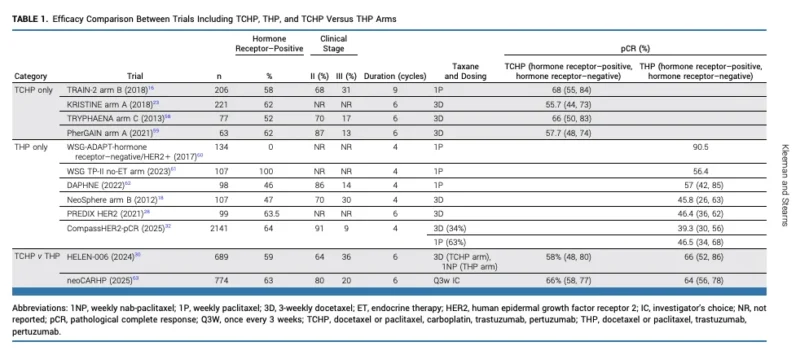
Two randomized trials directly compared carboplatin-containing TCHP with carboplatin-free THP. In HELEN-006, 689 patients with stage II–III HER2-positive breast cancer were assigned to six cycles of TCHP with every-3-week docetaxel or THP using weekly nab-paclitaxel. The pCR rate was actually higher with THP:
- 66.3% with THP vs 57.6% with TCHP
- P = .011
In neoCARHP, 774 patients were randomized to six cycles of THP or TCHP, and pCR rates were similar between the two treatment groups. Importantly, both studies demonstrated a substantial reduction in toxicity when carboplatin was omitted, particularly hematologic and gastrointestinal adverse events. These results provide important evidence that carboplatin may not be necessary for many patients receiving neoadjuvant dual HER2 blockade.
The authors conclude that, for many patients with stage II disease, carboplatin can reasonably be omitted and that THP incorporating weekly paclitaxel represents an emerging treatment strategy. However, mature event-free survival and overall survival results remain necessary before the long-term equivalence of these approaches can be fully established.
De-Escalation Requires More Caution in Stage III Disease
The evidence is less definitive for stage III disease. Fewer than 35% of participants in HELEN-006 and neoCARHP had stage III tumors, limiting certainty regarding broader de-escalation in this higher-risk population.
The review therefore supports a more conservative approach in stage III disease, where TCHP may remain appropriate and where more intensive strategies incorporating trastuzumab deruxtecan may also have a role in selected high-risk patients.
This distinction is central to the authors’ proposed framework: clinical stage remains an important first layer of risk stratification, but it should increasingly be complemented by tumor biology and early treatment response.
pCR Remains Central, but It Is Not the Whole Story
Pathologic complete response remains one of the most important tools for assessing neoadjuvant treatment efficacy in HER2-positive disease. A pCR, defined as absence of invasive cancer in the breast and axillary nodes, is associated with excellent long-term outcomes and helps determine postoperative systemic treatment.
Residual cancer burden can provide additional prognostic granularity, ranging from RCB-0, corresponding to pCR, through RCB-III, which identifies patients at particularly high risk of recurrence. Yet the relationship between pCR and survival is influenced by underlying biology.
Hormone receptor–positive/HER2-positive tumors generally have lower pCR rates than hormone receptor–negative/HER2-positive tumors, despite comparable long-term outcomes in many settings. The review notes that intrinsic molecular subtype may explain some of this discrepancy: HER2-enriched tumors achieve considerably higher pCR rates than luminal A or luminal B tumors. This provides another argument against using pCR alone to determine treatment intensity.
Can Chemotherapy Be Eliminated Entirely?
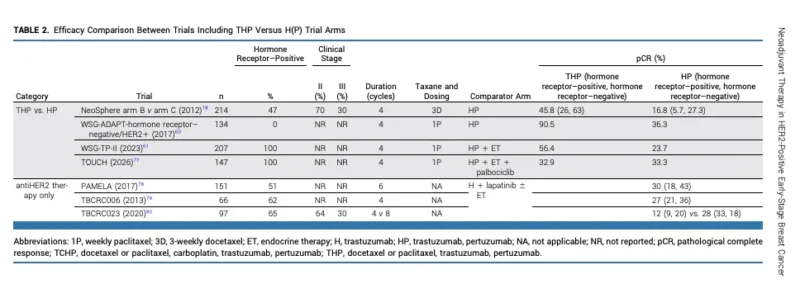
Probably not yet, at least not for an unselected population. Dual HER2 blockade without chemotherapy produces pCR in approximately 20%–30% of unselected patients, but chemotherapy-containing THP consistently achieves substantially higher response rates.
The authors therefore emphasize that chemotherapy cannot currently be safely omitted for most patients with stage II–III HER2-positive breast cancer based on clinical features alone. The question is whether biomarkers can identify the minority of tumors that are sufficiently HER2-dependent to respond to HER2 blockade alone.
Several characteristics appear particularly promising HER2 IHC 3+, a high or intermediate HER2DX pCR score, PAM50 HER2-enriched subtype, PIK3CA wild-type status, and high levels of tumor-infiltrating lymphocytes.
The treatment algorithm proposed in the review places these biomarkers at the center of future decisions about whether a patient might begin with HP, THP, or more intensive therapy. However, most of these approaches remain investigational and require prospective validation.
ctDNA Could Make De-Escalation Dynamic
One of the most important themes of the review is that treatment intensity may eventually be determined not only by pretreatment characteristics but also by what happens during the first weeks of therapy. ctDNA is particularly attractive because it provides a noninvasive measure of tumor burden and molecular response.
Patients who have undetectable ctDNA at baseline or rapidly clear detectable ctDNA during neoadjuvant therapy appear more likely to achieve pCR and favorable long-term outcomes.
In the HER2-positive subgroup of I-SPY2, ctDNA clearance by week 3 was strongly associated with pCR or minimal residual cancer burden, with an odds ratio of 15.0. Meanwhile, presurgical ctDNA negativity in the TBCRC040 cohort was associated with 93% 3-year disease-free survival, irrespective of whether residual disease was found at surgery.
These signals raise an important possibility: a patient might begin with less intensive HER2-targeted therapy and undergo escalation only if ctDNA fails to clear.
But the authors appropriately caution that current evidence comes largely from small exploratory cohorts using heterogeneous assays. Prospective trials must demonstrate that ctDNA-guided escalation or de-escalation improves clinical outcomes before it becomes routine practice.
Functional Imaging Could Provide Another Early Readout
FDG-PET and breast MRI may offer complementary approaches to response adaptation. In TBCRC026, early reduction in FDG uptake after HER2-directed therapy was strongly associated with eventual pCR. In PHERGain, metabolic responders were allowed to continue chemotherapy-free HP while nonresponders were escalated to TCHP; the selected responder population achieved a 3-year DFS of 98.8%.
MRI-based adaptation has also shown promising results. In TRAIN-4, patients with a marked early reduction in tumor volume continued chemotherapy-free therapy, contributing to an overall pCR rate of 73%. These strategies remain investigational, but they illustrate how early biological or radiographic response may ultimately become as important as baseline stage in selecting treatment intensity.
T-DXd Expands the High-Risk Neoadjuvant Strategy
ADCs are simultaneously reshaping the opposite end of the risk spectrum. In DESTINY-Breast11, four cycles of trastuzumab deruxtecan (T-DXd) followed by THP produced a significantly higher pCR rate than dose-dense anthracycline-cyclophosphamide followed by THP:
- 67.3% vs 56.3%
The T-DXd–THP strategy was also associated with fewer grade ≥3 adverse events and supported FDA approval in May 2026 for neoadjuvant treatment of stage II–III HER2-positive breast cancer. Yet the authors emphasize an important limitation: DESTINY-Breast11 did not directly compare T-DXd–THP with TCHP.
Consequently, the net benefit of moving T-DXd into the neoadjuvant setting relative to an established anthracycline-free regimen remains incompletely defined.
DESTINY-Breast05 Changes the Post-Neoadjuvant Landscape
Another option is to reserve T-DXd for patients who have residual disease after surgery. In DESTINY-Breast05, T-DXd substantially improved invasive disease-free survival compared with T-DM1 in patients with high-risk residual HER2-positive disease, leading to FDA approval in May 2026.
However, toxicity remains important. Drug-related interstitial lung disease occurred in 9.6% with T-DXd versus 1.6% with T-DM1, including two ILD-related deaths in the T-DXd group.
This may preserve a role for T-DM1 in selected patients with lower-volume residual disease, elevated ILD risk, or inability to tolerate T-DXd. Another unresolved issue is sequencing: if T-DXd is administered before surgery and residual disease remains, the optimal postoperative ADC is not established, and cumulative T-DXd exposure raises additional ILD concerns.
A New Risk-Adapted Framework
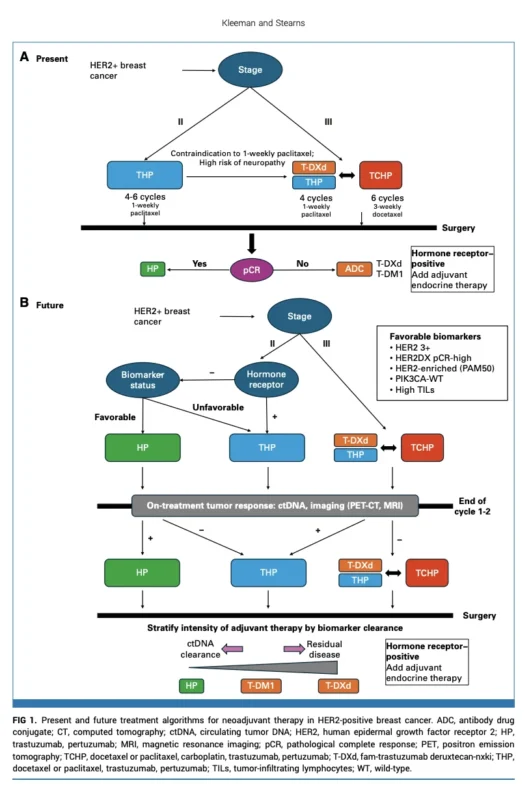
The review’s proposed treatment algorithm illustrates how HER2-positive early breast cancer management could evolve. At present, the authors envision THP as a de-escalated option for many stage II patients, while stage III disease may continue to warrant TCHP or, in selected high-risk cases, T-DXd–THP.
After surgery, pCR remains central to decisions regarding continuation of HER2-directed therapy versus escalation to an ADC. The future model is more ambitious.
Baseline biomarkers would define initial treatment intensity, followed within the first one or two cycles by ctDNA, PET-CT, or MRI assessment. Responding tumors could remain on or move toward less intensive therapy, while biologically resistant tumors could undergo early escalation. Postoperative treatment could then be further tailored according to residual disease and biomarker clearance.
OncoDaily Takeaway
The neoadjuvant treatment of HER2-positive early breast cancer is entering a period of genuine risk adaptation. For many patients with stage II disease, randomized evidence now supports omission of carboplatin, with THP providing comparable or higher pCR rates and substantially improved tolerability. Stage III disease remains less certain and may continue to justify more intensive treatment.
At the same time, DESTINY-Breast11 and DESTINY-Breast05 have introduced T-DXd into both neoadjuvant and post-neoadjuvant treatment, expanding options for patients with high-risk disease.
The next step is likely to move beyond clinical stage alone. ctDNA clearance, HER2 dependence, immune biology, PET response, and MRI response could eventually allow clinicians to intensify therapy only when necessary, and de-escalate treatment when tumor biology demonstrates that less may be enough.
As the authors frame it, the goal is no longer simply to maximize pCR. It is to preserve cure while minimizing unnecessary toxicity and protecting long-term quality of life.
Source
- Kleeman SO, Stearns V. Risk-Adapted Optimization of Neoadjuvant Therapy in Human Epidermal Growth Factor Receptor 2–Positive Early-Stage Breast Cancer. Journal of Clinical Oncology. Published September 9, 2026. DOI: 10.1200/JCO-26-01423.