
The five-year analysis of the randomized phase II PHERGain trial provides encouraging long-term evidence supporting response-guided chemotherapy de-escalation in patients with early-stage HER2-positive breast cancer. Using metabolic imaging and pathological response to individualize treatment, the strategy enabled nearly one-third of patients to avoid chemotherapy while maintaining favorable long-term disease outcomes.
Published in Nature Medicine, the analysis also investigated the potential of circulating tumor DNA (ctDNA) to refine treatment selection, demonstrating that early molecular clearance was associated with higher pathological complete response (pCR) rates and improved long-term invasive disease-free survival (iDFS).
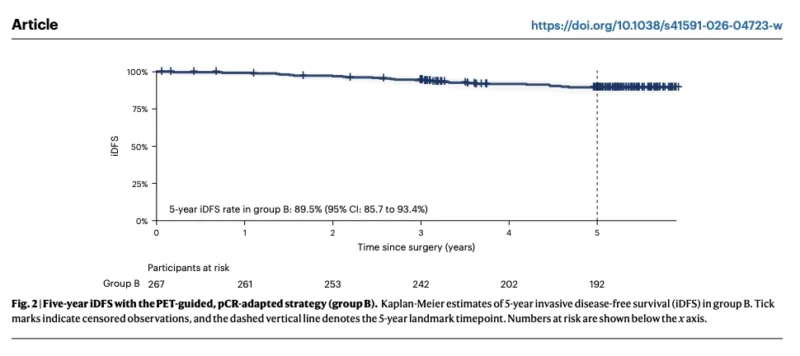
After a median follow-up of 5.6 years, the estimated five-year iDFS was 89.5% among 267 patients who underwent surgery following the PET-guided, response-adapted treatment strategy.
Among 86 patients who demonstrated an early metabolic response, subsequently achieved pCR, and received no chemotherapy, five-year iDFS reached 92.4% (95% CI 86.7–98.5), with only one distant recurrence.
The exploratory biomarker analysis revealed a striking association between ctDNA status and long-term outcomes. Five-year iDFS was 97.1% among patients without detectable baseline ctDNA compared with 86.7% among those with detectable ctDNA.
Furthermore, early ctDNA clearance during neoadjuvant treatment was associated with significantly higher pCR rates and improved five-year outcomes.
Although PHERGain was not designed to establish noninferiority to standard chemotherapy-containing treatment, these findings strengthen the rationale for combining functional imaging, pathological response, and molecular biomarkers to develop more individualized treatment strategies.
Why PHERGain Matters: Moving Beyond Uniform Chemotherapy
The treatment landscape for HER2-positive early breast cancer has changed substantially following the development of HER2-targeted therapies.
Neoadjuvant chemotherapy combined with trastuzumab and pertuzumab remains an established treatment strategy for many patients with stage II–III disease, achieving high pathological response rates and improving long-term outcomes.
However, HER2-positive breast cancer is biologically heterogeneous. Some tumors demonstrate exceptional sensitivity to HER2 inhibition, raising the possibility that selected patients may achieve durable disease control without conventional cytotoxic chemotherapy.
Reducing treatment intensity could offer meaningful advantages, including decreased hematologic toxicity, neuropathy, fatigue, and other chemotherapy-associated complications.
Nevertheless, de-escalation introduces a critical clinical concern: whether patients who initially respond to targeted treatment alone can safely avoid chemotherapy without increasing the risk of distant recurrence.
The PHERGain trial was developed to investigate a response-adapted strategy rather than uniformly treating all patients with the same chemotherapy-containing regimen.
By combining early metabolic imaging with pathological response assessment, investigators sought to identify patients whose tumors were sufficiently sensitive to dual HER2 blockade to permit chemotherapy omission. The updated five-year analysis provides important information about the durability of this strategy and whether molecular monitoring could improve patient selection.
Study Design: PET-Guided, Response-Adapted Treatment
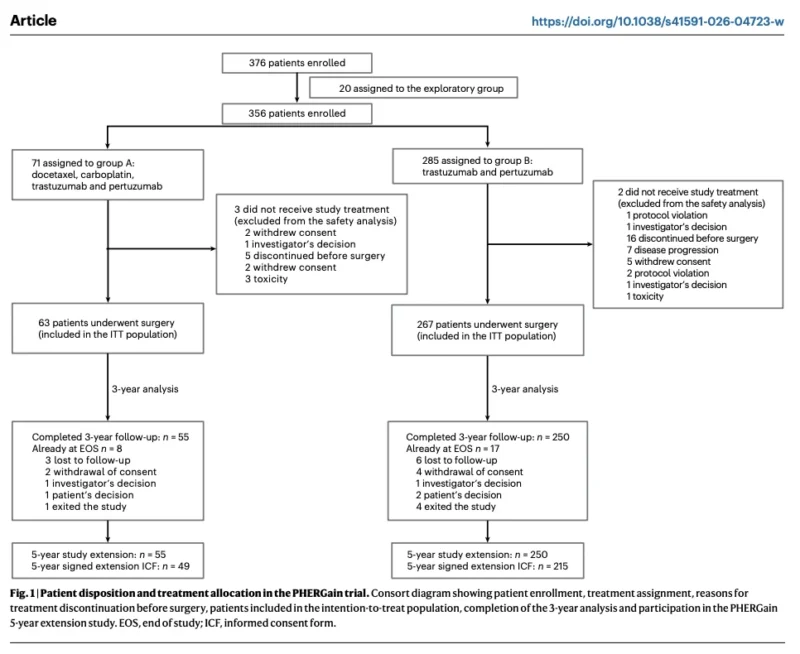
PHERGain (NCT03161353) was a multicenter, randomized, open-label, non-comparative phase II trial conducted across 45 hospitals in seven European countries. The study enrolled patients with centrally confirmed HER2-positive, operable stage I–IIIA breast cancer, with tumors measuring at least 1.5 cm.
A total of 376 patients were enrolled. Of these, 356 were randomized in a 1:4 ratio to standard treatment or a response-adapted strategy, while 20 patients with PET-detected subclinical metastatic disease were allocated to a separate exploratory cohort.
The standard-treatment group, group A, included 71 patients assigned to six cycles of docetaxel, carboplatin, trastuzumab, and pertuzumab.
The response-adapted group, group B, included 285 patients who initially received trastuzumab and pertuzumab without chemotherapy. Patients with hormone receptor-positive tumors also received endocrine treatment when indicated. After two cycles, response was assessed using fluorodeoxyglucose positron emission tomography (18F-FDG-PET).
Patients demonstrating at least a 40% reduction in maximum standardized uptake value continued chemotherapy-free HER2-directed treatment for six additional cycles. Patients without an adequate metabolic response switched to docetaxel and carboplatin combined with trastuzumab and pertuzumab.
Following surgery, patients in the response-adapted arm who had demonstrated an early metabolic response but did not achieve pCR received additional chemotherapy alongside dual HER2 blockade.
Patients achieving both an early PET response and pCR could avoid chemotherapy entirely. All patients were planned to complete up to 18 cycles of trastuzumab and pertuzumab, with endocrine treatment and radiotherapy administered when appropriate.
Importantly, the trial was designed to evaluate the feasibility and outcomes of a complete adaptive treatment strategy, not to establish direct equivalence between chemotherapy-free therapy and standard treatment.
Five-Year Results: Durable Outcomes With Response-Adapted Treatment
At the updated analysis, the median duration of follow-up was 5.6 years. Among the 267 patients in group B who underwent protocol-defined surgery, five-year iDFS was 89.5% (95% CI 85.7–93.4). A total of 26 patients experienced an invasive disease event or death within five years after surgery.
Distant recurrence was reported in 14 patients (5.2%), while second primary non-breast cancers accounted for four events (1.5%). Five-year distant disease-free survival was 92.7% (95% CI 89.5–96.0). The corresponding five-year iDFS estimate in the standard-treatment group was 96.7% (95% CI 92.2–100.0), based on 63 patients who underwent surgery.
Although numerically higher, this difference should not be interpreted as evidence that standard treatment was statistically superior to the response-adapted strategy. PHERGain was explicitly designed as a non-comparative study, and the standard-treatment group served primarily as an internal reference rather than a formally powered comparator.
Nevertheless, the updated results highlight an important consideration: although the response-adapted strategy produced favorable long-term outcomes, the possibility of an efficacy trade-off cannot be excluded. In the overall randomized population, five-year overall survival was 98.1% in group B compared with 98.4% in group A.
The results provide encouraging evidence that substantial treatment de-escalation can be achieved in selected patients, but they do not establish that chemotherapy omission preserves the same level of disease control as standard treatment.
Chemotherapy-Free Patients: Only One Distant Recurrence at Five Years
One of the most clinically relevant findings concerned patients who successfully completed the chemotherapy-free strategy. Among 86 patients who demonstrated an early PET response and achieved pCR following trastuzumab and pertuzumab, without receiving chemotherapy, five-year iDFS reached 92.4% (95% CI 86.7–98.5).
Only one patient experienced distant recurrence, corresponding to 1.2% of this subgroup. Five-year distant disease-free survival reached 98.7% (95% CI 96.3–100.0). No deaths were reported in this selected population during the five-year analysis.
These findings suggest that a subset of HER2-positive tumors may be sufficiently sensitive to dual HER2 blockade to achieve durable disease control without conventional chemotherapy. However, this was a highly selected population defined by treatment response and pCR after randomization.
Its favorable outcomes cannot establish that chemotherapy omission itself caused equivalent or better survival.
Patients achieving pCR are already known to have a more favorable prognosis, making it difficult to separate the effects of treatment de-escalation from the underlying biological characteristics of highly responsive tumors.
The results therefore support the feasibility of chemotherapy omission in research settings rather than validating routine chemotherapy-free treatment for all patients with HER2-positive early breast cancer.
ctDNA Detection Reflects Tumor Burden and Disease Stage
Beyond long-term clinical outcomes, PHERGain investigated whether ctDNA could provide additional information about treatment response and recurrence risk. The exploratory analysis used Guardant Reveal, a tissue-free, tumor-uninformed, methylation-based ctDNA assay.
Unlike personalized assays requiring tumor sequencing to identify patient-specific mutations, this approach evaluates circulating tumor-associated epigenetic patterns without requiring prior tumor tissue sequencing.
Across the study, 932 plasma samples were collected at baseline, after two cycles of neoadjuvant therapy, and before surgery. Of these, 801 samples were successfully sequenced.
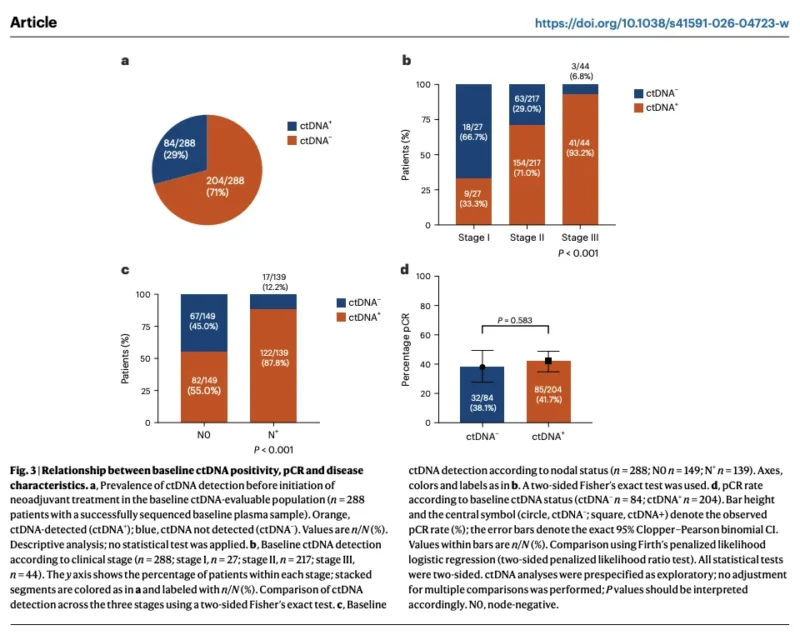
Baseline ctDNA was detected in 204 of 288 evaluable patients (71.0%). Detection was strongly associated with disease stage. Among patients with stage I disease, baseline ctDNA was detectable in 33.3%, increasing to 93.2% among patients with stage III disease.
Similarly, detectable ctDNA was identified in 87.8% of patients with lymph node involvement compared with 55.0% of node-negative patients.
These findings suggest that baseline ctDNA detection reflects, at least partly, the anatomical extent and biological burden of disease. However, the absence of detectable ctDNA does not necessarily indicate the absence of viable tumor.
Low tumor shedding, limited disease volume, and assay sensitivity may all contribute to negative results despite the presence of residual malignancy.
Early ctDNA Clearance Is Associated With Pathological Complete Response
The most compelling molecular finding was the association between early ctDNA clearance and pathological response. Among patients with detectable ctDNA at baseline, circulating tumor DNA concentrations declined rapidly following initiation of neoadjuvant treatment.
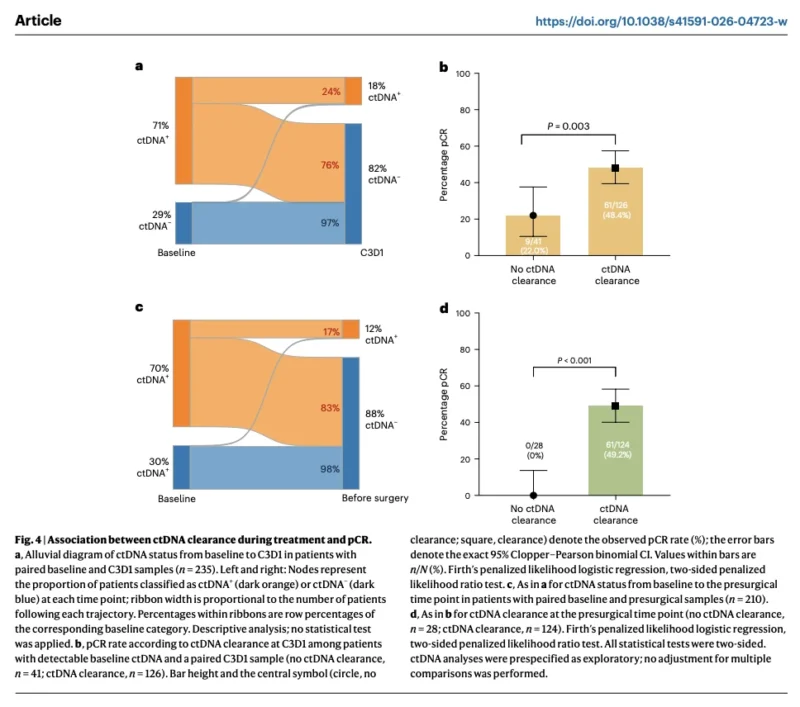
After two cycles, 76.0% of initially ctDNA-positive patients had no detectable ctDNA. By the presurgical assessment, clearance had occurred in approximately 83.0%. Importantly, baseline ctDNA status alone was not significantly associated with pCR.
The pCR rate was 41.7% among patients with detectable baseline ctDNA compared with 38.1% among those without detectable ctDNA (p=0.583). In contrast, early ctDNA clearance was strongly associated with pathological response.
Among patients with paired samples and detectable baseline ctDNA, pCR occurred in 48.4% of patients who achieved early ctDNA clearance versus 22.0% of those with persistent ctDNA (p=0.003). The association became even more pronounced at the presurgical assessment.
Among patients achieving ctDNA clearance before surgery, 49.2% achieved pCR, whereas none of the 28 patients with persistent ctDNA achieved a complete pathological response. These results suggest that dynamic molecular changes during therapy provide more clinically informative response information than a single baseline ctDNA measurement.
However, ctDNA clearance should not be considered equivalent to pCR: approximately half of patients with presurgical clearance still had residual pathological disease.
ctDNA Status Predicts Long-Term Recurrence Risk
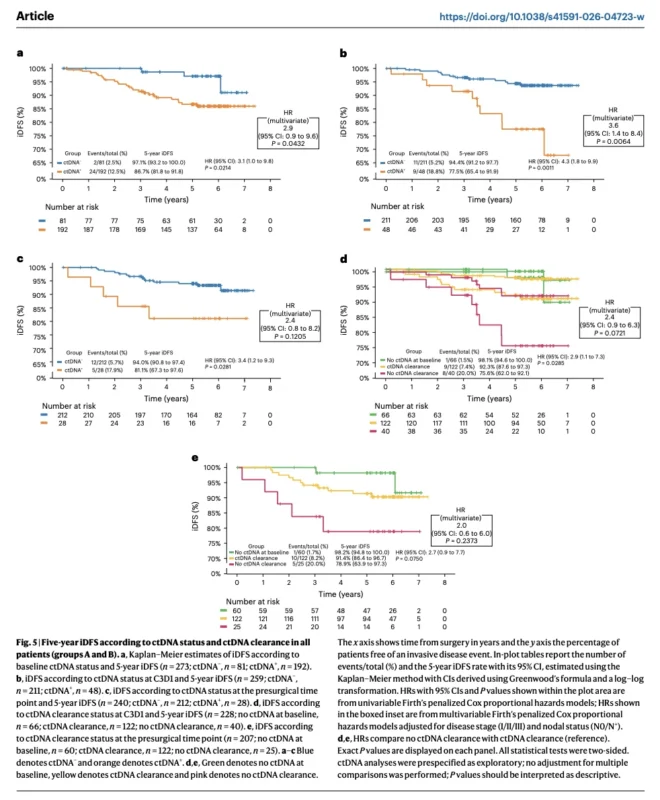
The prognostic value of ctDNA extended beyond pathological response. At baseline, patients with detectable ctDNA had inferior five-year iDFS compared with those without detectable ctDNA. Five-year iDFS was 86.7% versus 97.1%, respectively, with an HR of 3.1 (95% CI 1.0–9.8; p=0.021).
The relationship was even more pronounced during treatment. At cycle 3 day 1, after two treatment cycles, patients with detectable ctDNA had five-year iDFS of 77.5%, compared with 94.4% among those without detectable ctDNA. The HR was 4.3 (95% CI 1.8–9.9; p=0.0011).
After adjustment for disease stage and nodal status, detectable ctDNA at this timepoint remained associated with inferior outcomes (adjusted HR 3.6; 95% CI 1.4–8.4).
These findings suggest that early on-treatment ctDNA status may provide clinically meaningful prognostic information beyond conventional anatomical staging. The association between molecular clearance and long-term outcomes was similarly encouraging.
Patients achieving early ctDNA clearance had five-year iDFS of 92.3%, compared with 75.6% among those with persistent ctDNA. The unadjusted HR for the absence of clearance versus clearance was 2.9 (95% CI 1.1–7.3; p=0.028).
However, the association did not retain conventional statistical significance after adjustment for stage and nodal status (adjusted HR 2.4; 95% CI 0.9–6.3; p=0.072). Late presurgical clearance was also associated with numerically favorable five-year outcomes, but this relationship was not statistically significant in the reported analysis.
Taken together, these data support ctDNA as a promising prognostic biomarker while emphasizing the importance of avoiding conclusions about independently validated predictive utility.
Can PET and ctDNA Be Combined to Guide Treatment?
The integration of metabolic imaging and ctDNA represents one of the most important conceptual contributions of PHERGain. PET imaging assesses changes in tumor metabolism, while ctDNA provides molecular information about circulating tumor-derived material.
These approaches evaluate different biological aspects of treatment response and may therefore offer complementary information. In PHERGain, early ctDNA clearance was more frequent among PET responders than nonresponders.
Among patients with available paired samples, 90.5% of PET responders achieved early ctDNA clearance compared with 56.1% of PET nonresponders. This concordance supports the hypothesis that molecular response and metabolic response identify overlapping populations with treatment-sensitive disease.
However, neither method independently establishes whether residual viable tumor is present. A patient may achieve ctDNA clearance without pCR, while another may have undetectable baseline ctDNA despite substantial residual disease.
Consequently, molecular monitoring should currently be regarded as an investigational complement to imaging and pathological assessment rather than a replacement.
Future prospective studies will need to establish whether adding ctDNA to PET-guided treatment algorithms improves patient selection and whether molecularly guided escalation or de-escalation produces better long-term outcomes.
Clinical Implications: Promising De-escalation, but Not Yet a New Standard
PHERGain contributes to a broader movement toward individualized treatment intensity in early HER2-positive breast cancer.
Rather than assuming all patients require identical chemotherapy exposure, response-adapted strategies seek to identify those whose tumors are highly sensitive to HER2-directed therapy and those who require additional treatment.
The five-year results suggest that chemotherapy omission may be feasible for a selected subgroup achieving both early metabolic response and pCR. Nevertheless, important limitations remain. The trial was not designed to establish noninferiority or equivalence to standard chemotherapy-containing regimens.
The standard-treatment group was relatively small, and the chemotherapy-free subgroup was defined by post-treatment response rather than baseline randomization. Another important consideration is that PHERGain was conducted before contemporary post-neoadjuvant escalation strategies were incorporated into routine management.
Patients with residual disease did not receive adjuvant trastuzumab emtansine (T-DM1) within the original treatment algorithm, potentially limiting the applicability of the study to current clinical practice.
The investigators also acknowledged that a substantial proportion of patients did not provide renewed consent for extended follow-up, introducing potential attrition bias. For the ctDNA analyses, missing samples, limited numbers of events, and the tumor-uninformed assay approach may affect interpretation.
Additionally, the exploratory biomarker analyses were not adjusted for multiple comparisons. These limitations are particularly important when considering whether molecular clearance can justify omitting chemotherapy or other effective systemic treatments.
At present, the results support continued prospective investigation rather than routine ctDNA-directed treatment adaptation.
OncoDaily Takeaway
The five-year PHERGain analysis strengthens the evidence supporting response-guided chemotherapy de-escalation in HER2-positive early breast cancer, while highlighting the potential role of ctDNA in refining treatment selection.
After a median follow-up of 5.6 years, five-year iDFS reached 89.5% with the PET-guided, pCR-adapted strategy. Among 86 patients who achieved early metabolic response and pCR without receiving chemotherapy, five-year iDFS was 92.4%, with only one distant recurrence.
These findings demonstrate encouraging long-term outcomes in a carefully selected chemotherapy-free population, although the non-comparative design prevents conclusions about equivalence to standard chemotherapy.
The ctDNA analysis adds an important molecular dimension. Early clearance was associated with substantially higher pCR rates, while detectable ctDNA during treatment identified patients at increased risk of recurrence.
Yet ctDNA clearance did not reliably exclude residual pathological disease, and its independent prognostic contribution requires further validation.
The broader significance of PHERGain lies in its adaptive treatment framework: functional imaging, pathological response, and molecular monitoring may eventually allow oncologists to reduce treatment intensity for highly responsive tumors while identifying patients who require more aggressive therapy.
For now, chemotherapy-free dual HER2 blockade remains an investigational strategy for appropriately selected patients rather than a universal replacement for established neoadjuvant treatment.
The next challenge is translating these promising findings into prospectively validated treatment algorithms capable of safely reducing toxicity without compromising cure.
Source
- Pérez-García JM, Cortés J, Ruiz-Borrego M, et al. 5-year outcomes of chemotherapy de-escalation in HER2-positive early breast cancer and exploratory circulating tumor DNA analyses from the randomized phase 2 PHERGain trial. Nature Medicine. 2026.