The final overall survival (OS) analysis of the phase III OptiTROP-Breast01 trial has demonstrated a sustained survival advantage with sacituzumab tirumotecan (sac-TMT) compared with physician’s choice chemotherapy in patients with previously treated locally recurrent or metastatic triple-negative breast cancer (TNBC).
Presented by Man Li, MD, at the ESMO Congress 2026 in Madrid, the updated findings confirm the durability of the survival benefit established at the prespecified interim analysis, providing nearly 30 months of follow-up in a population with limited treatment options.
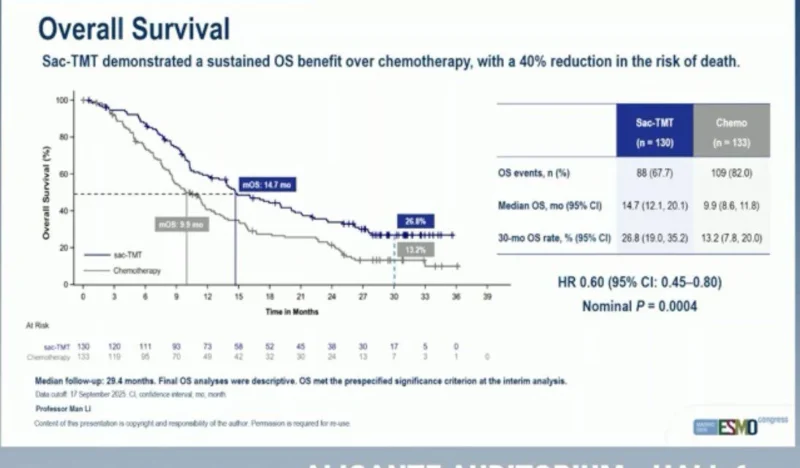
Among 263 randomized patients, median OS was 14.7 months with sac-TMT versus 9.9 months with chemotherapy, representing a 4.8-month improvement. The hazard ratio (HR) was 0.60 (95% CI 0.45–0.80), corresponding to a 40% reduction in the estimated hazard of death.
The survival advantage persisted at longer follow-up. At 30 months, 26.8% of patients receiving sac-TMT remained alive compared with 13.2% receiving chemotherapy, suggesting a sustained effect on longer-term survival.
Importantly, the benefit remained consistent after statistical adjustment for subsequent antibody-drug conjugate (ADC) treatment, which was received by 27.8% of patients in the chemotherapy arm. Following adjustment, the OS HR was 0.55 (95% CI 0.39–0.73).
Although the final survival analyses were descriptive, the OS endpoint had already crossed its prespecified statistical significance boundary at the interim analysis. The updated findings therefore reinforce an established survival benefit rather than representing a new independent confirmatory test.
Why OptiTROP-Breast01 Matters
Triple-negative breast cancer remains one of the most clinically challenging breast cancer subtypes because it lacks estrogen receptor, progesterone receptor, and HER2 expression patterns that define conventional endocrine and HER2-directed treatment strategies.
Although immunotherapy and antibody-drug conjugates have significantly expanded treatment options, patients with metastatic TNBC who progress through multiple systemic therapies continue to face limited prospects for sustained disease control.
TROP2 has emerged as an important therapeutic target in breast cancer. This transmembrane glycoprotein is expressed in many epithelial malignancies, including TNBC, and can be exploited to deliver cytotoxic payloads selectively through antibody-drug conjugates.
The clinical effectiveness of TROP2-directed therapy was established with sacituzumab govitecan, which demonstrated significant improvements in survival compared with conventional chemotherapy in previously treated metastatic TNBC.
However, ADCs targeting the same surface antigen are not necessarily clinically interchangeable. Differences in antibody structure, drug-linker chemistry, payload characteristics, and drug-to-antibody ratio may influence antitumor activity, drug exposure, and toxicity.
Sacituzumab tirumotecan, also known as SKB264 or MK-2870, is a distinct TROP2-directed ADC that incorporates a belotecan-derived topoisomerase I inhibitor payload and a bifunctional linker designed to facilitate intracellular payload release.
OptiTROP-Breast01 was developed to determine whether this approach could improve outcomes compared with conventional single-agent chemotherapy in heavily pretreated TNBC.
The final survival analysis is particularly relevant because it evaluates whether the substantial disease-control benefit reported earlier translated into a sustained advantage in overall survival.
Study Design and Treatment Population
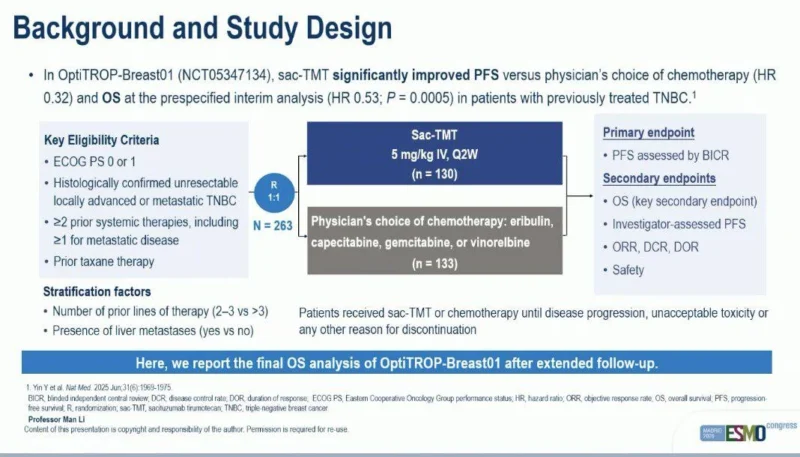
OptiTROP-Breast01 (NCT05347134) was a randomized, open-label phase III study enrolling patients with unresectable locally advanced or metastatic TNBC who had received at least two prior systemic therapies, including at least one treatment in the metastatic setting.
Eligible patients had ECOG performance status 0–1 and prior exposure to taxane-based treatment. A total of 263 patients were randomized 1:1 to receive sac-TMT 5 mg/kg intravenously every two weeks (n=130) or physician’s choice of chemotherapy (n=133).
Control treatments included eribulin, capecitabine, gemcitabine, or vinorelbine. Randomization was stratified according to the number of previous treatment lines, categorized as two to three versus more than three, and the presence or absence of liver metastases.
Treatment continued until disease progression, unacceptable toxicity, or another protocol-defined reason for discontinuation. The primary endpoint was progression-free survival (PFS) assessed by blinded independent central review (BICR). Overall survival was a key secondary endpoint, alongside investigator-assessed PFS, objective response rate, disease control rate, duration of response, and safety.
The final OS analysis had a data cutoff of September 17, 2025, with a median follow-up of 29.4 months.
Earlier Results Established Significant PFS and OS Benefits
The initial OptiTROP-Breast01 findings established the clinical activity of sac-TMT in this treatment setting. At the previously reported final PFS analysis, median PFS by BICR was 6.7 months with sac-TMT compared with 2.5 months with chemotherapy. The HR was 0.32 (95% CI 0.24–0.44), corresponding to a 68% reduction in the hazard of progression or death.
The objective response rate was also substantially higher with sac-TMT, reaching 45.4% compared with 12.0% in the chemotherapy group.
Median duration of response was 7.1 versus 3.0 months, respectively, suggesting that the advantage extended beyond initial tumor shrinkage to more durable disease control. Importantly, the prespecified interim OS analysis demonstrated a statistically significant survival advantage, with an HR of 0.53 (95% CI 0.36–0.78; one-sided p=0.0005).
These findings established the efficacy of sac-TMT compared with standard single-agent chemotherapy. The final analysis was intended to characterize the durability of that survival effect as additional deaths and follow-up accumulated.
Final Overall Survival: A Sustained 4.8-Month Median Advantage
At the final OS analysis, sac-TMT maintained a clinically meaningful survival advantage over physician’s choice chemotherapy. Median OS was 14.7 months (95% CI 12.1–20.1) with sac-TMT compared with 9.9 months (95% CI 8.6–11.8) with chemotherapy.
The HR was 0.60 (95% CI 0.45–0.80), with a nominal p-value of 0.0004. By the data cutoff, 88 patients (67.7%) in the sac-TMT arm and 109 patients (82.0%) in the chemotherapy arm had died.
Although the final HR of 0.60 was numerically closer to 1 than the interim HR of 0.53, the updated analysis continued to demonstrate a favorable and clinically relevant treatment effect. Changes in hazard ratio estimates are expected as additional events accrue and do not, by themselves, establish a weakening of biological treatment activity.
The final survival analysis was descriptive because the OS endpoint had already met its prespecified significance criterion at the interim assessment. Accordingly, the nominal p-value should not be presented as a separate confirmatory significance test. The central finding is that the previously established OS benefit remained evident after extended follow-up.
Longer-Term Survival: Separation Persists Beyond Two Years
The updated survival estimates provide further insight into the durability of benefit. At 24 months, estimated OS was 33.8% with sac-TMT compared with 21.4% with chemotherapy. By 30 months, survival was 26.8% (95% CI 19.0–35.2) versus 13.2% (95% CI 7.8–20.0), respectively.
This represented an absolute difference of 13.6 percentage points at 30 months, with the estimated survival rate approximately twice as high in the sac-TMT arm. These results suggest that sac-TMT may offer a meaningful opportunity for extended survival in a subset of patients with heavily pretreated metastatic TNBC.
However, interpretation of the late survival curve requires caution because the number of patients remaining under observation decreases over time. The 30-month landmark results are encouraging but should not be taken as proof of a durable long-term survival plateau.
Nevertheless, the continued separation of the survival estimates supports the conclusion that sac-TMT delivers a sustained clinical benefit beyond the early treatment period.
Subsequent ADC Treatment and Adjusted Overall Survival
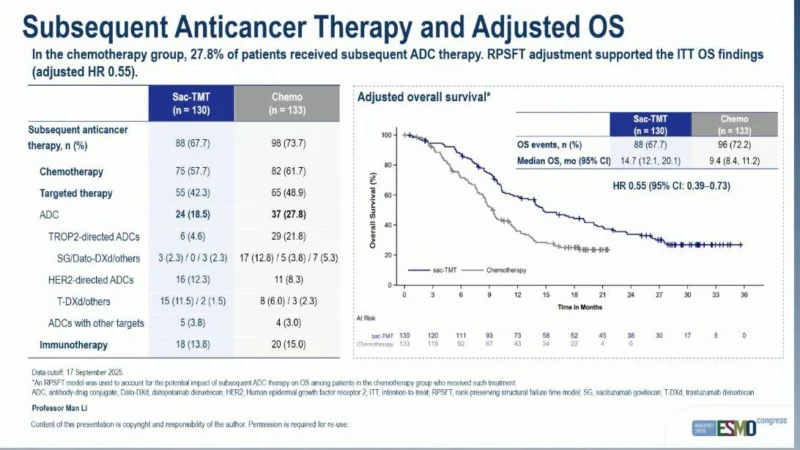
An important component of the final analysis was the assessment of subsequent anticancer therapy. Following discontinuation of randomized treatment, additional systemic anticancer therapy was received by 67.7% of patients in the sac-TMT arm and 73.7% in the chemotherapy arm.
Subsequent ADC treatment was received by 18.5% and 27.8% of patients, respectively. In the chemotherapy group, 21.8% received a subsequent TROP2-directed ADC. This is clinically relevant because access to an effective ADC after chemotherapy could potentially influence observed overall survival differences between randomized groups.
To explore this issue, investigators used a rank-preserving structural failure time (RPSFT) model to adjust for the potential impact of subsequent ADC treatment in the chemotherapy arm.
After adjustment, median OS remained 14.7 months with sac-TMT and was estimated at 9.4 months with chemotherapy. The adjusted HR was 0.55 (95% CI 0.39–0.73), compared with 0.60 in the unadjusted intention-to-treat analysis.
These findings suggest that the observed survival advantage was not explained by imbalances in later ADC use. The adjusted estimate was consistent with, and numerically more favorable than, the primary unadjusted result.
However, RPSFT analyses rely on statistical assumptions regarding the effect of subsequent treatment. They cannot completely eliminate uncertainty about post-progression treatment effects and should be interpreted as supportive sensitivity analyses rather than substitutes for randomized comparisons. The unadjusted intention-to-treat analysis remains the principal basis for assessing the treatment effect.
Overall Survival Across Prior Immunotherapy Exposure
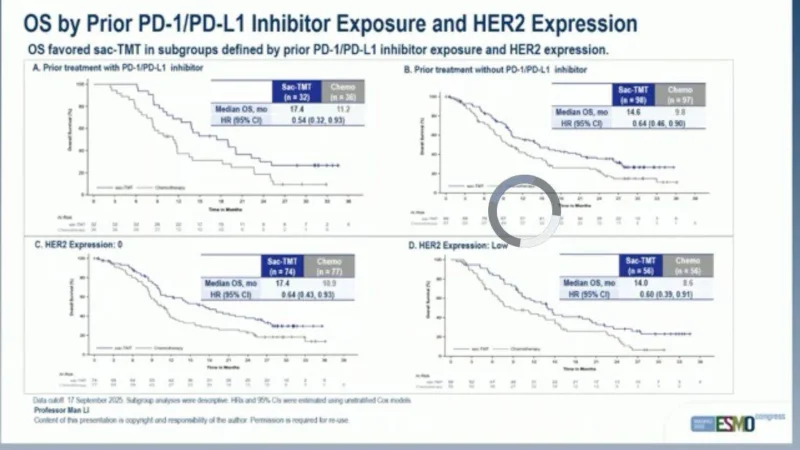
The final analysis also examined survival according to prior exposure to PD-1 or PD-L1 inhibitors. Among patients previously treated with immunotherapy, median OS was 17.4 months with sac-TMT compared with 11.2 months with chemotherapy. The HR was 0.54.
Among those without previous PD-1 or PD-L1 inhibitor exposure, median OS was 14.6 versus 9.8 months, with an HR of 0.64. The direction of benefit therefore favored sac-TMT in both groups.
This consistency is clinically relevant because previous immunotherapy exposure may influence treatment sequencing and reflects differences in the therapeutic histories of patients with metastatic TNBC. Nevertheless, the analyses were descriptive, and the immunotherapy-exposed population was relatively small.
The findings should not be interpreted as proving that sac-TMT is equally effective regardless of prior immune checkpoint inhibition or that previous immunotherapy modifies treatment sensitivity.
Rather, they suggest that the overall survival benefit was not restricted to patients with a particular immunotherapy treatment history.
HER2 Expression: Benefit in HER2-Zero and HER2-Low Disease
Exploratory analyses also assessed survival according to HER2 expression. Among patients with HER2 IHC 0 disease, median OS was 17.4 months with sac-TMT compared with 10.9 months with chemotherapy, with an HR of approximately 0.54.
In the HER2-low population, median OS was 14.0 versus 8.6 months, respectively, with an HR of 0.60. The direction of benefit remained favorable across both HER2 expression categories. These findings are particularly relevant as HER2 expression increasingly influences therapeutic selection in metastatic breast cancer, including access to HER2-directed ADCs.
However, sac-TMT targets TROP2 rather than HER2, and these subgroup findings do not establish HER2 expression as a predictive biomarker for sac-TMT efficacy.
The results should also not be interpreted as evidence of superiority over HER2-directed ADCs in patients with HER2-low TNBC, because no such direct comparison was performed.
Safety After Extended Follow-Up
The final analysis identified no new safety signals with longer observation. Treatment-related adverse events remained predominantly hematologic, consistent with the established safety profile of sac-TMT and the topoisomerase I inhibitor payload.
Earlier safety investigations identified anemia, neutropenia, thrombocytopenia, and stomatitis among clinically important adverse events requiring monitoring and supportive management. Treatment-related adverse events leading to permanent discontinuation occurred in approximately 1.5% of patients in each treatment arm.
These findings are reassuring regarding the absence of an emerging late safety signal, but they do not eliminate the need for careful toxicity management.
The extended analysis did not provide a complete new breakdown of grade ≥3 adverse events, individual toxicities, interstitial lung disease, or treatment-related mortality. Therefore, these outcomes should not be assumed to have improved without additional evidence.
For clinical practice, hematologic monitoring, assessment of mucosal toxicity, dose modification, and supportive care remain important components of sac-TMT administration.
Clinical Interpretation: Strengthening the Evidence for Sac-TMT in Later-Line TNBC
The final OptiTROP-Breast01 analysis reinforces the clinical relevance of sac-TMT as an active TROP2-directed ADC in previously treated metastatic TNBC. The consistency between PFS improvement, higher response rates, longer duration of response, and sustained OS benefit provides a coherent efficacy profile.
However, the treatment landscape has evolved considerably since the trial was initiated. Sacituzumab govitecan is an established option for previously treated metastatic TNBC, while HER2-directed ADCs may be available to selected patients with HER2-low disease. Additional ADC-based strategies are being investigated in earlier lines of treatment and in combination with immunotherapy.
OptiTROP-Breast01 compared sac-TMT with conventional single-agent chemotherapy, not with other ADCs. Consequently, the results do not establish whether sac-TMT is more effective than sacituzumab govitecan, trastuzumab deruxtecan, or emerging ADC combinations.
The study also excluded a direct evaluation of optimal ADC sequencing, an increasingly important question as more patients receive ADCs earlier in their treatment course.
Sac-TMT received regulatory approval in China in November 2024 for eligible patients with previously treated unresectable locally advanced or metastatic TNBC. Its availability in other jurisdictions remains dependent on regional regulatory authorization.
The current findings strengthen the evidence supporting that indication while informing the broader international development program.
Limitations and Remaining Questions
Despite the sustained survival benefit, several limitations remain relevant. OptiTROP-Breast01 was an open-label study conducted in China, which may affect the generalizability of its findings to populations with different treatment access and therapeutic histories.
The control arm consisted of conventional chemotherapy rather than an active ADC comparator, limiting conclusions about comparative effectiveness in contemporary treatment pathways.
The final OS analysis was descriptive because statistical significance had already been established at the interim analysis. Subgroup findings and adjusted OS analyses should therefore be interpreted as supportive rather than independently confirmatory.
Subsequent ADC treatment was more frequent in the chemotherapy group, and although the RPSFT adjustment supported the observed benefit, residual uncertainty related to post-progression therapies remains. Finally, longer-term treatment sequencing, efficacy after prior ADC exposure, quality-of-life outcomes, and the identification of reliable predictive biomarkers remain important areas for further investigation.
OncoDaily Takeaway
The final OptiTROP-Breast01 analysis provides reassuring evidence that the previously established survival benefit of sacituzumab tirumotecan is sustained with extended follow-up. Median OS remained 14.7 months versus 9.9 months, with an HR of 0.60, confirming a clinically meaningful advantage over conventional chemotherapy in heavily pretreated metastatic TNBC.
The long-term survival estimates are particularly important. At 30 months, 26.8% of patients receiving sac-TMT remained alive compared with 13.2% receiving chemotherapy, suggesting that the benefit extends beyond early disease control.
The subsequent-treatment analysis adds further support. Despite more frequent subsequent ADC use in the chemotherapy arm, the adjusted survival HR remained favorable at 0.55. However, statistical adjustment cannot replace direct randomized evidence, and the unadjusted OS results remain the primary basis for interpretation.
The findings also suggest broadly favorable outcomes across patients with and without prior immunotherapy and across HER2-zero and HER2-low populations. These observations support the general consistency of the treatment effect but do not establish predictive biomarkers or comparative superiority over other ADCs.
For oncologists, the principal message is that sac-TMT has demonstrated a sustained, previously confirmed overall survival benefit in later-line TNBC. The next clinical challenge is determining how it should be sequenced alongside established and emerging ADCs, particularly as these agents move into earlier treatment settings.
Source
- Li M, et al. Final OS Analysis of Sacituzumab Tirumotecan Versus Chemotherapy in Previously Treated Locally Recurrent or Metastatic Triple-Negative Breast Cancer: Phase III OptiTROP-Breast01.