
Metastasis-directed ablation has become increasingly used in selected patients with oligometastatic breast cancer, based on the premise that eliminating limited sites of metastatic disease may prolong disease control or potentially modify the natural history of metastatic disease. Randomized evidence from NRG-BR002, however, challenges routine use of this strategy.
The phase II/III trial found that adding stereotactic body radiation therapy (SBRT) or surgical resection of all metastatic sites to first-line systemic therapy did not improve progression-free survival (PFS) or overall survival (OS) compared with systemic therapy alone. The study was published in the Journal of Clinical Oncology in October 2026.
Testing Local Ablation in a Systemic Disease
NRG-BR002 enrolled patients with oligometastatic breast cancer defined as four or fewer metastases, controlled primary disease, and no progression during up to 12 months of first-line systemic therapy. All visible metastatic lesions had to be technically amenable to SBRT or surgical resection.
Patients were randomly assigned 1:1 to:
- First-line systemic therapy alone, or
- First-line systemic therapy plus metastasis-directed ablation.
The primary phase II endpoint was PFS. OS and toxicity were secondary endpoints, while circulating tumor cells (CTCs) were assessed as exploratory biomarkers.
A Population Dominated by HR-Positive, HER2-Negative Disease
Between December 2014 and September 2019, 129 patients were enrolled and 125 were eligible for analysis. Median age was 54 years. The study population was predominantly:
- 79% hormone receptor–positive/HER2-negative
- 60% with a solitary metastasis
- 50% with bone involvement
- 37% with bone-only metastatic disease
Most patients had recurrent rather than de novo metastatic breast cancer: 78% had relapsed disease, whereas 22% presented initially with stage IV disease. Among patients assigned to metastasis-directed therapy, 93% received SBRT, making the study primarily an evaluation of ablative radiotherapy rather than surgery.
Primary Endpoint Not Met
At the phase II primary analysis, median follow-up was 29.9 months. Median PFS was:
- 23.0 months with systemic therapy alone
versus
- 19.5 months with metastasis-directed ablation
The hazard ratio was 0.92 with a 95% CI of 0.57–1.47, and the difference was not statistically significant. Because the prespecified signal required to proceed was not achieved, NRG-BR002 did not advance to the phase III portion of the trial.
The result is clinically important because the intervention did not merely fail to produce a large effect; it failed to demonstrate a meaningful PFS signal despite successful local treatment of many metastatic lesions.
Longer Follow-Up Did Not Change the Conclusion
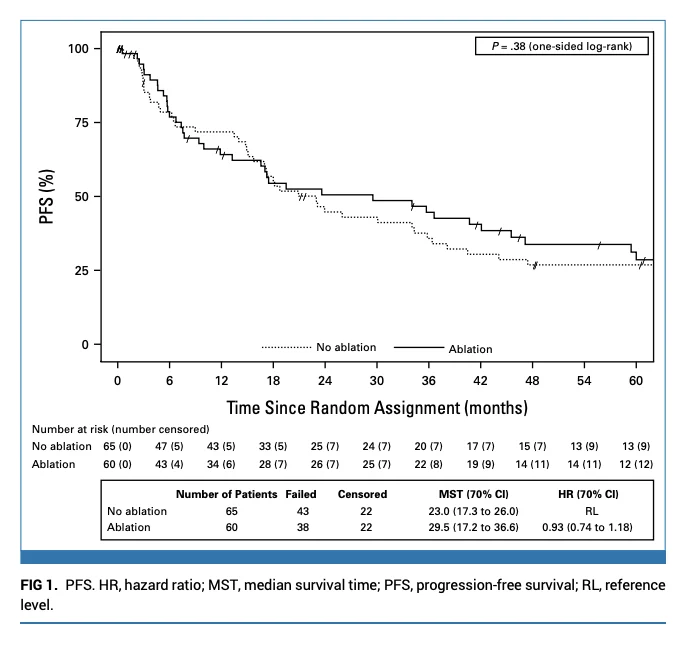
Extended follow-up was subsequently performed with a data cutoff in September 2025. At a median follow-up of 57.5 months, median PFS was:
- 23.0 months with no ablation
versus
- 29.5 months with ablation.
Despite the numerical difference, the treatment effect remained nonsignificant:
- HR 0.93; 95% CI, 0.60–1.44.
The Kaplan-Meier analysis similarly showed no statistically significant PFS advantage with metastasis-directed therapy. The extended analysis therefore reinforced rather than overturned the original phase II result.
No Overall Survival Benefit
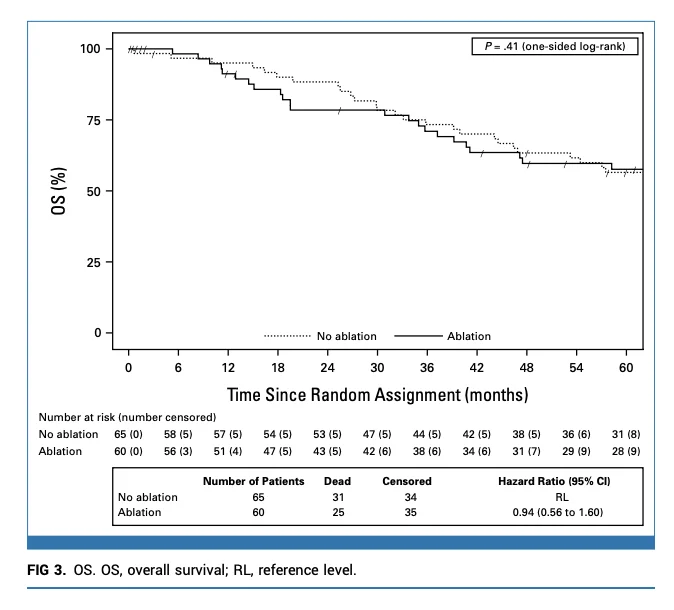
Metastasis-directed therapy also failed to improve OS. With extended follow-up, 56 deaths had occurred: 31 in the systemic-therapy-alone group and 25 in the ablation group.
The OS hazard ratio was:
- HR 0.94; 95% CI, 0.56–1.60
with no statistically significant difference between treatment groups. The absence of both a PFS and OS benefit substantially weakens the rationale for routinely adding metastasis-directed treatment to first-line systemic therapy in unselected patients with oligometastatic breast cancer.
Local Control Did Not Prevent Systemic Progression
One of the most informative findings concerns the mechanism by which metastasis-directed therapy failed. Among patients receiving ablation, many treated lesions remained locally controlled. However, some patients subsequently progressed at new metastatic sites outside the ablated areas.
The investigators concluded that metastasis-directed therapy did not prevent the emergence of new metastases, a requirement if local ablation is ultimately to translate into improved PFS or survival in a systemic malignancy.
This distinction is clinically relevant: effective local control does not necessarily translate into effective control of the underlying metastatic process.
Why NRG-BR002 Matters
Earlier studies across mixed tumor types, particularly SABR-COMET, generated substantial interest in aggressive local treatment of oligometastatic disease. NRG-BR002 provides a different level of disease-specific evidence.
Unlike trials incorporating multiple cancer types, NRG-BR002 exclusively enrolled patients with breast cancer, required use of first-line systemic therapy, and stratified patients according to clinically relevant breast cancer variables.
Even after prolonged follow-up, metastasis-directed treatment did not improve PFS or prevent the development of new metastatic lesions. These findings argue against extrapolating positive oligometastatic data from other malignancies directly to breast cancer.
Could Biomarkers Identify a Subgroup That Benefits?
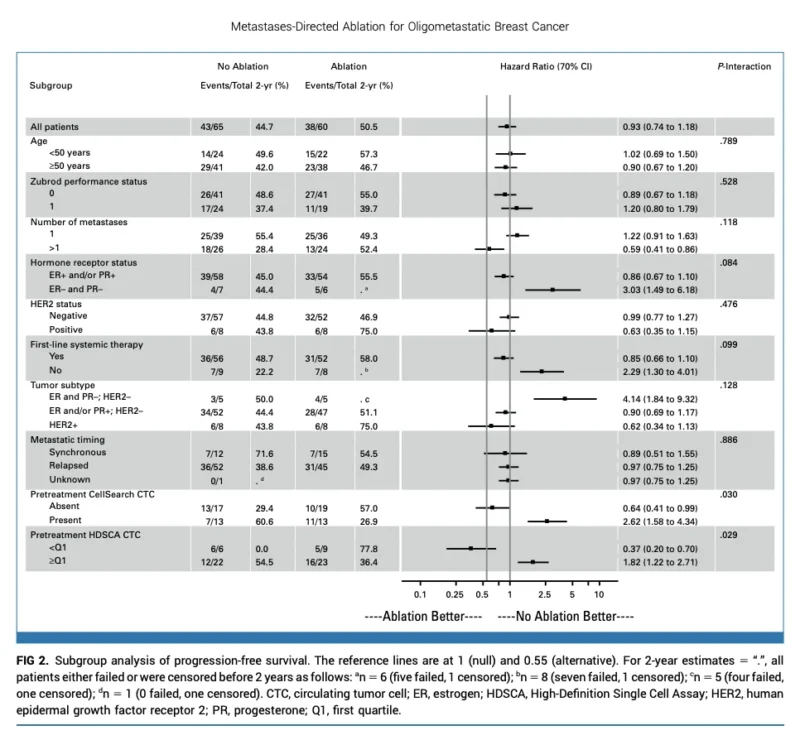
An exploratory translational analysis raises an important hypothesis. Pretreatment CTCs were assessed using both CellSearch and the High-Definition Single Cell Assay. CTC levels were not prognostic for PFS across the overall population. However, patients with absent or very low pretreatment CTC levels appeared to derive greater benefit from ablation.
For example, among patients with absent CellSearch CTCs, the exploratory hazard ratio favored ablation at 0.64, whereas patients with detectable CTCs appeared not to benefit. Similarly, patients with HDSCA CTC counts below the first quartile had a hazard ratio of 0.37, with a significant treatment-by-biomarker interaction.
These findings are hypothesis-generating rather than practice-changing. The biomarker subsets were small and were not designed to establish a treatment indication. Nevertheless, they raise the possibility that metastasis-directed treatment may ultimately require biologic selection rather than selection based simply on the number of visible metastases.
The authors specifically highlight minimal residual disease approaches, including CTCs and emerging ctDNA assays, as potential tools for future trials.
Treatment Was Generally Well Tolerated
The absence of efficacy was not driven by prohibitive acute toxicity. No treatment-related grade 5 events occurred. In the ablation arm, no grade 4 toxicities were reported and grade 3 toxicity occurred in approximately 5% of patients. However, safety alone does not establish clinical value.
The authors emphasize that ablative procedures carry additional treatment burden, potential late toxicity, and health-care costs. Without demonstrated improvement in clinically meaningful outcomes, routine use becomes difficult to justify.
Important Limitations
Several factors should shape interpretation of NRG-BR002. The study population was heavily weighted toward HR-positive/HER2-negative disease, limiting certainty in HER2-positive and triple-negative breast cancer. Subgroup analyses were also constrained by small patient numbers.
In addition, systemic therapy was not standardized, and the trial accrued between 2014 and 2019. The therapeutic landscape of metastatic breast cancer has subsequently changed substantially, particularly with CDK4/6 inhibitors, antibody-drug conjugates, and newer HER2-directed therapies.
These limitations justify continued investigation in carefully selected populations, but they do not negate the primary randomized finding.
OncoDaily Takeaway
NRG-BR002 provides the strongest breast cancer–specific randomized evidence to date against routine metastasis-directed ablation during first-line therapy for unselected oligometastatic breast cancer. Adding SBRT or surgery to systemic therapy did not improve PFS, did not improve OS, and did not prevent the development of new metastatic disease.
For current practice, the study supports reserving metastasis-directed treatment primarily for symptom palliation or clinical trials, rather than routinely ablating asymptomatic oligometastases in an attempt to improve survival.
The more important future question may no longer be whether every patient with a small number of metastases should receive ablation, but whether biomarkers such as CTCs or ctDNA can identify a biologically distinct subgroup in whom metastatic disease remains sufficiently limited for local treatment to matter.
Source
- Chmura SJ, Winter KA, Woodward WA, et al. NRG-BR002: A Randomized Phase II/III Trial of Metastasis-Directed Ablation With First-Line Systemic Therapy for Oligometastatic Breast Cancer. Journal of Clinical Oncology. Published October 7, 2026. DOI: 10.1200/JCO-26-00201.