
A new pooled analysis of three randomized clinical trials provides further evidence supporting carboplatin as a component of neoadjuvant chemotherapy for early-stage triple-negative breast cancer (TNBC). Combining individual patient-level clinical and molecular data from BrighTNess, CALGB 40603, and GeparSixto, investigators found that adding carboplatin significantly improved pathological complete response and event-free survival, although a statistically significant overall survival advantage was not demonstrated.
Published on October 27, 2026, in JCO Oncology Advances, the study was led by Brooke M. Felsheim, PhD, and colleagues, including Charles M. Perou, PhD, and Sibylle Loibl, MD. The analysis included 1,084 patients, of whom 664 received carboplatin in addition to anthracycline- and taxane-based neoadjuvant chemotherapy.
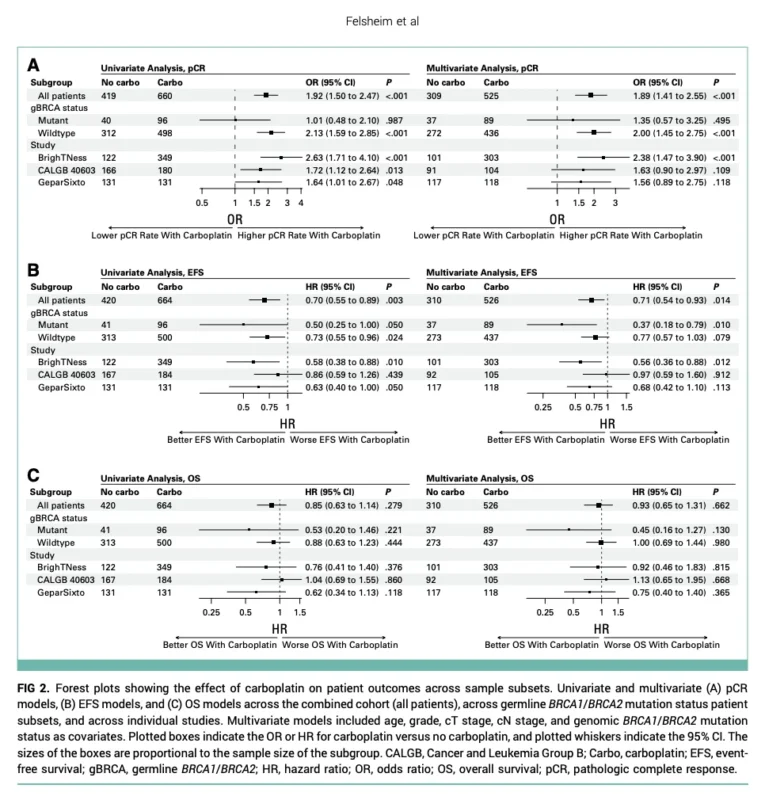
After adjustment for relevant clinical characteristics, carboplatin was associated with significantly greater odds of pathological complete response (pCR), with an odds ratio (OR) of 1.89 (95% CI 1.41–2.55; p<0.001).
The addition of carboplatin was also associated with improved event-free survival (EFS), with a hazard ratio (HR) of 0.71 (95% CI 0.54–0.93; p=0.01). However, the adjusted overall survival (OS) analysis did not demonstrate a significant difference (HR 0.93; 95% CI 0.65–1.31; p=0.66).
Beyond these efficacy findings, the study offers important insights into germline BRCA1/2 mutations, tumor immune signatures, and molecular subtypes, highlighting the distinction between prognostic biomarkers and markers capable of predicting carboplatin-specific benefit.
Why Reassess Carboplatin in Early-Stage TNBC?
Triple-negative breast cancer is defined by the absence of estrogen receptor and progesterone receptor expression and the lack of HER2 positivity. It is characterized by substantial molecular heterogeneity, an increased risk of early recurrence, and fewer endocrine- or HER2-directed treatment options than other major breast cancer subtypes.
Neoadjuvant anthracycline- and taxane-based chemotherapy has long formed the foundation of systemic treatment for patients with higher-risk early-stage TNBC. The addition of carboplatin has consistently increased pCR rates in several randomized studies. However, results concerning long-term survival have been less uniform.
This distinction is particularly important because pathological response, although strongly associated with prognosis, is not an interchangeable substitute for demonstrated improvements in long-term outcomes. The introduction of pembrolizumab-based perioperative treatment has further changed the clinical landscape.
In KEYNOTE-522, carboplatin was incorporated into the chemotherapy backbone in both treatment groups. The trial established the benefit of adding pembrolizumab but was not designed to isolate the independent contribution of carboplatin.
Consequently, questions remain about the specific long-term benefit of platinum-containing neoadjuvant chemotherapy, particularly in patients who cannot receive immunotherapy or for whom treatment de-escalation is being considered.
The new pooled analysis addresses these questions by combining patient-level data from three randomized trials that specifically evaluated carboplatin addition.
Study Design: Combining BrighTNess, CALGB 40603, and GeparSixto
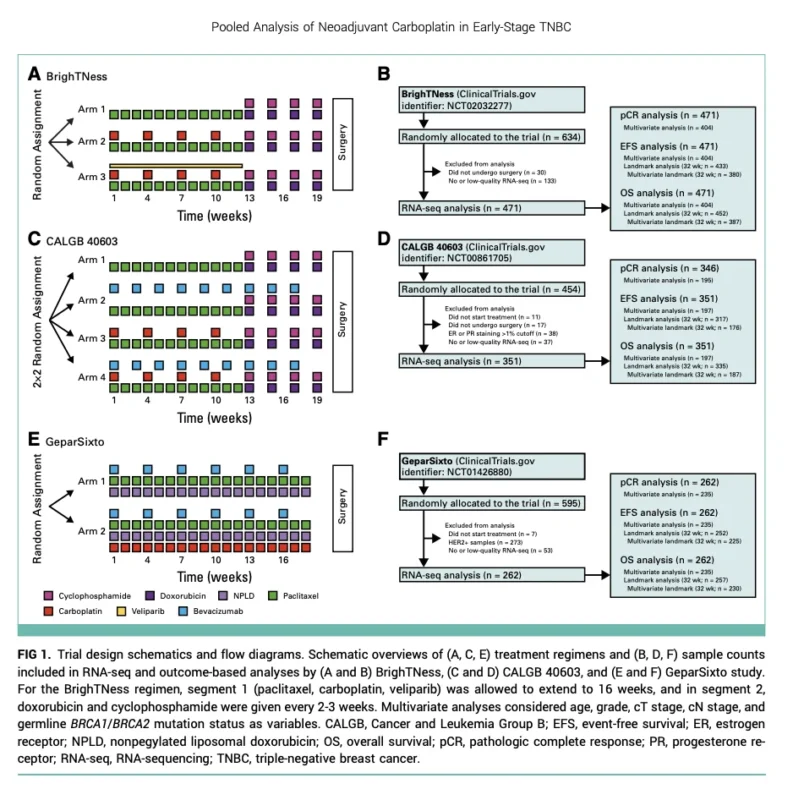
The investigators integrated clinical outcomes and pretreatment RNA-sequencing data from three major randomized studies. BrighTNess was a phase III trial investigating neoadjuvant carboplatin, with or without veliparib, added to standard chemotherapy.
CALGB 40603 was a randomized phase II trial evaluating the addition of carboplatin and/or bevacizumab to standard neoadjuvant treatment.
GeparSixto was a randomized phase II study investigating carboplatin addition in patients with early-stage TNBC and HER2-positive breast cancer; only the TNBC population was included in this pooled analysis.
All three studies investigated carboplatin in the context of anthracycline- and taxane-based neoadjuvant chemotherapy. Importantly, none of the included patients received immune checkpoint inhibitors. The final pooled population comprised 471 patients from BrighTNess, 351 from CALGB 40603, and 262 from GeparSixto.
Overall, 664 patients (61.3%) received carboplatin, while 420 did not. Median age was 49 years, and the majority of tumors were clinical T2. Approximately 56% of patients with available nodal information had clinically node-negative disease. The median EFS follow-up was 4.7 years, although follow-up duration differed substantially between studies.
The analysis included assessment of pCR, EFS, and OS, along with germline BRCA1/2 status, eight predefined gene-expression signatures, and molecular subtypes defined by PAM50 and the MD Anderson Cancer Center/Baylor College of Medicine classification.
The investigators used mixed-effects regression and study-stratified Cox models to account for differences between trials.
Carboplatin Significantly Improves Pathological Complete Response
The overall pooled pCR rate was 48.7%. When carboplatin was added to neoadjuvant chemotherapy, the odds of achieving pCR increased significantly. The univariate analysis demonstrated an OR of 1.92 (95% CI 1.50–2.47; p<0.001).
After adjustment for age, tumor stage, nodal status, germline BRCA status, and tumor grade, the benefit remained significant, with an OR of 1.89 (95% CI 1.41–2.55; p<0.001). These findings provide further evidence that carboplatin improves the depth of pathological response to anthracycline- and taxane-containing regimens.
However, interpretation of pCR requires consideration of its prognostic value. Patients achieving pCR after neoadjuvant treatment generally experience more favorable long-term outcomes than those with residual invasive disease.
Nevertheless, an improvement in pCR at the treatment-group level does not automatically establish a corresponding improvement in OS. The investigators therefore placed particular emphasis on evaluating long-term EFS and OS rather than relying solely on pathological response.
Event-Free Survival Improves With Carboplatin
The most clinically consequential finding was the association between carboplatin and improved EFS. In the overall pooled population, carboplatin was associated with a significantly lower hazard of an EFS event in the univariate analysis (HR 0.70; 95% CI 0.55–0.89; p=0.003).
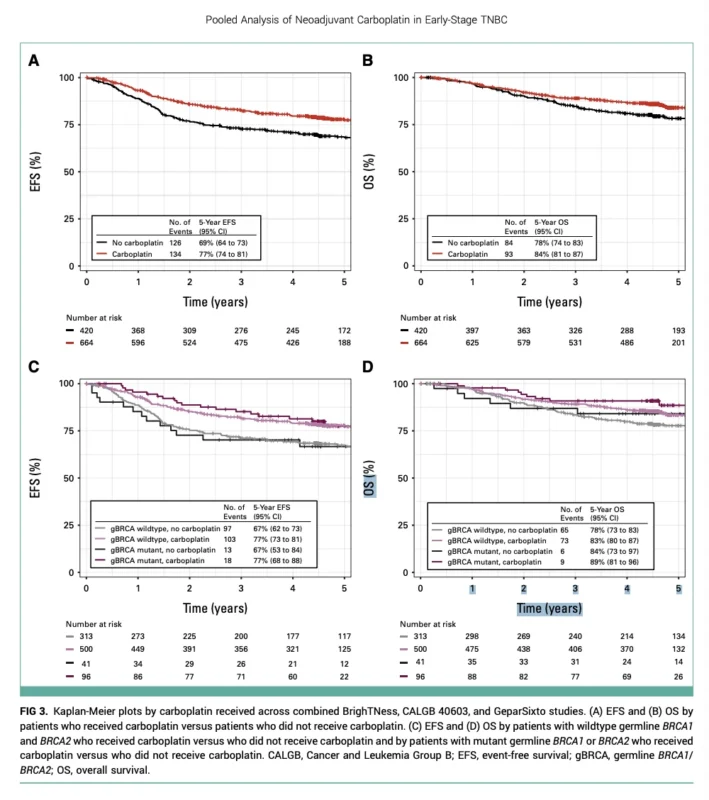
The association persisted after multivariable adjustment, with an HR of 0.71 (95% CI 0.54–0.93; p=0.01). At five years, estimated EFS was 77% among patients receiving carboplatin compared with 69% among those who did not.
This represents an eight-percentage-point numerical difference in five-year EFS. The findings strengthen the evidence that carboplatin provides benefits extending beyond improved pathological response.
However, the hazard ratio reflects an association estimated across the pooled analytical population and should not be interpreted as a direct randomized comparison of two otherwise identical treatment regimens.
The three original trials differed in chemotherapy schedules, concomitant treatments, eligibility criteria, and follow-up duration. Nevertheless, the consistency of the pooled EFS association provides support for carboplatin-containing neoadjuvant therapy in appropriately selected patients with early TNBC.
Overall Survival: No Statistically Significant Improvement
Despite the favorable EFS findings, the analysis did not demonstrate a statistically significant OS advantage. The univariate OS HR was 0.85 (95% CI 0.63–1.14; p=0.28). After adjustment for relevant clinical variables, the HR was 0.93 (95% CI 0.65–1.31; p=0.66).
Five-year estimated OS was 84% among patients who received carboplatin and 78% among those who did not. Although the numerical survival estimates favored carboplatin, the adjusted analysis did not establish a significant difference.
This distinction is essential. The absence of statistical significance does not prove that carboplatin has no OS benefit, particularly when the study may be underpowered to detect modest differences.
The authors acknowledged that a substantially larger number of events would be required to reliably identify a relatively small OS effect. Accordingly, the findings support improved pCR and EFS but do not establish an OS advantage or definitive equivalence between treatment approaches.
Germline BRCA Mutations: An Unexpected Difference Between pCR and EFS
One of the most intriguing findings emerged from the analysis of patients harboring germline BRCA1 or BRCA2 mutations. Because BRCA proteins participate in homologous recombination DNA repair, BRCA-mutated tumors may be particularly sensitive to DNA-damaging therapies, including platinum compounds.
This biological rationale has contributed to interest in germline BRCA status as a potential predictive biomarker for carboplatin. Among 950 patients with known germline BRCA status, 137 carried pathogenic BRCA1/2 mutations.
In this subgroup, adding carboplatin was not significantly associated with higher pCR rates. The adjusted OR was 1.35 (95% CI 0.57–3.25; p=0.495). However, carboplatin was associated with significantly improved EFS, with an adjusted HR of 0.37 (95% CI 0.18–0.79; p=0.01).
This represents an important observation because the survival association was not accompanied by a statistically significant improvement in pCR. The OS analysis in germline BRCA mutation carriers also did not demonstrate statistical significance.
These findings suggest that pathological response may not fully capture the potential long-term benefit of carboplatin in this subgroup. However, the relatively small sample size and exploratory nature of the subgroup analysis require cautious interpretation.
A statistically significant association within one subgroup and a nonsignificant result within another do not, by themselves, demonstrate that the treatment effects differ between those subgroups. Further evidence is necessary before germline BRCA status can be used to determine whether carboplatin should be included or omitted.
BRCA-Wildtype Disease Also Demonstrates Carboplatin Benefit
Among the 813 patients with germline BRCA-wildtype tumors, carboplatin was associated with significantly increased odds of achieving pCR. The adjusted OR was 2.00 (95% CI 1.45–2.75; p<0.001). EFS also favored carboplatin in the univariate analysis (HR 0.73; 95% CI 0.55–0.96; p=0.02).
However, the association did not retain statistical significance after multivariable adjustment (HR 0.77; 95% CI 0.57–1.03; p=0.08). No significant OS association was identified. These findings reinforce that carboplatin activity is not restricted to patients with inherited BRCA mutations.
Importantly, the results do not support excluding carboplatin solely because germline BRCA testing is negative. The clinical value of carboplatin must be considered within the full treatment strategy rather than inferred from germline BRCA status alone.
Immune Gene Signatures Predict Prognosis, Not Carboplatin-Specific Benefit
A major strength of the study was its integration of clinical trial outcomes with pretreatment tumor RNA-sequencing data. The investigators evaluated eight predefined gene-expression signatures reflecting immune activity, angiogenesis, and hypoxia.
Six immune-related signatures were significantly associated with higher pCR rates. Four signatures were also significantly associated with improved EFS and OS: the CD8-positive T-cell signature, immunoglobulin G signature, Immune1 TCGA breast signature, and CD274 expression.
For example, higher CD8-positive T-cell signature expression was associated with greater odds of pCR (OR 1.37; 95% CI 1.18–1.59), better EFS (HR 0.82; 95% CI 0.72–0.93), and better OS (HR 0.79; 95% CI 0.67–0.93).
The Immune1 signature demonstrated similar associations, with an OR of 1.45 for pCR, HR of 0.81 for EFS, and HR of 0.73 for OS. These observations reinforce the importance of an immunologically active tumor microenvironment in determining treatment response and prognosis.
However, none of the evaluated signatures demonstrated a statistically significant interaction with carboplatin treatment for pCR, EFS, or OS. This distinction is fundamental. The signatures were associated with favorable outcomes, but they did not reliably identify patients who derived a greater relative benefit from adding carboplatin.
Consequently, the study identifies potentially valuable prognostic biomarkers but does not establish a clinically actionable RNA-based test for carboplatin selection.
Molecular Subtypes Reveal Different Pathological Response Patterns
The investigators also explored whether established RNA-based TNBC subtypes were associated with pathological response and survival. Approximately 78% of tumors were classified as basal-like using PAM50.
Compared with basal-like disease, tumors classified as luminal A or luminal B demonstrated significantly lower odds of pCR in multivariable analysis (OR 0.47; 95% CI 0.23–0.94; p=0.04). Using the MDACC/BCM classification, the luminal androgen receptor (LAR) subtype demonstrated substantially lower odds of pCR than the basal-like immune-activated subtype (OR 0.27; 95% CI 0.11–0.59; p=0.002).
These findings support the biological heterogeneity of TNBC. However, molecular subtype was not significantly associated with EFS or OS in the pooled analysis, and no subtype demonstrated a significant treatment interaction capable of predicting carboplatin-specific benefit.
Therefore, the results do not support using PAM50 or the MDACC/BCM classification to routinely omit platinum treatment.
Pathological Response Remains a Strong Prognostic Marker
Across the pooled population, achieving pCR was strongly associated with improved survival. Using a 32-week landmark analysis to reduce guarantee-time bias, the investigators identified significant associations between pCR and both EFS and OS.
The adjusted HR was 0.31 (95% CI 0.22–0.42; p<0.001) for EFS and 0.27 (95% CI 0.17–0.42; p<0.001) for OS. These findings reinforce the important prognostic value of pathological response in early-stage TNBC. Nevertheless, pCR remains an imperfect surrogate for treatment benefit.
The germline BRCA findings illustrate this limitation: improved EFS was observed with carboplatin despite no significant pCR improvement in mutation carriers. The study therefore supports evaluating pathological response and long-term clinical outcomes together rather than assuming that one endpoint fully predicts the other.
How Do These Results Apply in the Pembrolizumab Era?
The relevance of this pooled analysis must be considered within the modern treatment landscape. The three component trials were conducted before the routine integration of neoadjuvant pembrolizumab and before response-adapted postoperative treatment strategies became widely established.
None included immune checkpoint inhibitors. Modern stage II–III TNBC treatment commonly incorporates carboplatin, paclitaxel, anthracycline-based chemotherapy, and pembrolizumab, followed by postoperative immunotherapy.
Long-term KEYNOTE-522 results have demonstrated a sustained EFS and OS benefit from the pembrolizumab-containing strategy. However, because carboplatin was administered in both KEYNOTE-522 groups, that trial did not directly determine whether carboplatin could safely be removed from the immunotherapy backbone.
Similarly, the present analysis cannot determine whether the historical carboplatin-associated EFS benefit would remain unchanged when patients also receive pembrolizumab. The authors acknowledge that the included trials preceded the establishment of adjuvant capecitabine for selected patients with residual disease.
Thus, the findings strengthen the rationale for carboplatin as part of neoadjuvant therapy but should not be interpreted as direct evidence for every contemporary treatment combination. They also do not establish that carboplatin must be given universally, irrespective of disease stage, comorbidities, or treatment tolerance.
Limitations and Remaining Questions
The pooled analysis has several important limitations. Although the component trials were randomized, the pooled evaluation included selected patients with available clinical and RNA-sequencing data rather than representing every randomized participant.
Chemotherapy regimens and carboplatin schedules differed across studies. Some participants also received bevacizumab or veliparib, introducing additional treatment heterogeneity. The investigators attempted to account for between-study differences through statistical modeling, but only three trials were available.
Missing molecular or clinical covariate data reduced sample sizes in adjusted analyses. The subgroup findings, particularly among germline BRCA mutation carriers, require further confirmation. The analysis also did not demonstrate a significant OS benefit and was not designed to provide a new pooled comparison of carboplatin-related toxicity.
Finally, no immune checkpoint inhibitors were administered, limiting direct applicability to the current pembrolizumab-containing standard. Future studies should establish whether patients can be selected for platinum omission using more reliable biological markers while preserving long-term disease control.
OncoDaily Takeaway
This 2026 pooled analysis strengthens the evidence supporting neoadjuvant carboplatin in early-stage TNBC by demonstrating significant improvements in pathological complete response and event-free survival across three randomized clinical trial populations.
The adjusted OR for pCR was 1.89, while the adjusted HR for EFS was 0.71. Estimated five-year EFS reached 77% with carboplatin compared with 69% without it. However, the study did not demonstrate a statistically significant OS benefit.
The germline BRCA analysis was particularly informative. Mutation carriers experienced improved EFS without a significant increase in pCR, while BRCA-wildtype patients demonstrated a clear pCR improvement. Immune gene-expression signatures were associated with favorable pathological and survival outcomes but did not predict carboplatin-specific benefit.
These findings reinforce two important clinical principles: carboplatin remains a supported component of treatment for appropriately selected patients with early-stage TNBC, and prognostic biomarkers should not be confused with validated predictors of treatment benefit.
The next challenge is to determine whether molecular and immune biomarkers can identify patients who require platinum-containing therapy and those who may safely receive less intensive treatment. Until such strategies are prospectively validated, the findings support the current carboplatin-containing approach while highlighting unresolved questions about optimization in the immunotherapy era.
Sources
- Felsheim BM, Huober J, Carey LA, et al. Impact of Neoadjuvant Carboplatin in Early-Stage Triple-Negative Breast Cancer: A Pooled Analysis of the BrighTNess, Cancer and Leukemia Group B 40603 (Alliance), and GeparSixto Clinical Trials. JCO Oncology Advances. 2026;3.