
The success of HER2-targeted therapy has created a clinical question that would have seemed improbable two decades ago: can treatment ever be safely stopped in patients with HER2-positive metastatic breast cancer who achieve a prolonged complete response?
An international physician survey conducted through the Breast International Group (BIG) shows that many oncologists now believe that a subset of patients with HER2-positive metastatic breast cancer may potentially achieve durable remission consistent with cure. Yet this evolving belief has not translated into routine treatment discontinuation.
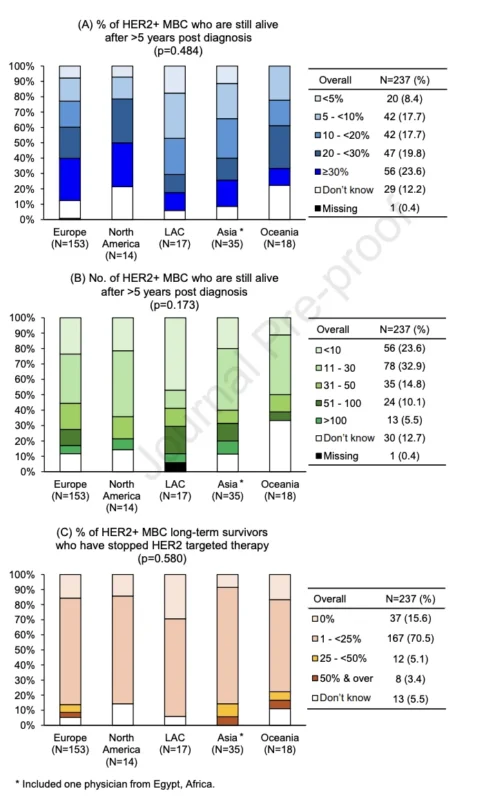
Among 237 physicians from 38 countries, 59.5% believed HER2-positive metastatic breast cancer could be cured in some patients, but fewer than half supported stopping maintenance HER2-targeted therapy after a prolonged complete response. In everyday practice, discontinuation remained uncommon.
The findings, published in The Breast, expose an increasingly relevant dilemma created by the success of modern HER2-directed treatment: how long should therapy continue when metastatic disease has been radiologically absent for years?
Long-Term Survival Is Changing the Clinical Question
HER2-positive metastatic breast cancer was historically associated with aggressive disease and poor survival. The development of trastuzumab, followed by pertuzumab, antibody-drug conjugates and other HER2-directed strategies, has fundamentally altered that prognosis.
Long-term follow-up from CLEOPATRA demonstrated that a meaningful proportion of patients receiving trastuzumab and pertuzumab could remain alive and in remission many years after treatment initiation. More recently, therapeutic advances have extended disease control even further. In DESTINY-Breast03, trastuzumab deruxtecan (T-DXd) produced a median PFS of 29.0 months compared with 7.2 months with T-DM1, with median OS of 52.6 versus 42.7 months.
The first-line landscape has subsequently evolved again. In DESTINY-Breast09, T-DXd plus pertuzumab achieved a median PFS of 40.7 months, compared with 26.9 months with taxane, trastuzumab and pertuzumab. Complete responses were reported in 15.1% and 8.5% of patients, respectively. For hormone receptor-positive/HER2-positive disease, PATINA has further extended disease control by incorporating palbociclib into maintenance HER2-targeted and endocrine therapy.
Collectively, these advances are creating a growing population of patients who live for many years with metastatic HER2-positive breast cancer, including some with no radiologically detectable disease. That success raises a new question: does every exceptional responder still require indefinite HER2 blockade?
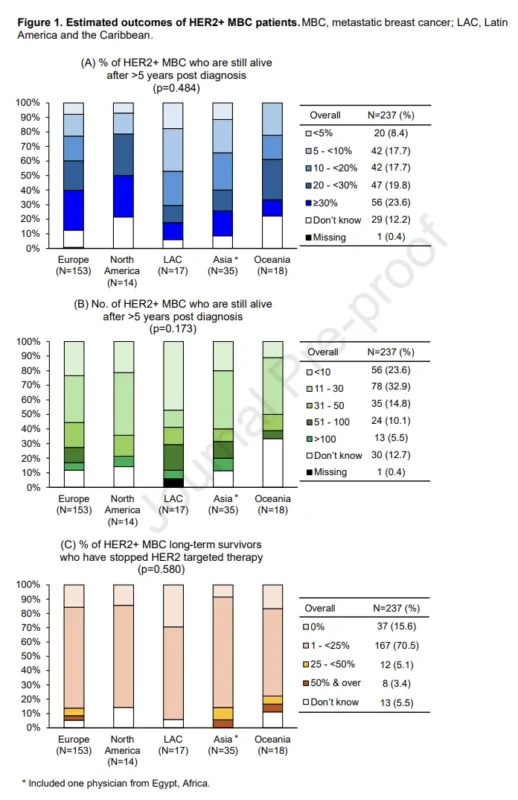
A Global Survey Across 38 Countries
The investigators conducted an online survey through the BIG network between October 30, 2024 and January 1, 2025. A total of 237 physicians from 197 institutions across 38 countries participated.
Most respondents were medical oncologists, and more than three-quarters had been practicing for at least 10 years, suggesting that the survey largely reflects clinicians with substantial experience treating metastatic breast cancer.
Geographic representation was weighted toward Europe:
- 64.6% of respondents were from Europe
- 14.3% from Asia
- 7.6% from Oceania
- 7.2% from Latin America and the Caribbean
- 5.9% from North America
- 0.4% from Africa
This distribution is important when interpreting the findings, particularly those involving treatment access.
Access to HER2-Targeted Therapy Remains Unequal
Most physicians reported broad access to standard HER2-targeted therapy, but substantial geographic disparities remained. Overall, 88.6% reported full access to trastuzumab, while 80.6% reported full access to pertuzumab for first-line HER2-positive metastatic breast cancer.
However, trastuzumab access was substantially lower in Asia, where full access was reported by 60.0% of physicians, compared with approximately 93%–94% in other major regions.
The difference was even more pronounced for pertuzumab. Full access was reported by only 48.6% of respondents from Asia and 47.1% from Latin America and the Caribbean, compared with 85.7%–100% in other regions.
These findings provide an important context for discussions about treatment duration. While some health systems are now considering whether long-term responders might safely stop therapy, others continue to face challenges providing access to established HER2-targeted treatments in the first place.
Physicians Are Increasingly Open to the Concept of Cure
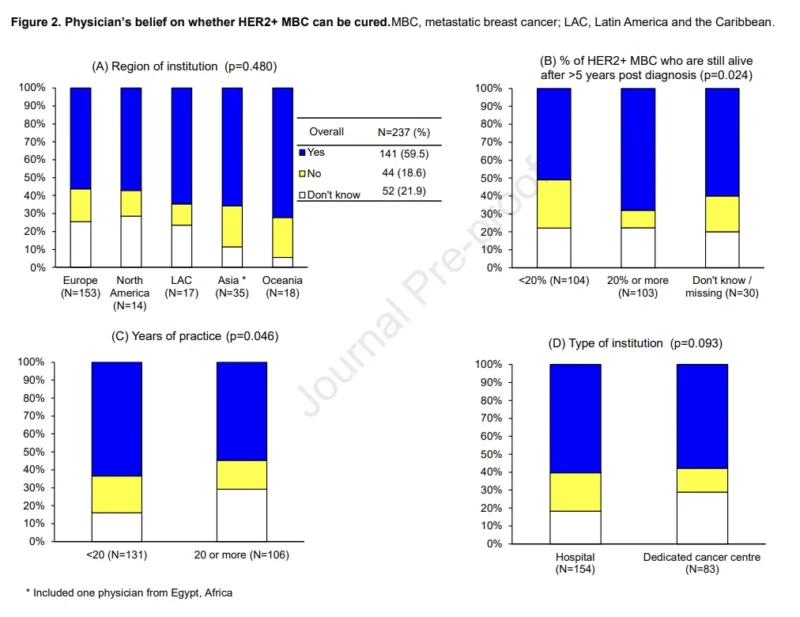
Perhaps the most striking result was how physicians now conceptualize metastatic HER2-positive disease. 59.5% believed that HER2-positive metastatic breast cancer could be cured. Another 21.9% were uncertain, while only 18.6% considered the disease definitively incurable.
This represents a notable departure from the traditional framework in which metastatic breast cancer is universally considered treatable but incurable.
Physicians who reported seeing better long-term survival in their own practice were substantially more likely to believe cure was possible. Those estimating a 5-year survival rate of at least 20% among their HER2-positive metastatic patients were approximately 3.8 times more likely to report believing that the disease could be cured than physicians reporting lower survival rates.
Importantly, the survey does not demonstrate that HER2-positive metastatic breast cancer is biologically cured in these patients. Rather, it shows how increasingly durable treatment responses are changing clinicians’ perception of what metastatic disease may mean for selected exceptional responders.
Belief in Cure Has Not Translated Into Treatment Discontinuation
Despite growing optimism, clinical practice remains considerably more conservative. Among physicians treating long-term survivors with no evidence of disease, 86.1% estimated that fewer than one-quarter of these patients had discontinued maintenance HER2-targeted therapy.
At the same time:
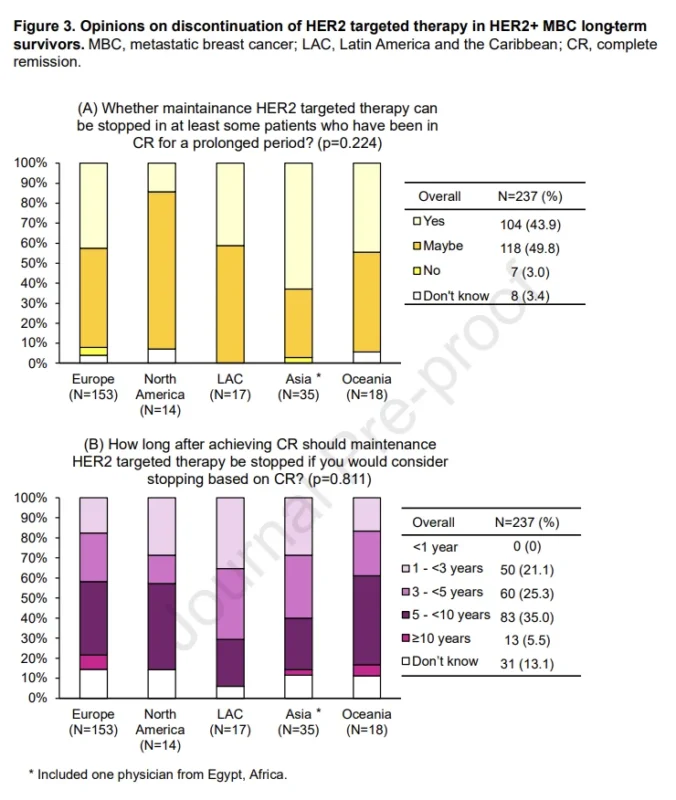
- 43.9% believed therapy could potentially be discontinued after a prolonged complete response
- Another 49.8% answered “maybe”
Only a small minority stated definitively that therapy should not be stopped. The discrepancy is revealing. Many clinicians are theoretically open to treatment discontinuation, yet few appear sufficiently confident in the evidence to implement it routinely.
The issue is therefore not simply whether oncologists believe stopping treatment might be possible. It is whether they can reliably identify who can stop without compromising long-term disease control.
When Should Treatment Stop?
There was no consensus on the appropriate duration of complete remission before considering discontinuation. No respondents supported stopping therapy before one year of complete response.
Among physicians willing to consider discontinuation:
- 21.1% favored stopping after 1 to <3 years of CR
- 25.3% favored 3 to <5 years
- 35.0% favored 5 to <10 years
- 5.5% favored waiting at least 10 years
- Another 13.0% remained uncertain
Thus, approximately 40% favored continuing therapy for at least five years before stopping. The broad distribution highlights the absence of a biologically established threshold separating prolonged disease control from a potentially durable treatment-free remission.
The Central Problem: Control or Cure?
This distinction is fundamental. A patient remaining in complete remission for many years while receiving trastuzumab, pertuzumab or another HER2-directed therapy could represent one of two very different biological situations. The treatment might still be suppressing microscopic residual disease, meaning discontinuation could permit recurrence.
Alternatively, the patient might have reached a state in which clinically relevant malignant disease has effectively been eradicated and continued treatment provides little additional benefit. As long as HER2-directed therapy continues indefinitely, distinguishing between these two states becomes extremely difficult.
This is one of the central paradoxes created by increasingly effective metastatic treatment: continued therapy prevents clinicians from knowing whether continued therapy is still necessary.
Patient Preference Is Driving Decisions
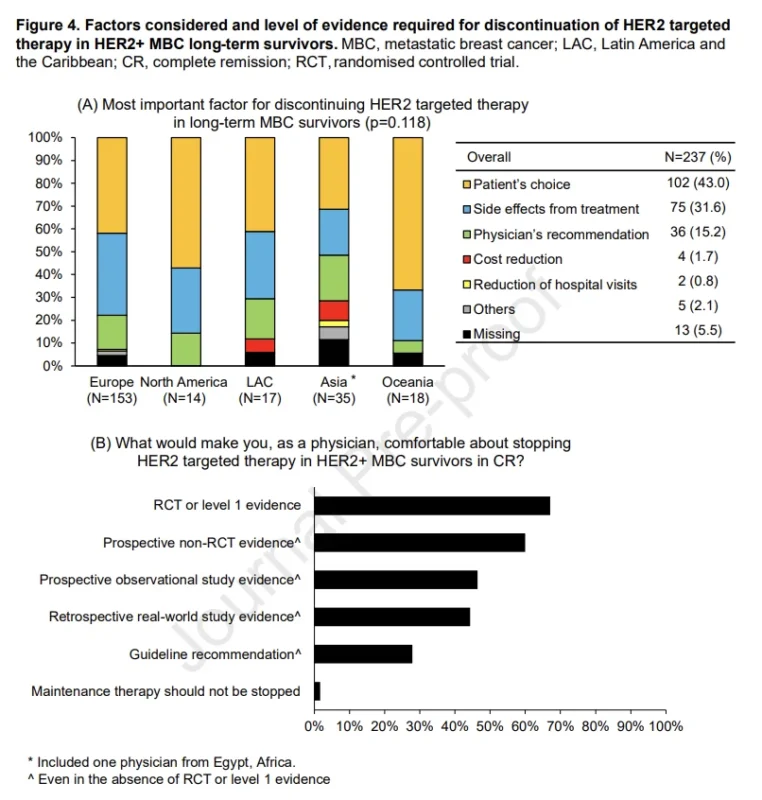
When physicians were asked which factor carried the greatest weight in deciding whether to discontinue HER2-directed therapy, the most common answer was not physician recommendation or treatment toxicity. It was patient preference. Patient choice was identified as the most important consideration by 43.0% of physicians, followed by:
- treatment-related adverse effects – 31.6%
- physician recommendation – 15.2%
- treatment cost – 1.7%
- reducing hospital visits – 0.8%
This reflects both the importance of shared decision-making and the lack of high-quality evidence supporting a standardized medical recommendation. When asked what would make patients more comfortable stopping treatment, 51.5% of physicians identified evidence demonstrating a low risk of relapse or progression as the most important factor.
Guideline endorsement and reassurance from the treating physician were each selected by 17.3%. In other words, clinicians believe patients are primarily looking for something that remains unavailable: a reliable method of demonstrating that residual metastatic disease is no longer present.
Physicians Want Prospective Evidence Before Changing Practice
The threshold for evidence was also clear. Approximately 67.1% of physicians said randomized controlled trial evidence would make them comfortable stopping maintenance HER2-targeted therapy.
Another 59.9% considered prospective non-randomized evidence potentially sufficient. Confidence fell with weaker evidence: only 46.4% regarded prospective observational studies as adequate, while 44.3% would accept retrospective real-world evidence.
This creates a practical research challenge. Randomizing exceptional responders who have remained disease-free for years to either continue or discontinue effective therapy can be logistically difficult, requires long follow-up and may face reluctance from both clinicians and patients. Nevertheless, several studies are beginning to address the question.
STOP-HER2, HEROES and Free-HER Could Help Define the Next Step
Several prospective studies are testing different approaches to HER2-targeted treatment discontinuation. STOP-HER2 (NCT05721248) is evaluating discontinuation in patients with an exceptional response, defined as disease control for at least three years.
HEROES (NCT06450314) incorporates molecular selection. Patients whose disease has remained controlled after two years of maintenance therapy and who have a negative circulating tumor DNA test are being evaluated for treatment de-escalation. Free-HER (NCT05959291) is following patients in complete radiologic remission who discontinue maintenance anti-HER2 therapy, incorporating ctDNA monitoring alongside standard surveillance.
These trials represent an important conceptual transition. Rather than stopping treatment after an arbitrary number of years, future approaches may identify candidates based on evidence of minimal residual disease or molecular remission.
Could ctDNA Define Who Is Ready to Stop?
Circulating tumor DNA is particularly attractive in this setting. Radiologic complete response does not necessarily mean complete eradication of cancer. Conventional imaging cannot reliably detect very small volumes of residual disease.
A sufficiently sensitive ctDNA assay could potentially provide another layer of information. Persistent or re-emerging ctDNA might indicate residual malignant clones and support continued therapy. Conversely, sustained ctDNA negativity over time could eventually help identify patients in whom treatment discontinuation can be considered with greater confidence.
This strategy remains investigational, and ctDNA negativity cannot currently be equated with cure. Still, the direction is important: the future of treatment discontinuation is likely to be biomarker-guided rather than calendar-guided.
The Question Is Becoming More Urgent in the T-DXd Era
The issue of treatment duration becomes even more relevant as T-DXd moves earlier in the HER2-positive metastatic treatment pathway. Newer regimens are producing deeper and more durable responses but also introduce concerns about cumulative toxicity.
Long-term HER2-directed therapy can be associated with cardiotoxicity, diarrhea, fatigue and rash. T-DXd adds additional considerations including nausea, vomiting, alopecia and, most importantly, interstitial lung disease/pneumonitis.
Indefinite intravenous treatment also imposes repeated clinic visits, laboratory monitoring, cardiac and respiratory surveillance, financial costs and disruption to work and daily life. As survival extends, these effects accumulate over years rather than months.
Consequently, treatment optimization in metastatic disease may increasingly involve not only determining which therapy should be given, but also determining when enough therapy has been given.
Maintenance Strategies Are Also Evolving
Treatment discontinuation is only one part of this broader discussion. The article highlights studies exploring different maintenance approaches after effective induction therapy.
The DEMETHER study is evaluating maintenance trastuzumab and pertuzumab after six cycles of T-DXd. Another planned strategy, DB-guide, involves transitioning patients to trastuzumab, pertuzumab and palbociclib after 18–24 cycles of T-DXd.
These studies reflect the same underlying objective: maintaining long-term disease control while reducing cumulative exposure to more intensive therapies.
The eventual strategy for exceptional responders could therefore include several possibilities, continuing the initial regimen indefinitely, transitioning to less intensive maintenance, or stopping treatment entirely in carefully selected patients.
Important Limitations
This was an international physician survey, not a clinical outcomes study. It cannot establish whether stopping HER2-targeted therapy is safe, identify which patients should discontinue treatment, or determine the optimal duration of therapy.
Respondents were predominantly European, with limited representation from Africa and smaller representation from Asia and North America. Participation was voluntary, creating the possibility of selection bias.
Clinical outcomes were also estimated by physicians rather than derived from patient-level databases, making recall bias possible. The survey additionally did not capture important patient-level characteristics such as hormone receptor status, number or sites of metastases, which could substantially influence perceptions regarding curability and treatment discontinuation.
These limitations are particularly important because the question of stopping effective metastatic treatment requires a high evidentiary threshold.
OncoDaily Takeaway
The most important message from this survey is not that maintenance HER2-targeted therapy should now be stopped in long-term responders. The evidence does not yet support that conclusion.
Instead, the study demonstrates that modern HER2-directed therapy has changed metastatic breast cancer enough that treatment discontinuation has become a legitimate research question.
Nearly 60% of surveyed physicians believe that at least some patients with HER2-positive metastatic breast cancer may be cured, yet maintenance therapy is rarely discontinued in practice. Most physicians remain constrained by the same fundamental uncertainty: there is currently no validated way to distinguish treatment-dependent complete remission from durable treatment-free remission.
That distinction could become increasingly important as T-DXd, pertuzumab, CDK4/6 inhibitors and future HER2-directed strategies produce progressively longer survival.
The next step should therefore not be indiscriminate treatment cessation. It should be prospective identification of patients in whom discontinuation can be tested safely – potentially integrating duration of response, disease burden, clinicopathological characteristics and molecular residual disease assessment with ctDNA. For exceptional responders, the future question may shift from “How long can we control metastatic HER2-positive breast cancer?” to “How do we know when continued treatment is no longer necessary?”
Source
- Lee HY, Ong WS, Tjan-Heijnen V, et al. To stop or not to stop? International physician survey on HER2 targeted therapy for metastatic breast cancer patients in remission. The Breast. 2026. DOI: 10.1016/j.breast.2026.104935.