
Can immune checkpoint inhibition preserve efficacy while allowing anthracyclines to be removed from neoadjuvant therapy for early triple-negative breast cancer? The phase III HELEN-Trio 011 trial provides important randomized evidence supporting that possibility.
In women with previously untreated stage II–III triple-negative breast cancer (TNBC), adding the PD-1 inhibitor camrelizumab to six cycles of docetaxel plus carboplatin significantly increased pathological complete response (pCR) compared with docetaxel-carboplatin alone.
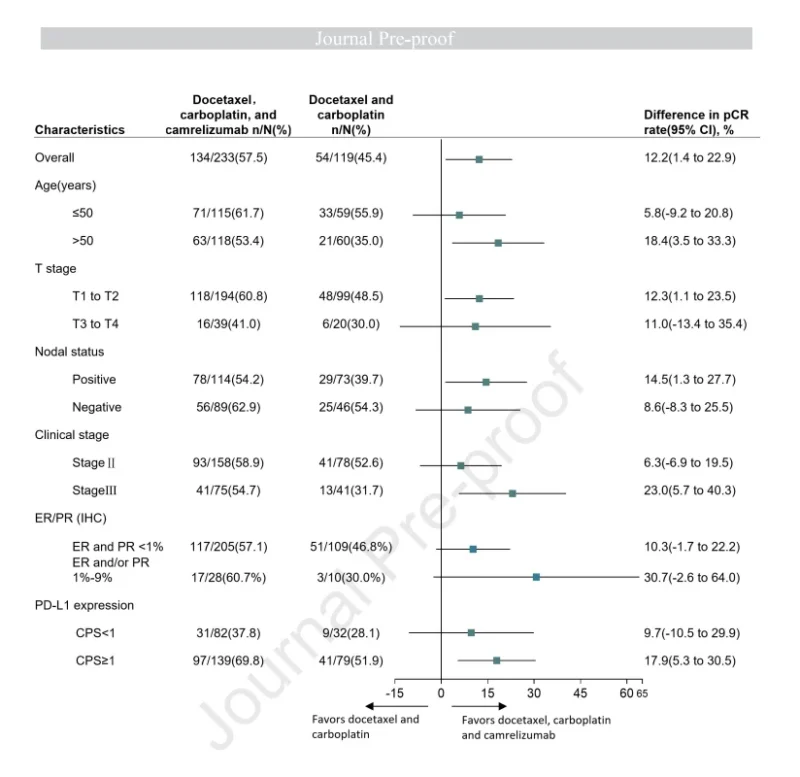
The primary endpoint was met: pCR increased from 45.4% to 57.5%, an absolute improvement of 12.2 percentage points. Importantly, the efficacy gain was achieved without a substantial increase in grade 3–4 treatment-related adverse events, which occurred in 24.9% with camrelizumab plus chemotherapy versus 21.8% with chemotherapy alone. No treatment-related deaths were reported.
HELEN-Trio 011 therefore addresses a central question in contemporary early TNBC: whether the benefit of neoadjuvant immunotherapy can be retained with a simpler, anthracycline-sparing chemotherapy backbone. The study was accepted for publication in Annals of Oncology in October 2026.
Why Anthracycline De-Escalation Matters in Early TNBC
Neoadjuvant chemoimmunotherapy has become a standard strategy for high-risk stage II–III TNBC. The KEYNOTE-522 regimen established perioperative pembrolizumab with sequential paclitaxel-carboplatin followed by anthracycline-cyclophosphamide chemotherapy, demonstrating improvements in pathological response, event-free survival and overall survival.
That efficacy, however, comes with substantial treatment intensity. Anthracyclines contribute important antitumor activity but are associated with acute hematologic toxicity as well as longer-term risks including cardiomyopathy and treatment-related leukemia. A regimen capable of preserving the benefits of chemoimmunotherapy while reducing cumulative treatment exposure could therefore have meaningful clinical value.
Anthracycline-free platinum-taxane strategies have already shown considerable activity in TNBC. In NeoSTOP, six cycles of docetaxel-carboplatin achieved a pCR rate similar to an anthracycline-containing sequential regimen but with substantially less severe toxicity. The phase II NeoPACT study subsequently demonstrated that adding pembrolizumab to docetaxel-carboplatin could produce a pCR rate of approximately 58%. HELEN-Trio 011 moves this concept into a randomized phase III setting.
A Randomized Phase III Study Across 14 Chinese Hospitals
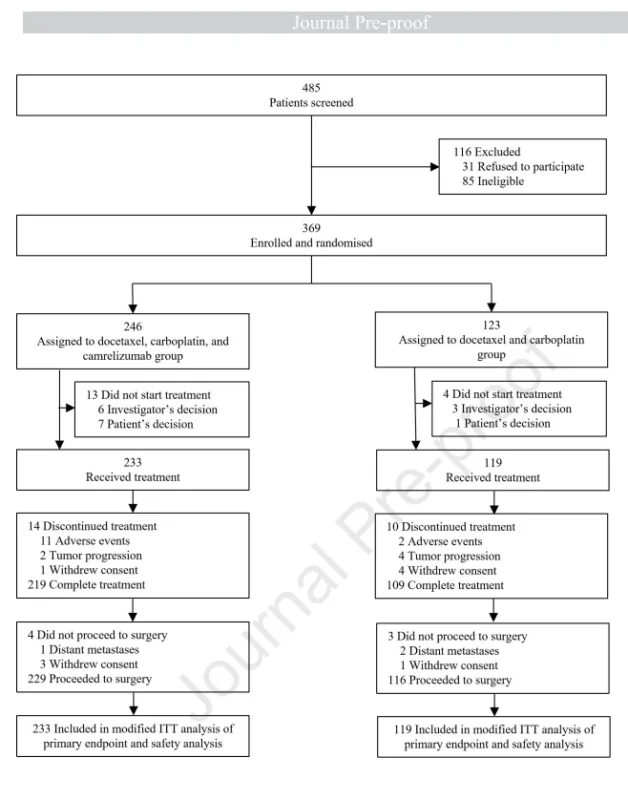
HELEN-Trio 011 was an open-label, multicenter phase III trial conducted at 14 hospitals in China between December 2022 and June 2025. Eligible patients were women aged 18–70 years with previously untreated, nonmetastatic stage II–III TNBC and ECOG performance status 0–1.
Eligible disease included clinical T1cN1–3 or T2–4 tumors with any nodal status. Patients with metastatic disease, previous immune checkpoint inhibitor exposure, active autoimmune disease or immunodeficiency, uncontrolled hepatitis, clinically significant cardiopulmonary disease or another active malignancy were excluded.
A total of 369 patients were randomized 2:1 to camrelizumab plus chemotherapy or chemotherapy alone. The modified intention-to-treat population consisted of 352 patients who received at least one dose of study therapy, 233 received camrelizumab plus chemotherapy and 119 received chemotherapy alone. Median age was 51 years.
Approximately 61.6% had node-positive disease, 16.8% had T3–T4 tumors, and PD-L1 expression with CPS ≥1 was present in about 62% of patients.
A Deliberately Simplified Chemotherapy Backbone
Both groups received six 21-day cycles of:
- docetaxel 75 mg/m² plus carboplatin AUC 6 on day 1
Patients in the experimental group additionally received:
- camrelizumab 200 mg intravenously on day 3 of each cycle
That timing is notable. Rather than administering chemotherapy and immunotherapy simultaneously, camrelizumab was delivered two days after chemotherapy.
All patients received primary prophylaxis with pegylated recombinant human G-CSF. Surgery was performed 2–6 weeks following completion of neoadjuvant therapy.
Patients assigned to camrelizumab continued adjuvant camrelizumab so that total treatment exposure from the beginning of neoadjuvant therapy was approximately 6 months. For patients with residual disease, six to eight cycles of adjuvant capecitabine were recommended.
Thus, HELEN-Trio 011 evaluated not only anthracycline omission but also a shorter overall immunotherapy duration than the 1-year perioperative approach commonly associated with KEYNOTE-522.
Camrelizumab Increased pCR by 12.2 Percentage Points
The primary endpoint was pathological complete response, defined as:
- ypT0/Tis ypN0
In the modified intention-to-treat population, pCR occurred in:
- 57.5% with camrelizumab + docetaxel-carboplatin
versus
- 45.4% with docetaxel-carboplatin alone.
The absolute difference was 12.2 percentage points with a 95% CI of 1.4–22.9. The one-sided P value was 0.014. The intention-to-treat analysis was consistent. pCR was 56.5% versus 43.9%, corresponding to an absolute difference of 12.6 percentage points.
These findings demonstrate that the addition of PD-1 blockade meaningfully increased eradication of invasive tumor from both breast and axillary lymph nodes despite omission of anthracyclines.
Radiologic Response Also Improved
The benefit was not confined to pathology. Preoperative radiologic objective response by MRI occurred in:
- 85.8% with camrelizumab plus chemotherapy
versus
- 72.3% with chemotherapy alone
The absolute difference was 13.5 percentage points. Residual Cancer Burden analyses were also reported as consistent with the primary pCR findings, further supporting greater depth of response with camrelizumab.
PD-L1-Positive Tumors Showed the Largest Numerical Benefit
PD-L1 was centrally evaluated using the 22C3 assay, with positivity defined as CPS ≥1. Among patients with PD-L1-positive tumors, pCR reached:
- 69.8% with camrelizumab
versus
- 51.9% with chemotherapy alone
That represented a 17.9-percentage-point absolute improvement. Among patients with PD-L1-negative disease, pCR was:
- 37.8% versus 28.1%
The difference of 9.7 percentage points was not statistically significant. However, the interaction between PD-L1 status and treatment effect was also not significant, with an interaction P value of 0.55. This is an important distinction.
The data suggest that PD-L1 positivity may identify a group with higher absolute response rates, but the trial does not demonstrate that PD-L1-negative patients derive no benefit.
This is consistent with the broader biology of early TNBC, in which PD-L1 has not been used to restrict eligibility for neoadjuvant checkpoint inhibition in the same way as in metastatic TNBC.
Early Event-Free Survival Is Encouraging but Not Yet Definitive
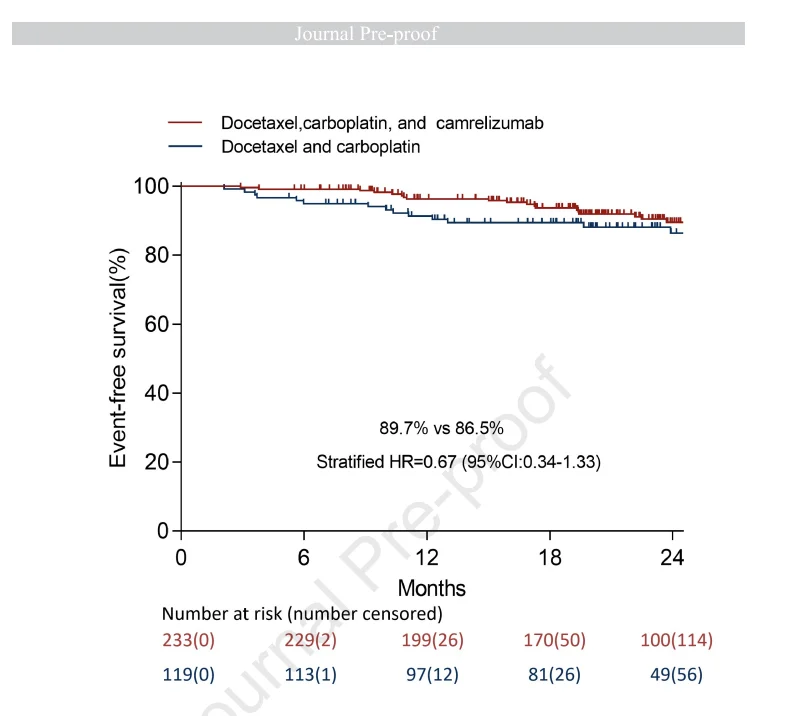
At a median follow-up of 22 months, estimated 2-year EFS was:
- 89.7% with camrelizumab + chemotherapy
versus
- 86.4% with chemotherapy alone
The hazard ratio was 0.67, but the 95% CI of 0.34–1.33 crossed 1. Therefore, the current data do not establish a statistically significant EFS advantage. DFS and distant disease-free survival were also immature.
This is one of the most important caveats when interpreting HELEN-Trio 011. pCR is clinically meaningful and strongly prognostic in TNBC, but the ultimate objective of neoadjuvant therapy is to prevent recurrence and improve survival.
Longer follow-up will therefore determine whether the higher pCR rate translates into durable event-free and overall survival benefit.
Safety Is One of the Most Interesting Findings
Nearly all patients experienced at least one treatment-related adverse event, but severe toxicity remained relatively uncommon. Grade 3–4 TRAEs occurred in:
- 24.9% with camrelizumab plus chemotherapy
versus
- 21.8% with chemotherapy alone
Grade 3–4 immune-related adverse events occurred in only 2.1% of patients receiving camrelizumab. Treatment-related serious adverse events occurred in:
- 3.0% with camrelizumab
and
- 2.5% with chemotherapy alone
These included anemia, neutropenia and thrombocytopenia. Dose reductions were required in 18.8% versus 15.1%, predominantly because of hematologic toxicity. Treatment discontinuation for any cause occurred in 6.0% with camrelizumab and 7.0% with chemotherapy alone. Most importantly, no treatment-related deaths occurred.
Reactive Capillary Endothelial Proliferation Was Characteristic but Usually Low Grade
Camrelizumab has a characteristic cutaneous immune-related toxicity known as reactive cutaneous capillary endothelial proliferation, or RCCEP. It occurred frequently but was predominantly low grade.
The investigators note that mild lesions can generally be observed or managed with topical corticosteroids, while severe ulcerated or bleeding lesions may require temporary treatment interruption.
Permanent discontinuation is uncommon. No new immune-related safety signals emerged during continued adjuvant camrelizumab.
How Does This Compare With KEYNOTE-522?
The obvious clinical comparison is KEYNOTE-522, but it must be made cautiously. KEYNOTE-522 remains the established standard and demonstrated long-term outcome benefits, including EFS and overall survival.
Its neoadjuvant pembrolizumab-containing regimen produced a pCR rate of approximately 63.4%, numerically higher than the 57.5% observed in HELEN-Trio 011.
But these are not randomized comparative data. The populations differed substantially. HELEN-Trio 011 included fewer PD-L1-positive tumors and a higher proportion of node-positive disease. Different treatment schedules, immunotherapy agents, chemotherapy backbones and subsequent therapies further complicate comparison.
The striking difference lies in reported toxicity. The HELEN-Trio investigators cite grade 3–4 TRAEs of 76.8% in KEYNOTE-522, versus 24.9% with camrelizumab-docetaxel-carboplatin in HELEN-Trio 011.
Treatment discontinuation because of adverse events was also markedly lower in HELEN-Trio 011. However, these figures come from different studies with different trial designs and should not be interpreted as proof that the HELEN regimen is definitively safer than KEYNOTE-522.
Universal prophylactic G-CSF in HELEN-Trio 011 may also have contributed to the relatively low rate of severe hematologic toxicity.
CamRelief Provides Another Camrelizumab Comparison
The phase III CamRelief study previously evaluated camrelizumab with a more intensive anthracycline-containing chemotherapy backbone. CamRelief produced a pCR rate of 56.8%, remarkably close to the 57.5% achieved in HELEN-Trio 011.
That similarity is clinically interesting because it raises the possibility that anthracycline omission might preserve much of the antitumor activity of camrelizumab-based neoadjuvant treatment. But again, cross-trial comparisons cannot answer that question.
CamRelief and HELEN-Trio 011 enrolled different populations and even used different PD-L1 testing platforms. A direct randomized comparison would be required to determine whether the anthracycline-free strategy is genuinely non-inferior to an anthracycline-containing regimen.
The Regimen Is Consistent With Other Anthracycline-Free Studies
HELEN-Trio 011 does not stand alone. Previous neoadjuvant studies using taxane-platinum chemoimmunotherapy without anthracyclines, including NeoPACT, NCI-10013, NeoN and cTRIO, have generally reported pCR rates in the approximately 53%–58% range.
The consistency of these results strengthens the biological and clinical rationale for anthracycline-sparing treatment. HELEN-Trio 011 is important because it adds a phase III randomized comparison against chemotherapy alone.
What remains missing is a direct comparison against the contemporary anthracycline-containing chemoimmunotherapy standard.
Does Giving Camrelizumab on Day 3 Matter?
One of the most provocative aspects of HELEN-Trio 011 is treatment scheduling. Camrelizumab was administered on day 3, whereas chemotherapy was administered on day 1. The investigators propose a biological rationale for this temporal separation.
Chemotherapy can produce immunogenic tumor-cell death, release tumor antigens and modify the tumor microenvironment. Allowing chemotherapy to act before PD-1 inhibition could theoretically create more favorable immune priming. Conversely, simultaneous chemotherapy might eliminate activated lymphocytes just as checkpoint blockade is attempting to expand them.
Preclinical and early clinical studies have suggested that sequencing chemotherapy before checkpoint inhibition might enhance antitumor immune activity. However, this remains hypothesis-generating.
HELEN-Trio 011 did not randomize patients between same-day and day-3 camrelizumab administration, so the trial cannot establish that delayed PD-1 blockade contributed to the observed efficacy or safety. This question warrants dedicated prospective study.
Six Months of Immunotherapy Raises Another De-Escalation Question
Patients receiving camrelizumab continued treatment after surgery only long enough to complete approximately 6 months of total therapy. That differs substantially from the approximately 1-year perioperative checkpoint-inhibitor strategy used in current practice with pembrolizumab.
The optimal duration of adjuvant immunotherapy after effective neoadjuvant treatment in TNBC remains uncertain. The investigators point to GeparNuevo, in which benefit was observed with neoadjuvant immune checkpoint inhibition without prolonged adjuvant immunotherapy, as evidence that shorter exposure deserves further investigation.
However, HELEN-Trio 011 was not designed to compare different immunotherapy durations. The 6-month strategy should therefore not be interpreted as evidence that shorter treatment is equivalent to standard 1-year pembrolizumab.
Important Limitations
HELEN-Trio 011 has several clinically important limitations. The trial was open label, although the primary pathological endpoint was centrally evaluated by blinded reviewers.
The primary endpoint was pCR rather than EFS or OS, and the trial was not powered for survival outcomes. At 22 months, EFS remains immature.
The study enrolled only Chinese patients, which may limit generalizability to more ethnically diverse populations. Subgroup analyses, including PD-L1 analyses, were based on relatively small numbers.
The inclusion of patients with ER or PgR expression of 1%–9% also introduces some biological heterogeneity. Most importantly, there was no pembrolizumab-containing control arm.
Therefore, HELEN-Trio 011 demonstrates superiority of camrelizumab plus docetaxel-carboplatin over docetaxel-carboplatin alone, but it does not establish equivalence or superiority to the current KEYNOTE-522-based standard.
A Promising De-Escalation Strategy, but Not Yet a New Standard
The clinical relevance of HELEN-Trio 011 lies in the possibility that treatment intensity can be reduced without substantially compromising antitumor activity. A six-cycle docetaxel-carboplatin backbone avoids anthracyclines.
Severe toxicity was relatively uncommon. Treatment discontinuation was low. The pCR rate approached 60%. And the addition of camrelizumab provided a clear randomized improvement over the same chemotherapy backbone alone.
These are compelling findings. But the key unanswered question is not whether the regimen works. It is whether it provides comparable long-term outcomes to established perioperative pembrolizumab-based anthracycline-containing therapy. Only mature EFS and OS results, and ideally direct comparative trials, can answer that question.
OncoDaily Takeaway
HELEN-Trio 011 provides phase III evidence that camrelizumab can significantly improve the efficacy of an anthracycline-free neoadjuvant docetaxel-carboplatin regimen in stage II–III TNBC. Adding camrelizumab increased pCR from 45.4% to 57.5%, while grade 3–4 treatment-related toxicity remained similar between groups at 24.9% versus 21.8%, with no treatment-related deaths.
The trial therefore strengthens the case for anthracycline-sparing chemoimmunotherapy as a potential de-escalation strategy in early TNBC. However, the findings should not yet be interpreted as replacing KEYNOTE-522. The study lacks a pembrolizumab-based standard-of-care comparator, EFS remains immature, and the exclusively Chinese population limits immediate generalizability.
The most important next question is whether this simpler regimen can preserve the long-term recurrence and survival benefits expected from contemporary perioperative immunotherapy while reducing treatment burden and toxicity.
If that is confirmed, HELEN-Trio 011 could represent an important step toward a future in which neoadjuvant therapy for TNBC is not simply intensified for everyone, but optimized to deliver the necessary efficacy with less unnecessary treatment.
Source
- Jiao D, Sun X, Qiao J, et al. Efficacy and safety of camrelizumab plus docetaxel and carboplatin as neoadjuvant therapy for stage II–III triple-negative breast cancer: the HELEN-Trio 011 randomized clinical trial. Annals of Oncology. 2026. DOI: 10.1016/j.annonc.2026.10.102.