
The phase III lidERA Breast Cancer trial has demonstrated that five years of adjuvant giredestrant significantly improves invasive disease–free survival compared with conventional endocrine therapy in patients with intermediate or high-risk ER-positive/HER2-negative early breast cancer. Published in the New England Journal of Medicine on November 25, 2026, the results show a 30% relative reduction in the hazard of invasive recurrence or death, accompanied by fewer distant recurrences and fewer treatment discontinuations. The findings have already translated into regulatory practice, with the FDA approving giredestrant monotherapy for eligible patients on November 23, 2026.
For more than two decades, tamoxifen and aromatase inhibitors have formed the foundation of adjuvant endocrine therapy for hormone receptor-positive early breast cancer.
These treatments have substantially reduced recurrence and breast cancer mortality. Nevertheless, endocrine resistance, persistent late recurrence risk, and treatment-related adverse effects continue to limit their long-term effectiveness.
Even among patients who complete initial treatment successfully, the risk of recurrence can extend for many years after diagnosis.
Recent therapeutic advances have focused primarily on intensifying endocrine therapy through the addition of CDK4/6 inhibitors, particularly abemaciclib and ribociclib in selected patients at elevated recurrence risk.
A different strategy is now emerging: replacing conventional endocrine therapy itself with a more potent, orally administered estrogen receptor antagonist and degrader. The randomized phase III lidERA Breast Cancer trial provides pivotal evidence supporting this approach.
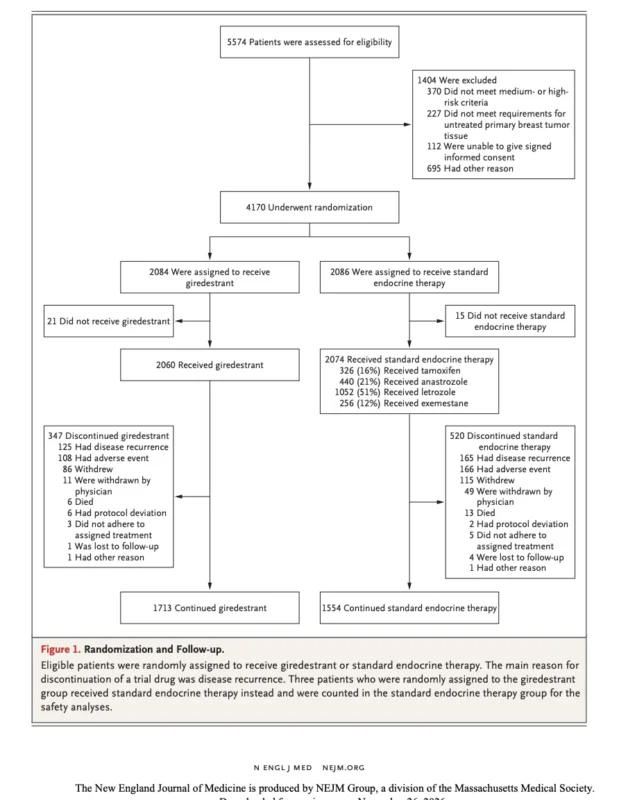
Led by Charles E. Geyer Jr., Aditya Bardia, Peter Schmid, and colleagues, lidERA enrolled 4,170 patients with ER-positive/HER2-negative early breast cancer across 622 centers in 54 countries. At a median follow-up of 32.3 months, patients receiving giredestrant experienced significantly fewer invasive disease–free survival events than those receiving standard endocrine therapy.
The findings mark an important development in endocrine treatment and raise new questions about the future integration of oral selective estrogen receptor degraders (SERDs) with established adjuvant strategies.
A New Endocrine Approach Beyond Tamoxifen and Aromatase Inhibitors
Conventional adjuvant endocrine therapies suppress estrogen receptor signaling through different mechanisms. Tamoxifen acts as a selective estrogen receptor modulator, antagonizing estrogen signaling in breast tissue while retaining tissue-dependent partial agonist activity.
Aromatase inhibitors reduce estrogen synthesis and are particularly effective in postmenopausal women or in combination with ovarian function suppression. However, both approaches leave the estrogen receptor protein present within tumor cells. Giredestrant acts differently.
It is an oral estrogen receptor antagonist with selective estrogen receptor-degrading activity, designed to inhibit both ligand-dependent and ligand-independent estrogen receptor signaling. By directly targeting the receptor, giredestrant aims to achieve sustained suppression of the signaling pathways responsible for the growth of ER-positive breast cancer.
Earlier neoadjuvant findings from coopERA Breast Cancer demonstrated greater short-term Ki-67 suppression with giredestrant than with anastrozole, providing evidence of stronger antiproliferative activity. Yet improvements in Ki-67 do not necessarily translate into fewer clinical recurrences.
The central question for lidERA was whether this pharmacological approach could outperform established endocrine therapy in a large population treated with curative intent.
lidERA: More Than 4,000 Patients Randomized Across 54 Countries
lidERA was a multinational, randomized, open-label phase III trial evaluating giredestrant against standard adjuvant endocrine therapy. Eligible adults had undergone definitive surgery for anatomical stage I, II, or III ER-positive/HER2-negative breast cancer and were considered at intermediate or high risk of recurrence.
Patients who had received adjuvant chemotherapy, or no chemotherapy, were required to meet specified nodal and other risk criteria. Selected node-negative patients were eligible if they had sufficiently high-risk clinical, pathological, or genomic features.
Those treated with neoadjuvant chemotherapy generally required residual axillary nodal disease. Enrollment took place between August 2021 and September 2023. Patients were randomly assigned to receive either giredestrant 30 mg orally once daily or investigator-selected standard endocrine therapy consisting of tamoxifen, anastrozole, letrozole, or exemestane.
Treatment was planned for five years, followed by additional observation. Premenopausal women and men receiving giredestrant or aromatase inhibitors were required to receive concurrent ovarian or gonadal hormone suppression with a luteinizing hormone–releasing hormone agonist.
Importantly, CDK4/6 inhibitors were not permitted after randomization. This means lidERA directly evaluated endocrine monotherapy strategies, rather than giredestrant-containing combinations against current CDK4/6 inhibitor-containing adjuvant regimens.
Of the 4,170 randomized patients, 2,084 received assignment to giredestrant and 2,086 to standard endocrine therapy. Within the control group, 84.3% received an aromatase inhibitor and 15.7% received tamoxifen.
The trial population reflected a clinically relevant intermediate- to high-risk setting. Approximately 68% were classified as high risk, 84% had received chemotherapy, 21.4% had node-negative disease, and 40.7% were premenopausal women. The median age was 54 years.
The Primary Endpoint: A Significant Reduction in Invasive Recurrence or Death
The primary endpoint was invasive disease–free survival, defined to include ipsilateral invasive recurrence, locoregional recurrence, distant recurrence, contralateral invasive breast cancer, or death from any cause.
The publication reports a prespecified interim efficacy analysis conducted at the August 8, 2025, data cutoff. At that point, 336 primary endpoint events had occurred, representing approximately 77% of the events originally required for the final primary analysis.
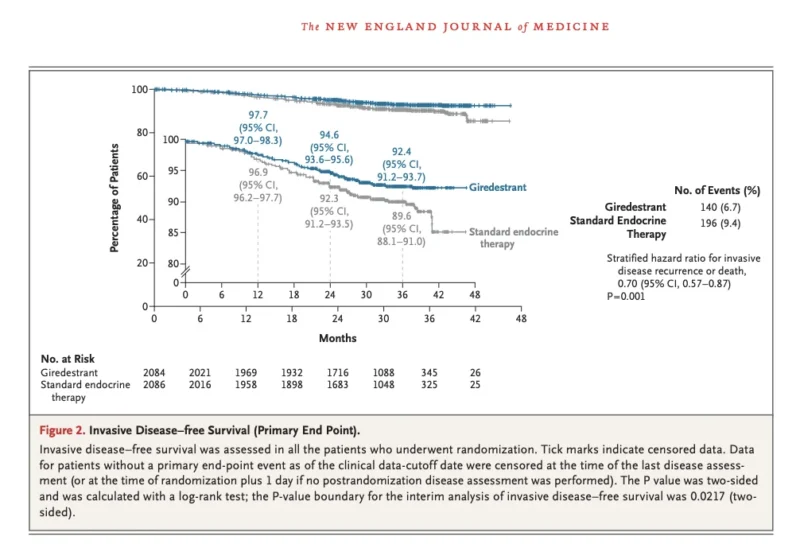
Invasive recurrence or death was reported in 140 of 2,084 patients receiving giredestrant (6.7%), compared with 196 of 2,086 patients receiving standard endocrine therapy (9.4%). The stratified hazard ratio was 0.70 (95% CI 0.57–0.87; P = 0.001). The result met the prespecified statistical boundary for superiority at the interim analysis.
At three years, invasive disease–free survival was 92.4% with giredestrant versus 89.6% with standard endocrine therapy. The absolute difference was 2.8 percentage points. Expressed differently, approximately 28 additional patients per 1,000 treated would be expected to remain free of an invasive disease–free survival event at three years, based on the trial estimates.
The hazard ratio represents a 30% relative reduction in the hazard of recurrence or death over the observed follow-up. It should not be interpreted as a 30-percentage-point absolute improvement or a demonstrated reduction in long-term mortality.
Nevertheless, the findings provide randomized evidence that direct estrogen receptor antagonism and degradation can improve clinically meaningful outcomes beyond conventional endocrine therapy.
Distant Recurrence Results Strengthen the Clinical Signal
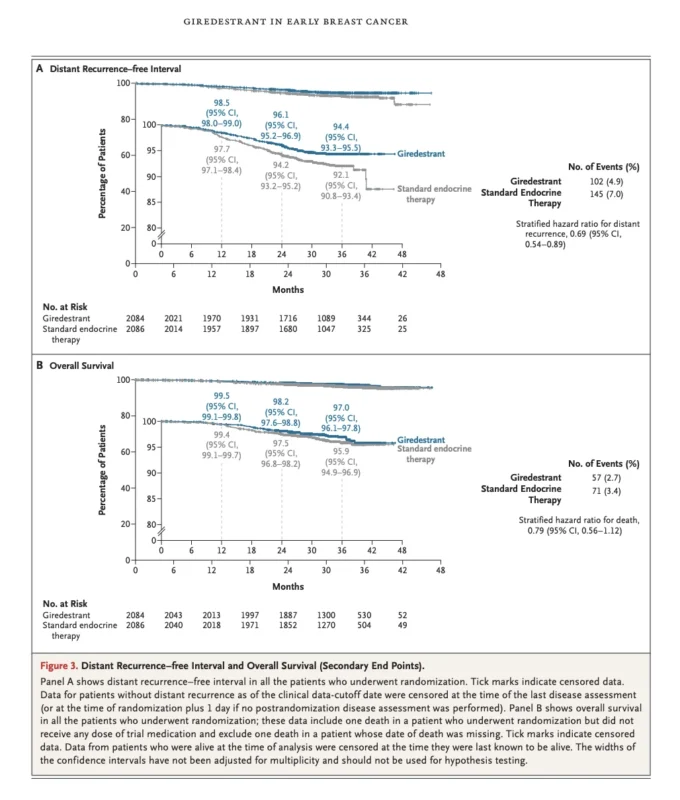
Avoiding distant metastatic recurrence remains one of the most important goals of adjuvant breast cancer treatment. In lidERA, the benefit was not confined to local or contralateral breast events. Distant recurrence occurred in 102 patients receiving giredestrant and 145 patients receiving standard endocrine therapy.
The hazard ratio for distant recurrence was 0.69 (95% CI 0.54–0.89). At three years, the estimated distant recurrence–free proportion was 94.4% with giredestrant compared with 92.1% with standard therapy. This corresponds to an absolute difference of 2.3 percentage points.
The improvement in distant recurrence is clinically important because metastatic relapse remains the principal determinant of breast cancer-specific outcomes for many patients with high-risk early disease. However, the secondary endpoint confidence intervals were not adjusted for multiple comparisons.
The results support the consistency of the primary finding but should be interpreted within the trial’s statistical framework. Similarly, overall disease-free survival at three years was 91.3% versus 88.5%, favoring giredestrant.
Overall Survival: Encouraging Numerical Trend, but No Established Benefit Yet
At the interim analysis, overall survival data remained immature. There had been 57 deaths in the giredestrant group, representing 2.7% of patients, and 71 deaths in the standard endocrine therapy group, representing 3.4%. The overall survival hazard ratio was 0.79 (95% CI 0.56–1.12).
The confidence interval included the possibility of no survival advantage. Therefore, lidERA has not yet established that adjuvant giredestrant improves overall survival. This is particularly relevant in ER-positive early breast cancer because recurrence risk may extend over decades.
With a median follow-up of only 32.3 months, the current results primarily characterize early recurrence. Longer follow-up will determine whether the treatment advantage persists throughout the planned five years of therapy and beyond.
The investigators also propose further research into whether sustained estrogen receptor suppression may reduce the emergence of acquired ESR1 mutations during adjuvant treatment. That possibility remains a mechanistic hypothesis rather than a demonstrated clinical outcome of lidERA.
Similar Overall Adverse-Event Rates, but Fewer Treatment Discontinuations
Tolerability is particularly important in adjuvant endocrine treatment because patients may require daily medication for five years or longer. Adverse effects that appear manageable during short-term treatment can substantially influence adherence over time.
In lidERA, adverse events of any grade occurred in 94.9% of patients receiving giredestrant and 94.4% receiving standard endocrine therapy. Serious adverse events were reported in 10.8% and 10.1%, respectively. However, adverse events leading to permanent treatment discontinuation were less common with giredestrant: 5.3% versus 8.2%.
Arthralgia was among the most frequently reported adverse events. It occurred in 48.0% of patients receiving giredestrant, 50.1% receiving aromatase inhibitors, and 31.0% receiving tamoxifen. The proportions of patients discontinuing treatment because of arthralgia were 1.6% and 3.7% in the overall giredestrant and standard endocrine therapy groups, respectively.
At the data cutoff, 83.2% of patients in the giredestrant safety population remained on assigned therapy, compared with 74.9% in the standard endocrine therapy group. These findings suggest potentially meaningful differences in long-term treatment persistence.
Nevertheless, the open-label design may have influenced treatment discontinuation and adverse-event reporting. Long-term adherence and patient-reported outcomes will be essential to determine whether the observed differences persist.
Bradycardia: A Distinct Safety Consideration
Although overall tolerability was broadly comparable, bradycardia was more frequent with giredestrant. Bradycardia-related events occurred in 11.3% of patients receiving giredestrant versus 3.2% receiving standard endocrine therapy.
Most giredestrant-associated events were asymptomatic grade 1 abnormalities detected through scheduled electrocardiographic monitoring. Grade 2 bradycardia occurred in 0.7% of giredestrant-treated patients, and no grade 3–5 events were reported.
Among symptomatic patients, most events resolved with treatment interruption or discontinuation. The study protocol incorporated scheduled ECG monitoring because of the known potential for heart-rate reduction.
This finding is particularly relevant when considering treatment in patients with baseline conduction abnormalities, cardiovascular disease, or medications that may also reduce heart rate. The FDA prescribing information includes warnings for bradycardia and embryo-fetal toxicity.
Although the absence of severe bradycardia in this large study is reassuring, appropriate clinical monitoring remains necessary.
FDA Approval Arrives Before Publication of the Primary Results
An important feature of the lidERA story is the timing of the regulatory decision. On November 23, 2026, the FDA approved giredestrant (Wilserdly) as a single agent for the adjuvant treatment of adults with ER-positive/HER2-negative stage I–III breast cancer at intermediate to high risk of recurrence.
The decision preceded publication of the full trial results in the New England Journal of Medicine on November 25. The recommended giredestrant dosage is 30 mg orally once daily, with or without food, for five years or until recurrence or unacceptable toxicity.
Crucially, the adjuvant indication does not require an ESR1 mutation. This distinguishes it from the separate November 16 approval of giredestrant plus everolimus for eligible adults with ESR1-mutated locally advanced or metastatic breast cancer following specified prior endocrine therapy.
The two approvals involve distinct patient populations, treatment regimens, clinical trials, and therapeutic objectives. In the advanced setting, evERA established the benefit of giredestrant combined with everolimus following endocrine treatment failure.
In early breast cancer, lidERA demonstrates the effectiveness of giredestrant as an adjuvant endocrine treatment intended to prevent recurrence. Together, the decisions establish giredestrant as a treatment option across both early and advanced ER-positive breast cancer in the United States.
How Does Giredestrant Fit With Adjuvant CDK4/6 Inhibitors?
Perhaps the most important unresolved clinical question is how giredestrant should be integrated with contemporary adjuvant CDK4/6 inhibitor strategies. The monarchE and NATALEE trials demonstrated improved invasive disease–free survival when abemaciclib or ribociclib, respectively, was added to standard endocrine therapy in selected patients.
These treatment approaches target a different biological component of hormone receptor-positive breast cancer. Giredestrant directly targets estrogen receptor activity, whereas CDK4/6 inhibitors suppress downstream cell-cycle progression.
Combining the mechanisms may be biologically attractive. However, lidERA did not evaluate giredestrant plus abemaciclib or ribociclib against standard endocrine therapy combined with those agents. CDK4/6 inhibitors were excluded after randomization, reflecting the treatment standards in place when the study began.
Consequently, the trial cannot establish whether giredestrant alone is superior, equivalent, or inferior to CDK4/6 inhibitor-containing adjuvant regimens. Nor can it determine whether replacing an aromatase inhibitor with giredestrant improves outcomes when both are combined with a CDK4/6 inhibitor.
Investigational combination studies are ongoing. Until their results become available, the choice of adjuvant endocrine treatment and treatment intensification must consider the clinical and genomic risk profile, available randomized evidence, regulatory indications, and the patient’s anticipated tolerance of therapy.
Cross-trial comparisons of hazard ratios between lidERA, monarchE, and NATALEE cannot resolve this question because the populations, treatment regimens, and follow-up differ.
Does This Change Treatment for Premenopausal Patients?
The inclusion of premenopausal women is an important strength of lidERA. Approximately 41% of the study population consisted of premenopausal women. The trial required concurrent luteinizing hormone–releasing hormone agonist therapy for premenopausal women receiving giredestrant.
This means the trial tested giredestrant within an ovarian-suppressed treatment strategy, not as a substitute for ovarian function suppression in premenopausal patients. The findings therefore support consideration of giredestrant with appropriate ovarian suppression in eligible premenopausal women.
However, the study does not establish that ovarian suppression can be omitted, and it does not directly compare giredestrant against all established intensification strategies involving ovarian suppression and aromatase inhibitors.
For younger patients, adverse effects, fertility considerations, treatment adherence, and long-term survivorship remain especially important.
What Are the Remaining Evidence Gaps?
Despite the statistically significant primary result, several uncertainties remain. First, follow-up is still relatively short for a malignancy characterized by substantial late recurrence risk. Second, overall survival benefit has not yet been demonstrated.
Third, the open-label design may influence treatment persistence and subjective adverse-event reporting, although recurrence outcomes provide a more objective measure of benefit. Fourth, Black or African American patients were underrepresented, accounting for only 2.4% of participants.
Fifth, the comparator included both aromatase inhibitors and tamoxifen. Although exploratory analyses were directionally consistent, lidERA was not designed to establish separate definitive superiority claims against every individual standard endocrine agent.
Finally, the study does not answer how best to combine giredestrant with CDK4/6 inhibitors, how long treatment benefits will persist after discontinuation, or which biologically defined subgroups may derive the greatest benefit. Longer follow-up and additional comparative studies will therefore be essential.
OncoDaily Takeaway
lidERA represents an important change in the adjuvant treatment landscape for ER-positive/HER2-negative early breast cancer. In 4,170 patients with intermediate- or high-risk disease, five years of giredestrant significantly improved invasive disease–free survival compared with standard endocrine therapy.
At three years, iDFS was 92.4% versus 89.6%, with a hazard ratio of 0.70, corresponding to a 30% relative reduction in the hazard of invasive recurrence or death. Distant recurrence was also reduced, with an HR of 0.69, supporting the clinical relevance of the observed benefit.
Treatment discontinuation due to adverse events was less frequent with giredestrant, although bradycardia was more common and requires appropriate monitoring. The FDA’s November 23, 2026, approval makes giredestrant a new adjuvant endocrine treatment option for eligible patients with stage I–III ER-positive/HER2-negative disease, without requiring an ESR1 mutation.
The central clinical implication is that directly targeting and degrading the estrogen receptor can improve adjuvant outcomes beyond conventional endocrine therapy. However, immature overall survival, relatively short follow-up, and the absence of comparisons with CDK4/6 inhibitor-containing strategies remain important limitations.
The next stage of research must clarify whether giredestrant can improve long-term survival, reduce late recurrence, and provide additional benefit when incorporated into more intensive adjuvant treatment regimens.
Sources
- Geyer CE Jr, Bardia A, Hurvitz SA, et al. Giredestrant in the Treatment of ER-Positive, HER2-Negative Early Breast Cancer. New England Journal of Medicine. Published online November 25, 2026. DOI: 10.1056/NEJMoa2608669 ClinicalTrials.gov: NCT04961996 — lidERA Breast Cancer
- US Food and Drug Administration. FDA Approves Giredestrant for Adjuvant Treatment of ER-Positive, HER2-Negative, Stage I, II, and III Breast Cancer at Intermediate to High Risk of Recurrence. November 23, 2026.
- US Food and Drug Administration. FDA Approves Giredestrant in Combination With Everolimus for ER-Positive, HER2-Negative, ESR1-Mutated Locally Advanced or Metastatic Breast Cancer. November 16, 2026.
- monarchE: Adjuvant abemaciclib plus endocrine therapy in high-risk HR-positive/HER2-negative early breast cancer.
- NATALEE: Adjuvant ribociclib plus endocrine therapy in HR-positive/HER2-negative early breast cancer.