
The year 2026 has fundamentally reshaped the role of antibody-drug conjugates (ADCs) and bispecific antibodies in breast cancer. New regulatory approvals, positive randomized phase III trials, and the emergence of dual-targeting ADC platforms are expanding treatment opportunities across HER2-positive, HER2-low, hormone receptor-positive, and triple-negative disease. Yet these advances have created a critical question: how can oncologists identify the patients most likely to benefit from each increasingly complex antibody-based treatment?
The evidence emerging from ASCO 2026, ESMO Congress 2026, and recent peer-reviewed publications demonstrates that ADCs are moving beyond salvage treatment into first-line metastatic therapy, neoadjuvant treatment, and post-neoadjuvant escalation.
In HER2-positive disease, trastuzumab deruxtecan (T-DXd) has established new treatment strategies in both metastatic and early-stage settings, supported by the DESTINY-Breast09, DESTINY-Breast11, and DESTINY-Breast05 trials.
In HER2-low metastatic disease, the phase III HORIZON-Breast06 and APEX-Breast01 trials have introduced compelling evidence for trastuzumab rezetecan and the biparatopic HER2-directed ADC TQB2102, respectively.
TROP2-directed ADCs have also expanded substantially. In June 2026, the US Food and Drug
Administration approved sacituzumab govitecan as monotherapy and in combination with pembrolizumab for distinct first-line metastatic triple-negative breast cancer (TNBC) populations. Datopotamab deruxtecan demonstrated significant overall survival (OS) and progression-free survival (PFS) improvements in TROPION-Breast02, supporting its European approval in first-line TNBC when immunotherapy is not an option.
Meanwhile, izalontamab brengitecan, a dual EGFR/HER3-targeting bispecific ADC, has delivered positive phase III results in both previously treated TNBC and hormone receptor-positive/HER2-negative metastatic breast cancer.
The field is therefore entering an era in which antibody architecture, target expression, payload biology, and treatment sequencing increasingly influence clinical decisions.
The defining challenge is no longer simply identifying a targetable antigen, but determining whether its expression, and the biological context surrounding it, predicts meaningful treatment benefit.
From Surface Antigens to Multidimensional Precision Oncology
Traditional breast cancer treatment selection has largely relied on estrogen receptor, progesterone receptor, and HER2 status, complemented by genomic and molecular alterations such as PIK3CA, ESR1, and germline BRCA1/2 mutations.
ADCs add another therapeutic dimension by using surface-antigen recognition to deliver potent cytotoxic drugs selectively to malignant cells.
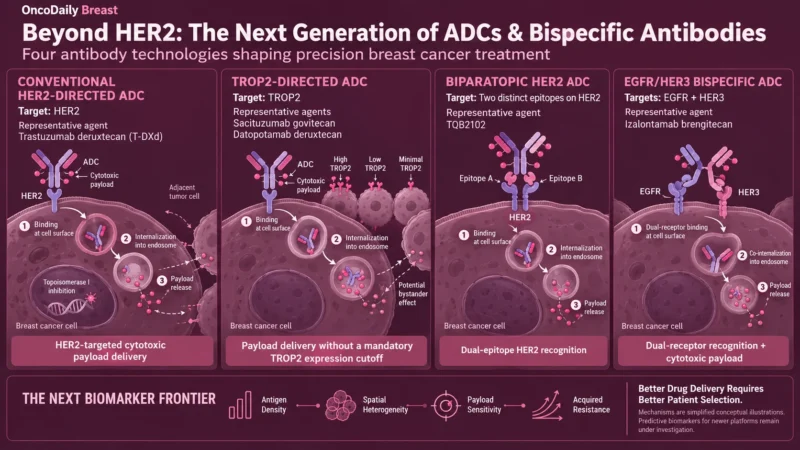
Their activity depends on multiple processes: antigen accessibility, antibody binding, internalization, intracellular processing, linker stability, payload release, and tumor sensitivity to the delivered drug. Several modern ADCs also exhibit bystander activity, allowing released payloads to affect neighboring tumor cells with heterogeneous or relatively low target expression.
Consequently, conventional immunohistochemical staining may not fully capture the biological determinants of treatment response. Bispecific antibodies create additional opportunities by recognizing two epitopes or molecular targets, potentially improving receptor clustering, signaling blockade, or immune engagement. Bispecific ADCs combine dual-targeting antibody technology with cytotoxic drug delivery.
However, these platforms should not be considered mechanistically interchangeable. A HER2-directed biparatopic ADC, an EGFR/HER3 bispecific ADC, and a PD-L1/VEGF bispecific immunotherapy agent each require distinct strategies for evaluating biomarkers.
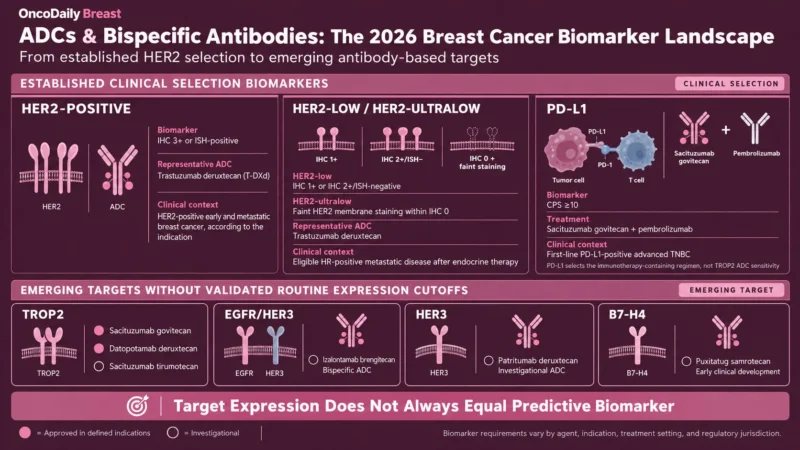
The most useful clinical distinction in 2026 is between biomarkers that are validated for treatment selection, biomarkers defining eligibility in clinical trials, and exploratory biomarkers that may correlate with response but have not demonstrated predictive utility.
HER2-Positive Breast Cancer: ADCs Move Across the Treatment Continuum
HER2 remains the most clinically established ADC biomarker in breast cancer. Historically, HER2-positive disease has been defined by immunohistochemistry (IHC) 3+ or HER2 gene amplification confirmed by in situ hybridization.
T-DXd, which combines a trastuzumab-based antibody with a cleavable linker and topoisomerase I inhibitor payload, has substantially expanded the therapeutic possibilities for HER2-expressing tumors.
The phase III DESTINY-Breast09 trial demonstrated that T-DXd combined with pertuzumab significantly improved PFS compared with taxane, trastuzumab, and pertuzumab in previously untreated HER2-positive metastatic breast cancer.
Median PFS was 40.7 months versus 26.9 months, corresponding to a hazard ratio (HR) of 0.56. These results supported US FDA approval of T-DXd plus pertuzumab in December 2025. In May 2026, the FDA also approved two early-stage HER2-positive breast cancer indications.
In the neoadjuvant setting, DESTINY-Breast11 demonstrated a pathological complete response (pCR) rate of 67.3% with T-DXd followed by taxane, trastuzumab, and pertuzumab, compared with 56.3% with dose-dense doxorubicin/cyclophosphamide followed by the same HER2-directed backbone.
In the post-neoadjuvant setting, DESTINY-Breast05 demonstrated superior three-year invasive disease-free survival with T-DXd compared with trastuzumab emtansine (T-DM1) in patients with residual invasive HER2-positive disease: 92.4% versus 83.7% (HR 0.47).
These findings strengthen the role of HER2 as a clinically actionable biomarker across multiple disease stages. However, pCR and invasive disease-free survival are distinct endpoints, and overall survival data remain immature in the relevant new treatment settings.
The expanded use of T-DXd also increases the importance of careful monitoring for interstitial lung disease, pneumonitis, and other treatment-related toxicity.
HER2-Low and HER2-Ultralow: A Diagnostic Revolution With Important Limitations
Perhaps the most important biomarker transformation in breast oncology has been the expansion of HER2-directed ADC therapy beyond conventionally HER2-positive tumors. HER2-low breast cancer is generally defined as IHC 1+ or IHC 2+ with negative in situ hybridization.
HER2-ultralow refers to tumors scored IHC 0 but demonstrating faint, incomplete membrane staining that does not meet the threshold for IHC 1+. These categories are therapeutically relevant but are not necessarily distinct intrinsic molecular subtypes.
In January 2025, the FDA expanded T-DXd eligibility to hormone receptor-positive metastatic breast cancer with HER2-low or HER2-ultralow expression following progression on endocrine therapy. By 2026, differentiating HER2-low, HER2-ultralow, and truly HER2-null tumors has become increasingly consequential.
However, conventional HER2 IHC assays were initially developed to identify tumors with HER2 overexpression or amplification, not to quantify very low antigen abundance. At the lower end of the expression spectrum, interobserver variability, fixation methods, assay sensitivity, tumor heterogeneity, and temporal changes in expression may all influence classification.
A tumor reported as HER2-zero on one specimen may be classified as HER2-ultralow or HER2-low on another. This creates an important diagnostic challenge: small analytical differences may affect access to effective therapy.
The emergence of newer HER2-directed ADCs further increases the need for standardized assessment and potentially quantitative biomarker technologies.
HORIZON-Breast06: A New HER2-Directed ADC Produces Major PFS Gains
One of the most important late-breaking studies at ESMO 2026 was the randomized phase III HORIZON-Breast06 trial, simultaneously published in JAMA.
The study evaluated trastuzumab rezetecan (SHR-A1811), a HER2-directed ADC carrying a topoisomerase I inhibitor payload, against physician’s choice chemotherapy in 551 patients with HER2-low advanced breast cancer.
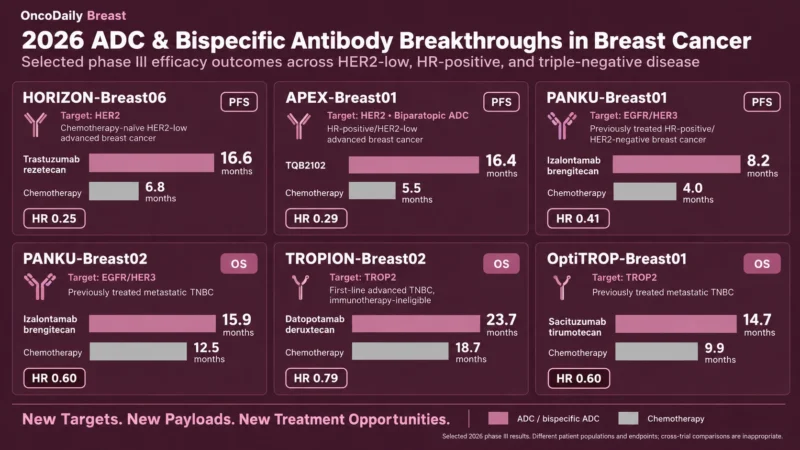
The trial included patients who had received no more than one prior line of chemotherapy in the metastatic setting, with endocrine treatment required for hormone receptor-positive disease. Among chemotherapy-naïve patients, median PFS was 16.6 months with trastuzumab rezetecan versus 6.8 months with chemotherapy (HR 0.25; 95% CI 0.19–0.33).
In the overall population, median PFS was 16.4 versus 6.8 months (HR 0.27; 95% CI 0.21–0.34). Confirmed objective response rates were 75.5% versus 41.2%, and median duration of response reached 15.0 versus 6.8 months.
Activity was observed in both hormone receptor-positive and hormone receptor-negative subgroups. However, OS remained immature. Treatment-related adverse events of grade 3 or higher occurred in 84.1% of patients receiving trastuzumab rezetecan compared with 67.9% receiving chemotherapy, predominantly hematologic toxicity.
The results demonstrate substantial activity in HER2-low disease, but they do not establish superiority over existing HER2-directed ADC standards because the comparator was conventional chemotherapy rather than another ADC.
The study also reinforces the need to evaluate whether the degree of HER2 expression predicts differential benefit from competing ADC platforms.
APEX-Breast01: Biparatopic HER2 Targeting Challenges Conventional ADC Design
The phase III APEX-Breast01 trial introduced another major development in HER2-low metastatic breast cancer. TQB2102, also known as rolditamig deuderuxtecan, is a biparatopic ADC engineered to recognize two distinct HER2 epitopes.
Unlike an EGFR/HER3 bispecific ADC, it does not simultaneously target two different receptor proteins. Instead, its dual-epitope HER2 recognition represents an alternative approach to improving target binding and payload delivery.
The trial enrolled 543 patients with HER2-low recurrent or metastatic breast cancer who had not received chemotherapy for advanced disease. In the primary hormone receptor-positive population, median PFS was 16.4 months with TQB2102 versus 5.5 months with chemotherapy (HR 0.29; 95% CI 0.22–0.39).
The objective response rate was 66.7% versus 31.3%. PFS benefit was also demonstrated across the overall HER2-low population. Although preliminary OS estimates favored TQB2102, survival data remained immature and should not be interpreted as definitive evidence of an OS advantage.
The results raise an important mechanistic question: can dual-epitope binding improve ADC delivery in tumors expressing relatively low amounts of HER2?
At present, that remains a biological hypothesis rather than a clinically validated explanation for the observed efficacy.
Moreover, the similar median PFS estimates reported in APEX-Breast01 and HORIZON-Breast06 do not establish comparable efficacy between the two drugs. Differences in patient populations, trial design, comparator treatment, and follow-up prevent reliable cross-trial ranking.
TROP2: Broad Therapeutic Success Without a Validated Expression Cutoff
Trophoblast cell-surface antigen 2 (TROP2), encoded by TACSTD2, has become one of the most successful ADC targets in breast cancer. Its expression across hormone receptor-positive and triple-negative tumors has supported the development of sacituzumab govitecan, datopotamab deruxtecan, and sacituzumab tirumotecan.
Yet TROP2 differs from HER2 because treatment selection generally does not require a validated antigen-expression threshold. In many clinical trials, patients were enrolled according to hormone receptor status, HER2 classification, prior treatment, and immunotherapy eligibility rather than TROP2 IHC levels.
This reflects an important biological reality: although target expression may influence ADC binding, the relationship between antigen abundance and treatment efficacy is complex.
For currently approved breast cancer indications, routine quantitative TROP2 testing is not required to determine eligibility.
The absence of a validated expression threshold does not mean that TROP2 expression is biologically irrelevant. Rather, available clinical evidence has not established a sufficiently reproducible assay and cutoff to improve treatment selection.
ASCENT-03 and ASCENT-04: TROP2 ADCs Enter First-Line TNBC
A major regulatory milestone occurred on June 24, 2026, when the FDA approved two new first-line TNBC indications for sacituzumab govitecan.
The phase III ASCENT-03 trial evaluated sacituzumab govitecan monotherapy versus physician’s choice chemotherapy in 558 patients with previously untreated unresectable locally advanced or metastatic TNBC who were not candidates for PD-1/PD-L1 inhibitor therapy.
Median PFS was 9.7 versus 6.9 months (HR 0.62; 95% CI 0.50–0.77). The phase III ASCENT-04/KEYNOTE-D19 trial evaluated sacituzumab govitecan plus pembrolizumab versus chemotherapy plus pembrolizumab in 443 patients with PD-L1-positive advanced TNBC.
Median PFS was 11.2 versus 7.8 months (HR 0.65; 95% CI 0.51–0.84). The combination indication requires PD-L1 expression with a combined positive score (CPS) of at least 10, determined using an authorized assay.
This is a crucial distinction: PD-L1 is the treatment-selection biomarker for the immunotherapy-containing combination, not a validated predictor of TROP2 ADC sensitivity. Overall survival data remained immature at the respective approval analyses.
These approvals establish ADC-based treatment as a first-line option across different TNBC clinical populations, moving TROP2-directed therapy earlier in the disease course.
TROPION-Breast02: Datopotamab Deruxtecan Demonstrates an Overall Survival Benefit
The phase III TROPION-Breast02 trial further reinforced the role of TROP2-directed ADCs in previously untreated advanced TNBC.
The study randomized 644 patients who were not candidates for immunotherapy to datopotamab deruxtecan or investigator’s choice chemotherapy. Median PFS was 10.8 months versus 5.6 months (HR 0.57; p<0.0001).
Importantly, median OS reached 23.7 months with datopotamab deruxtecan versus 18.7 months with chemotherapy (HR 0.79; p=0.029). The study met both primary endpoints and supported European approval of datopotamab deruxtecan for first-line advanced TNBC in patients ineligible for PD-1/PD-L1 inhibitor therapy in July 2026.
The agent was already approved in the United States for previously treated HR-positive/HER2-negative metastatic breast cancer.
TROPION-Breast02 highlights the clinical value of TROP2-directed treatment without a mandatory TROP2 expression test. However, it also introduces treatment-sequencing challenges as several ADCs compete for similar patient populations.
Differences in stomatitis, ocular toxicity, hematologic adverse events, diarrhea, and other agent-specific safety characteristics may influence individual treatment selection.
OptiTROP-Breast01: Mature Survival Data Strengthen Sacituzumab Tirumotecan
The final OS analysis of the phase III OptiTROP-Breast01 trial, presented at ESMO 2026, provided further evidence supporting sacituzumab tirumotecan (sac-TMT) in previously treated metastatic TNBC. Among 263 randomized patients, median OS was 14.7 months with sac-TMT versus 9.9 months with chemotherapy (HR 0.60; 95% CI 0.45–0.80).
At 30 months, estimated OS rates were 26.8% and 13.2%, respectively. The final analysis confirmed the durability of the survival effect established at the earlier prespecified interim analysis; it was descriptive rather than a new independent confirmatory test.
An exploratory analysis accounting for subsequent ADC treatment in the chemotherapy group also favored sac-TMT.
These findings further strengthen the evidence for TROP2-directed treatment in metastatic TNBC. However, the trial does not establish that sac-TMT is superior to sacituzumab govitecan or datopotamab deruxtecan.
The increasing number of effective TROP2 ADCs highlights the need for direct comparative studies and validated biomarkers capable of identifying sensitivity to specific payloads.
EGFR/HER3 Bispecific ADCs: PANKU-Breast02 Establishes a Survival Advantage
One of the most significant advances in 2026 was the emergence of izalontamab brengitecan (iza-bren), also known as BL-B01D1. This investigational bispecific ADC targets EGFR and HER3 and delivers a topoisomerase I inhibitor payload.
At ASCO 2026, the phase III PANKU-Breast02 trial demonstrated significant improvements in both PFS and OS compared with physician’s choice chemotherapy in previously treated advanced TNBC. The study randomized 418 patients who had received one or two prior systemic treatment lines for advanced disease.
Median PFS reached 8.5 months with iza-bren versus 3.1 months with chemotherapy (HR 0.29; 95% CI 0.22–0.38). Median OS was 15.9 versus 12.5 months (HR 0.60; 95% CI 0.42–0.85; p=0.0019). Confirmed objective response rates were 51.7% versus 20.5%.
These results provide randomized phase III evidence that dual EGFR/HER3-directed payload delivery can improve both disease control and survival in previously treated TNBC. However, the trial did not establish an EGFR or HER3 expression threshold as a validated predictive biomarker.
The importance of dual receptor binding, internalization, antigen coexpression, and payload sensitivity therefore remains an active area of investigation.
PANKU-Breast01 Extends Bispecific ADC Activity to HR-Positive/HER2-Negative Disease
The phase III PANKU-Breast01 trial presented at ESMO 2026 broadened the potential clinical role of iza-bren.
The study enrolled 383 patients with previously treated hormone receptor-positive/HER2-negative unresectable locally advanced or metastatic breast cancer. All patients had received prior endocrine therapy, CDK4/6 inhibition, and taxane exposure, with previous chemotherapy required in the advanced setting.
Median PFS was 8.2 months with iza-bren versus 4.0 months with chemotherapy (HR 0.41; 95% CI 0.33–0.53; p<0.0001). Confirmed objective response rates were 40.5% versus 20.2%, while median duration of response was 6.9 versus 4.2 months.
OS remained immature. The findings are particularly important because they establish bispecific ADC activity in a population whose tumors are conventionally classified as HER2-negative. They also demonstrate that EGFR and HER3 represent relevant delivery targets beyond the setting of classical receptor-driven oncogenic addiction.
However, EGFR/HER3 coexpression has not been validated as an independent selection biomarker, and the relative contribution of each target to therapeutic efficacy remains uncertain.
HER3: A Promising Target With Emerging Evidence in CNS Disease
HER3 is increasingly recognized as an attractive ADC target because of its expression across multiple breast cancer subtypes and involvement in HER-family signaling networks.
Patritumab deruxtecan (HER3-DXd) has shown activity in metastatic breast cancer, including exploratory studies in patients previously treated with multiple systemic agents. The phase II TUXEDO-3 study also investigated HER3-DXd in patients with active brain metastases and leptomeningeal disease.
Final findings presented at ESMO 2026 reported a median OS of 7.9 months among 21 patients with metastatic breast cancer and active brain metastases. Intracranial PFS in this population was 4.0 months.
These results are encouraging in a difficult-to-treat population, but the small, nonrandomized study does not establish comparative efficacy or a new treatment standard. Moreover, HER3 expression has not yet emerged as a validated routine selection biomarker for HER3-directed ADC therapy.
Research must determine whether receptor expression, internalization characteristics, prior ADC exposure, or acquired resistance mechanisms better predict sensitivity.
B7-H4: A New ADC Target Enters Clinical Development
B7-H4, encoded by VTCN1, is an immune-regulatory protein expressed in several solid tumors, including subsets of breast cancer. Its limited expression in many normal tissues and association with aggressive tumor biology make it an attractive ADC target.
On October 30, 2026, Nature Communications published early clinical findings from the phase I/IIa BLUESTAR study of puxitatug samrotecan (AZD8205), a B7-H4-directed ADC carrying a topoisomerase I inhibitor payload. The study enrolled 47 patients with advanced B7-H4-positive solid tumors, including breast, ovarian, endometrial, and cholangiocarcinoma populations.
Among 44 patients treated at doses within the anticipated efficacious range, the overall objective response rate was 20.5%, with responses observed across multiple tumor types, including breast cancer. Importantly, this response rate represents the pooled evaluable population and should not be interpreted as a breast cancer-specific efficacy estimate.
Translational findings supported target-dependent payload delivery and DNA damage within B7-H4-expressing tumor cells. However, optimal expression thresholds and predictive value remain unvalidated.
B7-H4 therefore represents an important emerging ADC opportunity, but development remains at an early clinical stage.
HER2 Bispecific Antibodies Beyond ADCs: Zanidatamab and the Post-T-DXd Challenge
Bispecific antibodies without cytotoxic payloads are also being investigated in breast cancer. Zanidatamab is a HER2-targeted biparatopic antibody designed to bind two distinct extracellular HER2 domains, potentially enhancing receptor clustering, internalization, and antitumor activity.
The phase III EMPOWER-HER trial is evaluating zanidatamab plus chemotherapy against trastuzumab plus chemotherapy in metastatic HER2-positive breast cancer following progression on or intolerance to T-DXd. This setting is increasingly important as T-DXd moves into earlier treatment lines.
In the future, antibody-based therapy after ADC progression may require understanding whether resistance is driven primarily by antigen loss, impaired internalization, payload resistance, or broader changes in tumor biology.
Zanidatamab therefore provides an example of how bispecific antibody engineering could contribute to treatment sequencing beyond ADC delivery. However, its efficacy in this specific post-T-DXd breast cancer setting remains under investigation.
PD-L1/VEGF Bispecific Antibodies: A New Immunotherapy Strategy for TNBC
Beyond receptor-directed treatment, bispecific immune-modulating antibodies are emerging as potential therapies for TNBC. Pumitamig (BNT327/PM8002), an investigational bispecific antibody targeting PD-L1 and VEGF-A, combines immune checkpoint inhibition with antiangiogenic activity.
The global phase III ROSETTA Breast-01 trial is evaluating pumitamig-containing treatment strategies in advanced TNBC. The biological rationale involves simultaneously enhancing antitumor immune activity and modifying VEGF-mediated vascular and immune suppression.
However, this approach differs fundamentally from ADC therapy because it does not deliver a conventional cytotoxic payload. PD-L1 expression may help characterize immunologically relevant populations, but the optimal predictive biomarker for combined PD-L1/VEGF blockade has not been established.
The phase III program remains investigational, and its clinical efficacy should not be presented as proven before mature randomized results become available.
TALENT: A Reminder That Metastatic ADC Success Does Not Guarantee Early-Disease Benefit
One of the most informative findings from ESMO 2026 came from the negative or limited pathological response signals in the phase II TALENT trial. TALENT investigated neoadjuvant T-DXd alone, combined with anastrozole, or followed by chemotherapy in hormone receptor-positive/HER2-low early breast cancer.
Although radiological tumor responses were common, pCR rates were low. pCR occurred in 7% with T-DXd alone, 3% with T-DXd plus anastrozole, and 9% with sequential T-DXd followed by docetaxel/cyclophosphamide.
These findings contrast with the impressive disease-control outcomes seen with HER2-directed ADCs in metastatic HER2-low breast cancer. They suggest that a biomarker sufficient to identify benefit in advanced disease may not necessarily predict deep pathological response in the curative-intent setting.
Exploratory findings also suggested that tumors achieving pCR tended to have higher quantitative HER2 levels, while HER2 expression could decline during treatment.
The findings raise questions about whether antigen abundance, spatial heterogeneity, and target modulation during therapy should be incorporated into future neoadjuvant trial designs.
TALENT does not establish T-DXd as a chemotherapy-replacing neoadjuvant standard in HER2-low early breast cancer. Instead, it highlights the need for more precise biomarker selection and endpoints appropriate to the disease setting.
The Next Biomarker Frontier: Target Abundance, Payload Sensitivity, and Resistance
The growing number of ADCs creates a new challenge for precision oncology: treatments directed against different antigens may use highly similar cytotoxic payloads. For example, several HER2-, TROP2-, HER3-, and EGFR/HER3-directed ADCs rely on topoisomerase I inhibition.
Consequently, changing the target antigen may not completely overcome resistance if resistance is driven by alterations affecting payload sensitivity.
Potential mechanisms include reduced antigen expression, impaired internalization, altered intracellular trafficking, increased drug efflux, and changes in DNA damage response pathways. These mechanisms remain incompletely validated as predictive clinical biomarkers.
As newer ADCs move earlier in the treatment sequence, prospective studies will need to determine the clinical consequences of prior ADC exposure and whether switching to a different antigen or payload class restores sensitivity.
Quantitative HER2 assessment, digital pathology, spatial proteomics, serial tissue biopsies, and circulating tumor DNA could provide more comprehensive biological information than conventional categorical IHC scores.
However, ctDNA is primarily suited to evaluating genomic alterations, tumor burden, molecular response, and resistance evolution. It does not directly replace measurement of surface-protein abundance.
An effective future biomarker strategy may therefore need to integrate tissue-based antigen quantification, genomic profiling, and dynamic molecular monitoring.
What Is Clinically Actionable in 2026?
By October 2026, HER2 expression remains the clearest established biomarker for selecting among certain ADC treatments. HER2-positive status, defined as IHC 3+ or ISH-positive disease, guides T-DXd-based treatment in approved metastatic and early-stage settings.
HER2-low and HER2-ultralow classifications determine eligibility for specific T-DXd indications in hormone receptor-positive metastatic disease, subject to regulatory jurisdiction and prior treatment requirements.
In TNBC, PD-L1 CPS of at least 10 is an established selection criterion for sacituzumab govitecan combined with pembrolizumab in the United States. Importantly, PD-L1 is not a surrogate for TROP2 expression.
There is currently no routinely required TROP2 expression cutoff for selecting patients for approved sacituzumab govitecan or datopotamab deruxtecan breast cancer indications.
Similarly, EGFR/HER3 expression, B7-H4 expression, and other emerging protein targets remain investigational selection strategies for their respective breast cancer therapies.
The expanding number of active agents also makes regulatory geography increasingly important. A treatment supported by positive phase III data or approved in one jurisdiction may remain investigational elsewhere.
For clinical practice, biomarker testing must therefore be interpreted alongside approved indications, prior treatment, disease subtype, and patient-specific toxicity considerations.
OncoDaily Takeaway
The 2026 clinical trial landscape represents a major expansion of ADC and bispecific antibody therapy in breast cancer, with multiple positive phase III trials and regulatory decisions establishing these technologies across increasingly diverse patient populations.
HER2-directed ADCs are now integrated into metastatic and early-stage HER2-positive treatment strategies, while HER2-low and HER2-ultralow classification continues to broaden therapeutic eligibility.
HORIZON-Breast06 and APEX-Breast01 demonstrate substantial PFS improvements with next-generation HER2-directed ADCs, although comparisons against existing ADC standards remain essential.
In TNBC, ASCENT-03, ASCENT-04, TROPION-Breast02, and OptiTROP-Breast01 reinforce the growing importance of TROP2-directed treatment, including first-line metastatic therapy and sustained survival benefits in later treatment settings.
The phase III PANKU-Breast01 and PANKU-Breast02 trials introduce a further evolution through EGFR/HER3 bispecific ADC technology, demonstrating meaningful efficacy in both HR-positive/HER2-negative and triple-negative disease.
Meanwhile, HER3-, B7-H4-, and immune-modulating bispecific platforms expand the investigational landscape beyond established targets. However, a critical limitation persists: the presence of a therapeutic target does not necessarily establish its value as a predictive biomarker.
The clinical success of TROP2-directed ADCs without mandatory TROP2 testing and the emergence of EGFR/HER3 bispecific ADCs without validated receptor-expression thresholds illustrate this distinction.
The negative pathological response findings in TALENT also demonstrate that ADC efficacy cannot automatically be transferred between metastatic and early-stage disease.
The next generation of precision breast oncology will require more sophisticated biomarker strategies that combine antigen expression, spatial distribution, payload sensitivity, tumor heterogeneity, and dynamic resistance assessment.
Ultimately, progress will depend not only on developing more potent ADCs and innovative bispecific antibodies, but on identifying which therapeutic construct offers the greatest benefit for each patient’s evolving tumor biology.
Sources
- Regulatory evidence: US FDA approvals for T-DXd plus pertuzumab in HER2-positive metastatic breast cancer (December 2025); T-DXd neoadjuvant and adjuvant indications (May 2026); sacituzumab govitecan first-line TNBC indications (June 2026); and the previously established HER2-low/HER2-ultralow and HR-positive/HER2-negative ADC indications. European approval of datopotamab deruxtecan for first-line TNBC (July 2026).
- Principal clinical studies: DESTINY-Breast09, DESTINY-Breast11, DESTINY-Breast05, HORIZON-Breast06, APEX-Breast01, ASCENT-03, ASCENT-04/KEYNOTE-D19, TROPION-Breast02, OptiTROP-Breast01, PANKU-Breast01, PANKU-Breast02, TALENT, and TUXEDO-3.
- Emerging development: BLUESTAR phase I/IIa B7-H4 ADC study; EMPOWER-HER phase III zanidatamab trial; ROSETTA Breast-01 phase III PD-L1/VEGF bispecific antibody program.