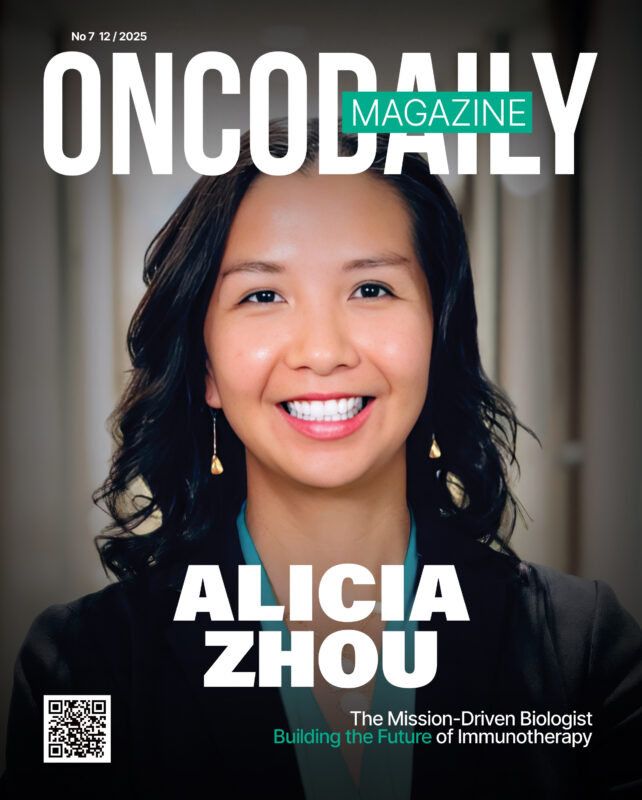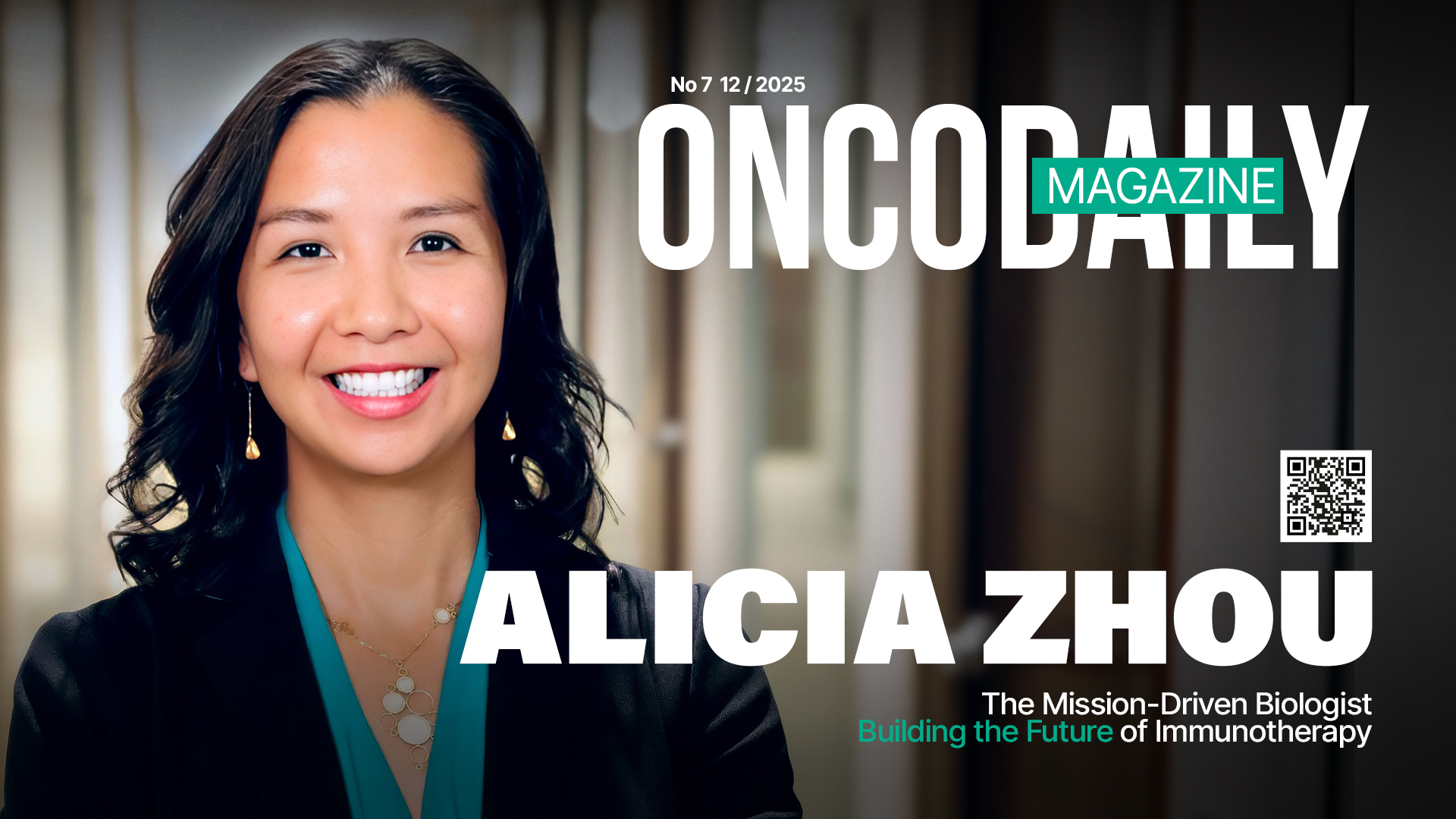
There are scientists who chase titles, and there are scientists who chase impact. Dr. Alicia Zhou belongs entirely to the second category — a self-described “mission-driven biology nerd who is trying to maximize my individual impact on the world.” Today, as CEO of the Cancer Research Institute, she stands at one of the most strategic vantage points in modern oncology, shaping how immunotherapy research is funded, guided, and accelerated. But her journey began much earlier, and much closer to the bench than the boardroom.
Falling in Love with Biology at 15
Alicia knew early. In high school, she fell in love with molecular biology and was fortunate to study at the University of Chicago Lab Schools, a unique environment where real scientific inquiry was accessible to teenagers. While most high school students were memorizing textbook diagrams, Alicia was already subcloning DNA.
She joined the laboratory of Geof Greene, the breast cancer researcher known for his work on estrogen receptors. At 15 or 16, she was pipetting in a real cancer lab, learning fundamentals of bench science, not as a visitor, but as a contributing mind.
That experience changed her life. It set the trajectory: cancer biology would not be the subject she studied, it would be the world she lived in.
Entering MIT and stumbling (naïvely) into Bob Weinberg
Arriving at MIT, Alicia Zhou already knew she wanted to pursue cancer research, but not yet the depth of the field or its giants.
“So I naively Googled ‘MIT cancer researchers,’” she remembers, “and the first name that popped up was Bob Weinberg. I didn’t really know who he was.”
That simple search, innocent, almost humorous, brought her into the orbit of one of the most consequential figures in oncology. Weinberg welcomed her into his lab as an undergraduate UROP student. She worked with him for four formative years, even contributing to his renowned textbook The Biology of Cancer.
Still today, Alicia says, her most-cited paper stems from work done during that time.
What Weinberg modeled for her was not just brilliance, but curiosity. Despite his stature as the discoverer of oncogenes, a founding architect of modern cancer biology, he remained deeply engaged in the daily life of science. He attended every lab meeting, asked incisive questions, and maintained personal connection with even the youngest trainees.
“He knew who I was, he knew what I was working on, and I would have one-on-one meetings with him, even though I was an undergraduate,” she recalls. That kind of mentorship left a deep imprint. Alicia Zhou carries it with her and consciously pays it forward.
The Weinberg Lineage
Her next step remained within the Weinberg intellectual family tree. She did her PhD at Harvard under Bill Hahn, another Weinberg alumnus, and during that period found herself at the nexus of cancer genomics during its explosion.
These were the days of The Cancer Genome Atlas, of the Broad Institute’s ascendance, of new genomic technologies that redefined how researchers interrogated tumors. Alicia’s scientific neighborhood on the 15th floor of Dana-Farber included Matthew Meyerson, Levi Garraway, and Todd Golub, luminaries of the new data-driven era.
She watched the Broad building being constructed, physically and symbolically, as the future home of large-scale computational biology.
UCSF: The Postdoc Years
Her postdoctoral work took her to UCSF, where she joined Andrei Goga’s lab, a leading center for MYC biology. There she worked alongside Michael Bishop himself, who first discovered MYC and won the Nobel Prize for it.
“My entire path,” Alicia says, “was really about being a cancer researcher. That’s what I wanted to be.”
From Academic Identity to Entrepreneurial Leap
For most of her career, Alicia couldn’t imagine doing anything outside academia. It was her world, her orientation, her identity. But then she moved to the Bay Area, where the gravitational force of biotech entrepreneurship is almost a geological force.
In 2015, she took the leap.
She joined Color Health, then a Series A startup of 30 people, building affordable BRCA1/2 testing for patients. The mission was compelling: democratizing access to genetic information.
As Color grew to become a population health cancer care delivery company, Alicia rose to become its Chief Science Officer, learning clinical diagnostics, regulatory navigation, interfacing with FDA, commercial translation of science, productizing genomics, building scientific and medical teams.
This was the education academia could not provide, an immersion in real-world application.
From oncogenes to germline testing, from bench to product, Alicia zoomed out from molecules to systems.
Leading the Cancer Research Institute — a Full-Circle Return
After nearly a decade at Color, Alicia was recruited to lead the Cancer Research Institute, the original organization behind immunotherapy, founded in 1953, before the term even existed. CRI invests about $40 million annually into basic and translational research.
“The way that I describe it to people is I have sort of three unique vantage points on science or on cancer. I’ve had the opportunity to work on gain of function in oncogenes. I’ve had the opportunity to work on loss of function in germline genetics. And now here at CRI, we focus on tumor microenvironment and tumor immunology. And then similarly, I have three very distinct sort of business vantage points. I’ve been an academic scientist. I’ve been industry startup executive. And now I’m a non-profit executive.”
This triangulation gives her a rare ability to see how the pieces fit together.
Embracing Stochastic Life and Choosing Impact
Scientists are trained to be careful, planned, procedural, but Alicia has learned a different philosophy for life:
“You have to embrace the randomness, the stochasticity of life,” she says.
Her compass is not a title, not a linear plan, but a mission:
“maximize individual impact on the good I can have in the world”
Every career move, MIT, Harvard, UCSF, startup, CRI, was guided not by ladder-climbing, but by a felt sense of where she could do the most.
Taekwondo
Alicia was a competitive Taekwondo athlete at MIT, even joining the U.S. collegiate national team and representing the country at world championships. It was there, not in a classroom, that she learned influence, leadership, and human dynamics.
Leadership, she says, isn’t about being the smartest voice in the room, but the most perceptive. Understanding what each person optimizes for and steering toward a shared outcome.
Books and Imagination
“I’m a mom of a 10-year-old and my son, Davi, he really enjoys reading. And one of the things that I always think is really important in kids, and I was this way, is just to encourage that voracious curiosity and imagination.”
Alicia Zhou sees imagination as central to science. Growing up, she devoured science fiction and fantasy, especially the Star Wars expanded universe.
“We underestimate the importance of imagination in science,” she reflects. “You have to be able to imagine something that has never been done before.”
Today, she balances fiction with an unusual commitment: she actually loves reading the primary scientific literature, deeply and regularly.
For leadership, she cites Working Backwards, about Amazon’s methodology of building toward the goal by starting with the end-state in mind.
What CRI Does and Why This Moment Is Urgent
CRI was funding immunotherapy long before it had a name. Today, the organization also supports programs for patient education and is increasingly turning toward data-driven and AI-enabled research.
Alicia sees the next revolution coming from computational biology:
“We know the compute is there. The question is: how do we now use those same algorithms to predict how biology works?”
To make that happen, she emphasizes the need for foundational truth datasets, especially in immunology, to train the next generation of models.
But alongside this momentum sits a crisis: shrinking federal funding for biomedical research is demoralizing a generation of young scientists.
“We are on this precipice of potentially losing an entire generation of scientists,” she warns. Many postdocs don’t see a future, not because of lack of talent, but because of lack of opportunity.
CRI is responding by expanding its fellowship, transition, and mid-career programs, including the new IGNITE Award and STAR Award, to support scientists during their most vulnerable career phases.
***
“This is not the time to pull back on investment in biology. This is the time to add fuel into the tank.”
When asked who I should interview next, she suggests Jim Allison and Liz Jaffee of Johns Hopkins.
Who is Alicia Zhou?
She summarizes herself in a single sentence:
“I am a mission-driven biology nerd who is trying to maximize my individual impact on the world.”
That sentence encapsulates not only a career, but a worldview. A worldview in which curiosity, commitment, humility, imagination, and purpose converge to push the frontier of what biology can do for humanity.
Interview by Gevorg Tamamyan, Editor-in-Chief of OncoDaily